About this place
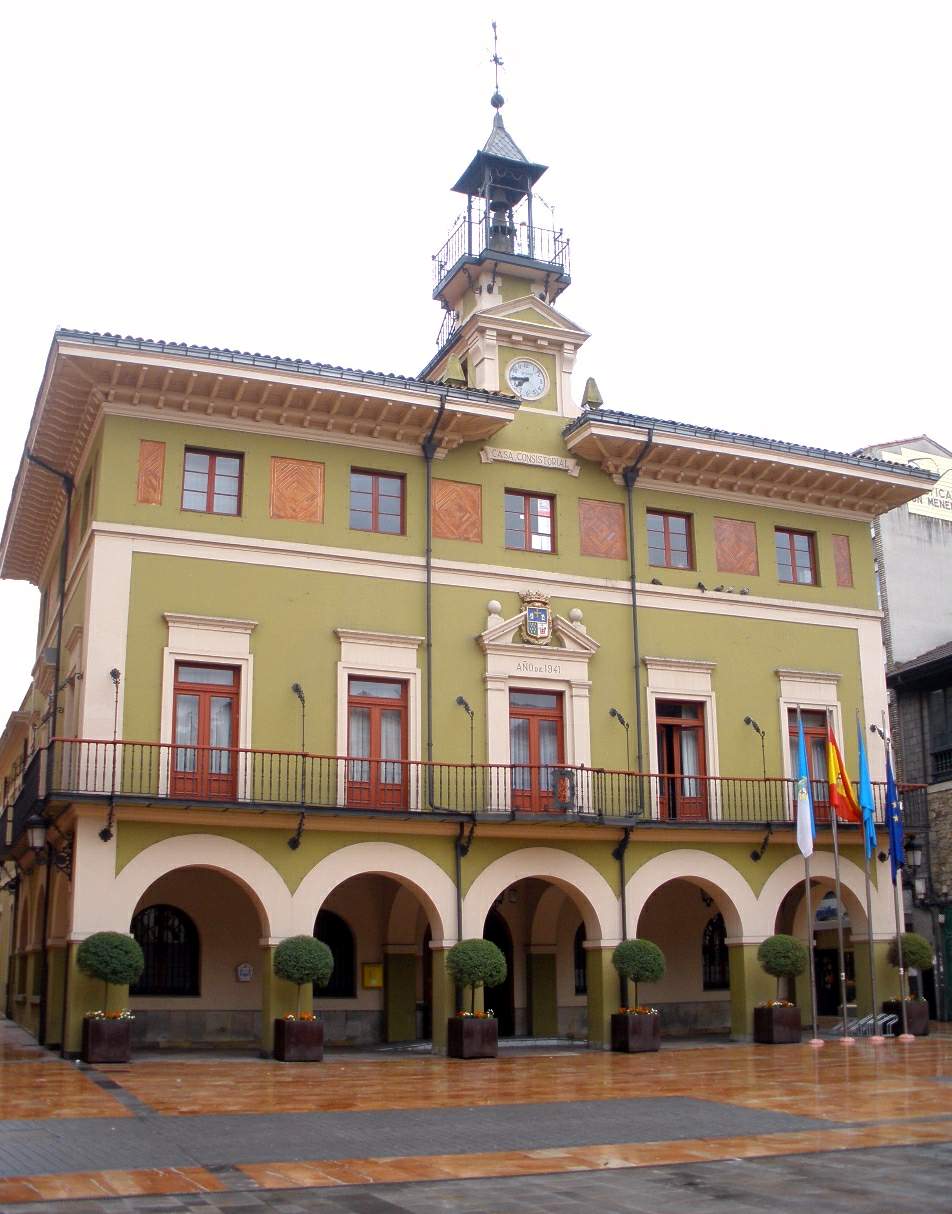
Llangréu town hall (Ayuntamiento de Langreo) is the seat of municipal government in Langreo, a town in the Nalón valley at the heart of Asturias's coal and steel country.
Where does the town hall stand and what does it look like
The building occupies a central position in Langreo, in the valley carved by the Nalón river, on ground that has served as the seat of local authority for centuries. Its three-storey facade combines street-level arcades with wrought-iron balconies, topped by a clock tower that crowns the whole composition. That combination — arcades, balconies, a clock — was a common formula for Asturian town halls raised in the second half of the 19th century, a period when towns across the region were building new, representative seats of government.
Why the building looks the way it does today
The current town hall was built in 1872 by local master builder Manuel Rodríguez Rodríguez. It did not survive unaltered, though: in 1874, during the last of Spain's Carlist Wars, the building was set on fire, and the municipal archive burned with it. The loss went beyond bricks and paperwork — among the documents destroyed was the parchment of Langreo's fuero, the medieval charter that had set out the rights of the valley's residents and stood as one of the oldest records of local self-government. What visitors see today is largely the result of a thorough 1941 renovation, which restored the building's administrative role and gave it its present appearance.
How far back does Langreo's town government go
Langreo formed its own ayuntamiento as early as 1504, an early date by regional standards for formalising local self-rule. In 1581, residents bought the town's jurisdiction outright from the Crown — a purchase that later, under Philip II, reverted back to royal hands. That episode says a lot about how much the local community valued control over its own affairs, even as the wider balance of power in Spain kept shifting.
What connects the town hall to Langreo's mining past
The late 19th century brought rapid mining and industrial expansion to Langreo: coal pits and steelworks turned the Nalón valley into one of Asturias's most important industrial centres. The town hall, rebuilt during this very period of change, stood as both witness and symbol of that shift — Langreo went from a modest farming settlement to an industrial town whose administration had to manage a growing working-class population and expanding mining infrastructure.
Frequently Asked Questions
Can visitors go inside Langreo's town hall? The building is a working administrative office, so access to the interior depends on opening hours and current rules; the facade itself can be viewed from outside at any time.
Why was the municipal archive destroyed in the 19th century? The 1874 fire broke out during the last Carlist War, one of Spain's internal 19th-century conflicts, and it consumed important historical records along with the building, including the parchment of the town's fuero.
How does today's building differ from the 1872 original? The appearance most visitors see dates from a 1941 renovation. The earlier building put up by Manuel Rodríguez Rodríguez suffered serious damage, and the reconstruction gave the town hall the form it has today.
What's useful to know about Langreo before visiting the town hall? Langreo is a Nalón valley town shaped by a strong mining and industrial tradition, and its town hall sits at the centre of town, close to other sites connected to the area's administrative and industrial history.
Nearby places

Earn badges for the places you visit
Download NextOnTrip, discover new places and check off your trails.