About this place
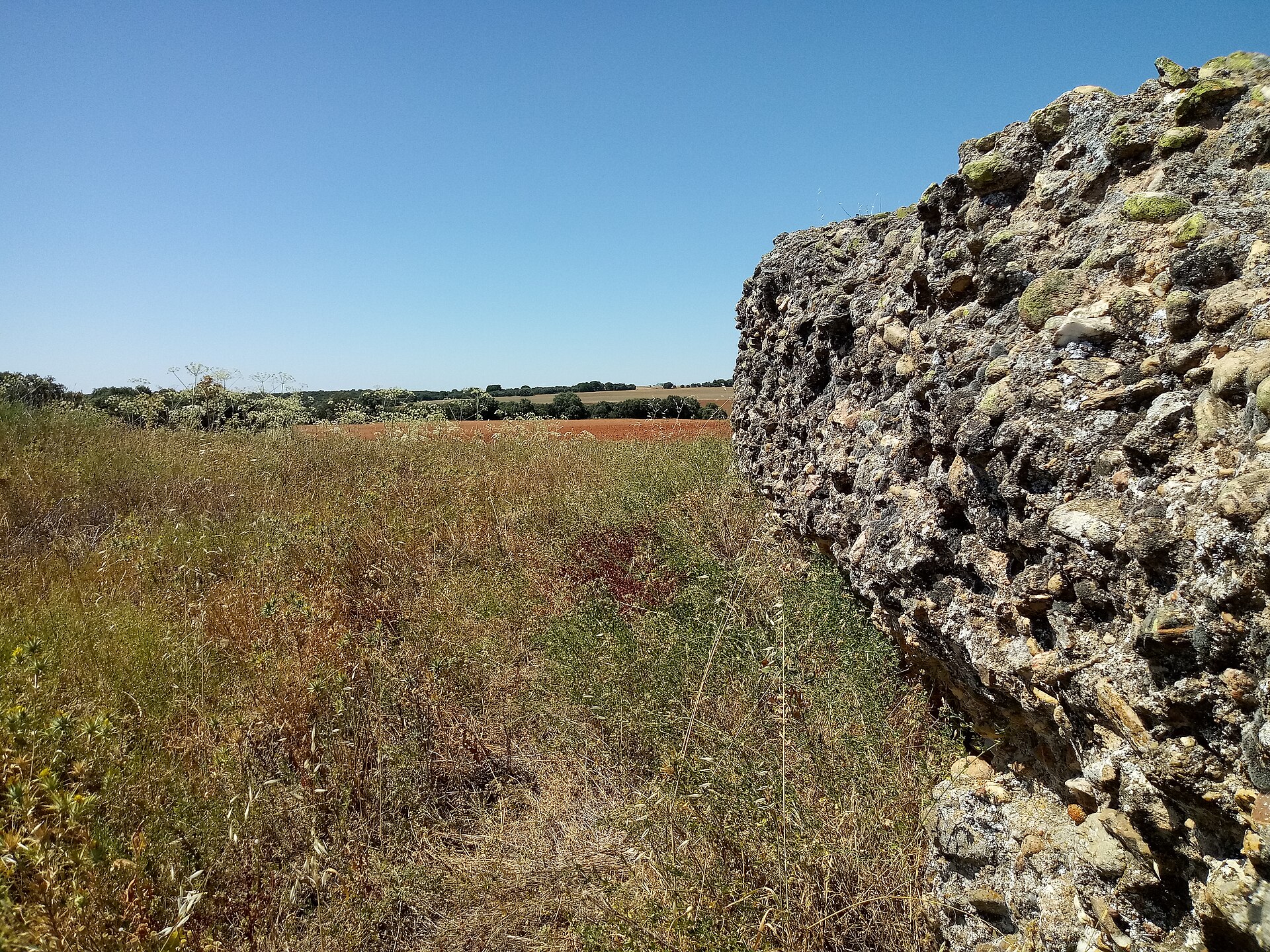
Lagunas Rubias Castle, near Aldeanueva de Figueroa in the province of Salamanca, Castile and León, is a ruined medieval fortress dating from the 12th and 13th centuries. Also known locally as El Palomar, it was raised by the Kingdom of León as a border stronghold against neighboring Castile, at a time when the frontier between the two crowns was an active flashpoint rather than a line on a map. Today the site survives as an unexcavated archaeological ruin, with a section of its rubble-and-mortar wall still standing above ground and the outline of its defensive perimeter traceable from above.
Where is the castle located?
The ruins sit in the northwestern part of the municipality of Aldeanueva de Figueroa, on a piece of raised ground overlooking the surrounding plain — a position that once gave the garrison a clear view over the open frontier country. The wider area is quietly agricultural, with gentle rises breaking up the otherwise flat terrain typical of this stretch of Salamanca.
What is the history behind it?
The fortress was built under the Leonese kings Fernando II and Alfonso IX, during a period when relations between the Kingdom of León and the Kingdom of Castile were tense enough to spill into open conflict along their shared border. It formed part of a chain of strongholds León raised across the northeastern reaches of Salamanca to hold this frontier. Once the two crowns were later united, the castle lost its strategic purpose and was left to decay; the site has never been fully excavated, and much of its structure is presumed to remain buried underground.
What will you see on site?
This is an archaeological site in the raw sense, not a restored monument — a stretch of wall projects above the soil, and the perimeter of the old fortifications shows up as a low, overgrown rise in the land rather than as standing towers or gatehouses. It appeals most to visitors interested in the medieval León–Castile frontier and in defensive architecture encountered in its unrestored, ruined state. There is no visitor infrastructure on the ground, so a visit here feels more like exploring an untouched historical trace than a curated tourist attraction.
How do you get there?
Aldeanueva de Figueroa lies within the agricultural belt of the province of Salamanca, in Castile and León. The most practical way to reach it is by car via the local roads connecting the village to the provincial road network; the castle site itself lies outside the built-up area, on farmland to the northwest of the village, so plan to cover the final stretch on foot from the nearest accessible point.
When is the best time to visit?
Because the site is entirely open and unsheltered, spring and autumn are the most comfortable seasons, avoiding the summer heat of the Salamanca plateau and finding the surrounding vegetation still low enough to make the wall lines easy to pick out.
Frequently Asked Questions
Can you visit Lagunas Rubias Castle? Yes, the site is accessible as an open-air archaeological area, though it has no organized visitor facilities or set opening hours.
Has the castle been excavated? Largely not — only sections of wall projecting above ground level are currently visible, with the rest of the structure believed to remain buried.
What was the castle's historical role? It defended the eastern frontier of the medieval Kingdom of León against Castile, built during the reigns of Fernando II and Alfonso IX.
Are there other attractions nearby? Aldeanueva de Figueroa itself is a small rural village, and the surrounding area suits travelers interested in the quiet historical borderlands of old León rather than developed tourist attractions.
Nearby places

Earn badges for the places you visit
Download NextOnTrip, discover new places and check off your trails.