About this place
Lagrasse Abbey sits on the banks of the Orbieu river in the Corbières hills of the Aude department, roughly 35 km from Carcassonne. Few religious sites in this part of southern France carry as much layered history: a Carolingian-era foundation, centuries as a dominant Benedictine power, and today a dual life as both a heritage site open to visitors and a home for an active religious community.
How old is the abbey, and who founded it?
Local tradition credits Charlemagne with founding the abbey, and a surviving charter dated 779 is usually treated as its founding document. Historians note, though, that the wording of that charter implies a monastic settlement may already have existed on the site, with Charlemagne effectively taking it under royal protection rather than starting from nothing. That royal backing mattered: it gave the community standing and resources that fuelled centuries of growth. Between the 9th and 11th centuries the abbey became one of the most influential religious houses in the region, and by the 12th century its monks had been entrusted with reforming other monasteries, extending its authority across an area running from Toulouse to Narbonne and from Roussillon into Catalonia. At its height, Lagrasse was the largest abbey in the entire department.
What does the abbey look like today?
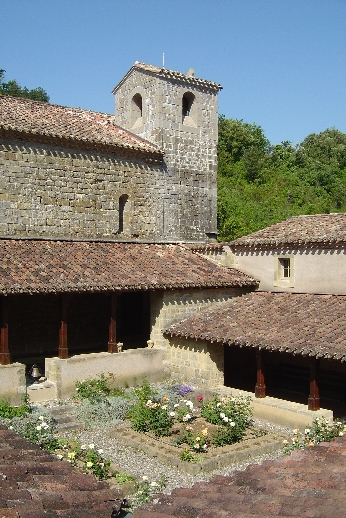
Because construction and rebuilding continued for more than a thousand years, from the 8th century into the 19th, the site is a patchwork of styles rather than a single unified design. Its oldest surviving structure is a pre-Romanesque tower, a rare survival from the earliest building phase. Visitors walking the grounds encounter the abbot's residential courtyard, the old monastic cellar, a set of chapels with their vestibules, the sacristy, the north transept, a formal reception hall, and a dormitory wing restored in 2009. A lapidary store on site gathers carved stone fragments recovered during conservation work. This range of periods and structures is often cited as one of the architectural highlights of the wider Occitanie region.
Who owns the abbey, and is anyone still living there?
Since 2004 the medieval section, listed as a historic monument, has belonged to the Aude departmental council, which funds its upkeep and has run it as a public cultural venue open to visitors since 2007. A separate, privately owned part of the same complex has been home, also since 2004, to a community of Canons Regular of the Mother of God. The canons follow a life centred on prayer and liturgy, but they are also directly involved in restoring the buildings and in welcoming visitors, sometimes guiding them personally through parts of the site tied to its history.
Beyond the abbey, what else is there to see in Lagrasse village?
Lagrasse itself is listed among the "Plus Beaux Villages de France" (Most Beautiful Villages of France), and much of that reputation comes from its setting: the Orbieu river splits the village in two, with the abbey rising on one bank. The two halves are joined by the Pont Vieux, the Old Bridge, documented as far back as the early 14th century and one of the classic photo spots for the abbey's tower and walls together. On the opposite bank stand the medieval covered market halls and narrow, cobbled lanes lined with workshops — Lagrasse also holds the designation "Ville et métiers d'art," recognising its concentration of traditional craft trades.
Frequently asked questions
Did Charlemagne really found Lagrasse Abbey? A charter from 779 names him as founder, though historians believe a religious community may have already existed there before he extended his protection and patronage to it.
Can visitors tour the abbey? Yes. The Aude department's section has operated as a public cultural venue since 2007, while the part inhabited by the canons is occasionally shown through tours the community organises itself.
How far is Lagrasse from Carcassonne? About 35 km, making it a feasible day trip from the city.
What is the significance of the Old Bridge? It connects the two halves of the village across the Orbieu river and has done so since at least the early 1300s, serving as the main approach to the abbey and one of the most photographed views in Lagrasse.
Nearby places

Earn badges for the places you visit
Download NextOnTrip, discover new places and check off your trails.