About this place
Fontfroide Abbey is a former Cistercian monastery tucked into the dry, stony hills of the Corbières massif, roughly 15 kilometers southwest of Narbonne in the Aude department of southern France. Remarkably, it has been privately owned for over a century, yet remains one of the most visited historic sites in the region.
When was the abbey founded, and where does its name come from?
The story begins in 1093, when Aimeric I, Viscount of Narbonne, granted a group of Benedictine monks permission to settle on an isolated plot of his land, next to a spring of cold water. That spring — known in Latin as Fons Frigida, "cold fountain" — gave the abbey its name, Fontfroide. The community did not stay Benedictine for long: between 1144 and 1145 it joined the reformed Cistercian order, a shift that ushered in its most prosperous period of construction and expansion.
What role did the abbey play in the Albigensian Crusade?
Fontfroide's most consequential moment in European history came through one of its own monks, Pierre de Castelnau. In 1203, Pope Innocent III appointed him papal legate, tasked with confronting the Cathar movement spreading through Languedoc. The mission ended badly: in early 1208, Castelnau was assassinated on a Languedoc road. His death gave the pope the pretext he needed to call on the nobility of northern France to take up arms against the Cathars, setting off the Albigensian Crusade — one of the bloodiest chapters of medieval French history, with a Fontfroide monk at its origin.
What happened to the abbey after that?
The monastery's later history mirrors the turbulence of France itself. During the French Revolution, in 1791, the monastic community was dispersed and the buildings stood empty. Cistercian monks returned in 1848, but their tenure would not last either. The turning point came in 1908, when the property — at risk of being sold to a foreign collector — was purchased by the artists Gustave and Madeleine Fayet. It is thanks to this family that the buildings survive in such good condition today: stained-glass windows were restored, wrought-iron window fittings added, and statues and reliefs installed throughout the walls and gardens. Descendants of the Fayets still live at Fontfroide and personally oversee its upkeep.
Why is the rose garden so celebrated?
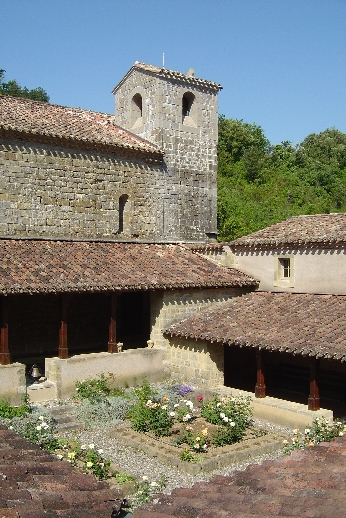
One of Fontfroide's signature features is its sprawling rose garden, laid out on the far side of the monastic buildings. The Fayet family planted the first roses there in the early 20th century, and in 1990 the garden was thoroughly replanted with more than three thousand rose bushes. The blooming terraces stand in striking contrast to the austere Romanesque-Gothic stonework of the abbey, making it one of the most photographed spots in the Aude countryside.
Can visitors tour the abbey?
Yes. Despite remaining private property in the hands of the Fayet family's descendants, Fontfroide is open to the public and ranks among the top tourist draws near Narbonne. Visitors can explore the abbey church, the cloisters, the chapter house, and the rose garden, taking in both the Cistercian architecture and the site's dramatic connection to the Albigensian Crusade.
Frequently asked questions
When was Fontfroide Abbey founded? The monastery was established in 1093 as a Benedictine community and joined the Cistercian order between 1144 and 1145.
Where does the name Fontfroide come from? It derives from the Latin Fons Frigida, "cold fountain," referring to the spring on the site where the abbey was built.
What is the abbey's connection to the Albigensian Crusade? A Fontfroide monk, Pierre de Castelnau, served as papal legate and was assassinated in 1208, an event that directly triggered the crusade against the Cathars.
Who owns Fontfroide Abbey today? The Fayet family has owned it since 1908, when artists Gustave and Madeleine Fayet purchased the property; their descendants still live there and maintain the site.
What else is worth seeing besides the monastic buildings? The rose garden, replanted in 1990 with over three thousand rose bushes, is considered one of the abbey's main attractions.
Nearby places

Earn badges for the places you visit
Download NextOnTrip, discover new places and check off your trails.