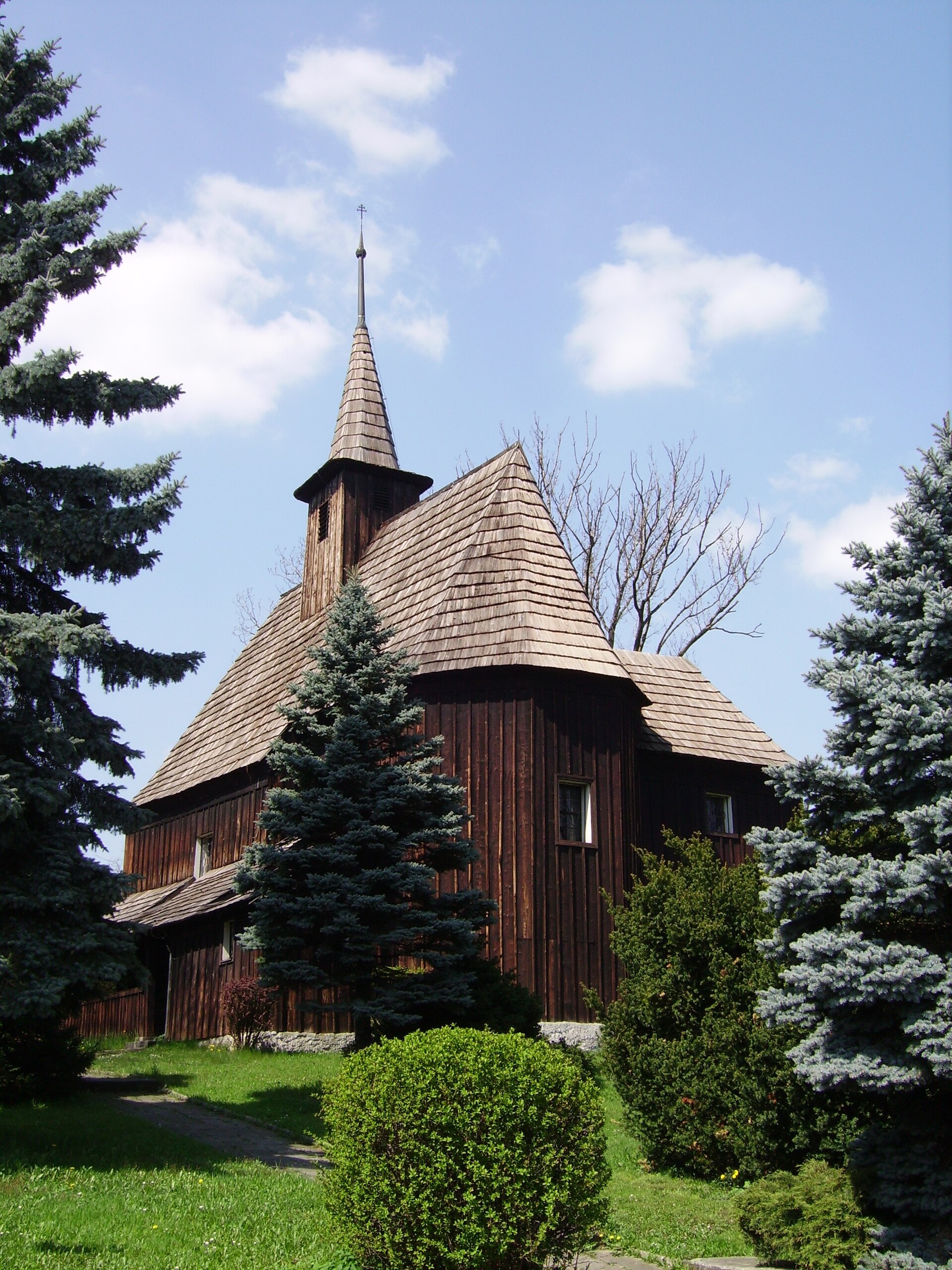
About this place
The Church of Saint Andrew is a wooden church in the village of Hodslavice in northern Moravia, right on the border between the Moravian-Silesian and Zlín regions. It holds the title of the oldest surviving church in the entire Moravian-Silesian region, and its plain timber silhouette stands out immediately for anyone driving through the area toward Nový Jičín or Ostrava.
Where does this church come from?
The earliest written record of a parish and church in Hodslavice dates back to 1437, though the building visible today is somewhat younger — some sources place its construction in 1451, others push it to the mid-16th century. Whatever the exact year, the structure is unmistakably Gothic, and its log-built (roubená) timber technique explains why such a modest building has survived for centuries.
The church has not had an easy history. It suffered serious damage toward the end of the 15th century, and in 1523 a special tithe was ordered specifically to fund repairs. Around the turn of the 16th and 17th centuries the church was run by Protestants, then from the mid-17th century by Jesuits, before finally returning to Catholic administration in 1624. This back-and-forth is typical of many Moravian churches from that era, and it is reflected in the mixed character of the interior furnishings.
What is worth seeing inside?
The interior is a single-nave, log-built structure clad in wooden boards on the outside, roughly oriented along an east-west axis. During the 17th and 18th centuries a masonry Empire-style extension was added, which today creates an interesting contrast of materials — timber standing right next to brick.
The most valuable piece inside is a carved Baroque altar dating from 1658. Next to it, look out for a massive stone baptismal font shaped like a chalice, along with an early Baroque pulpit. The church also houses a Gothic statue known as the Hodslavice Madonna — the original is kept elsewhere today, while a copy remains on display inside the building.
On 20 June 1895 the church was struck by lightning, but fortunately did not catch fire, which is one reason the timber structure has survived intact to this day. A thorough restoration took place between 1975 and 1978, preserving both the shape of the building and its historic furnishings in good condition. The church is now listed as a cultural monument of the Czech Republic.
How to get there and when to visit?
Hodslavice sits along the road connecting Nový Jičín and Valašské Meziříčí, so reaching it by car is straightforward — the church stands in the central part of the village and is clearly visible from the main road. It makes a good stop for anyone exploring the Moravian-Silesian Beskids or travelling between Valašské Meziříčí and Nový Jičín. Keep in mind that the same village has two other churches — an Evangelical one and the Church of the Sacred Heart — so it is worth having the exact address handy when planning a visit, to avoid mixing them up.
The best time to visit is anywhere from spring to autumn, when the wooden facade shows well in daylight and the surrounding hills add to the scenery. A visit typically takes between ten and thirty minutes, longer if you happen to catch the interior open during a service or a special occasion.
Frequently asked questions
Is the Church of Saint Andrew the oldest wooden church in the region? Yes, it is considered the oldest surviving church in the entire Moravian-Silesian region.
How old is the building? Sources give different dates — from 1451 to the mid-16th century — while the first mention of the parish in Hodslavice dates back to 1437.
What can be seen inside the church? A Baroque altar from 1658, a chalice-shaped stone baptismal font, an early Baroque pulpit, and a copy of the Gothic Hodslavice Madonna statue.
Are there other churches worth seeing in Hodslavice? Yes, the village also has an Evangelical church and the Church of the Sacred Heart — three distinct buildings, so it is worth planning a route that covers all of them.
Nearby places

Earn badges for the places you visit
Download NextOnTrip, discover new places and check off your trails.