About this place
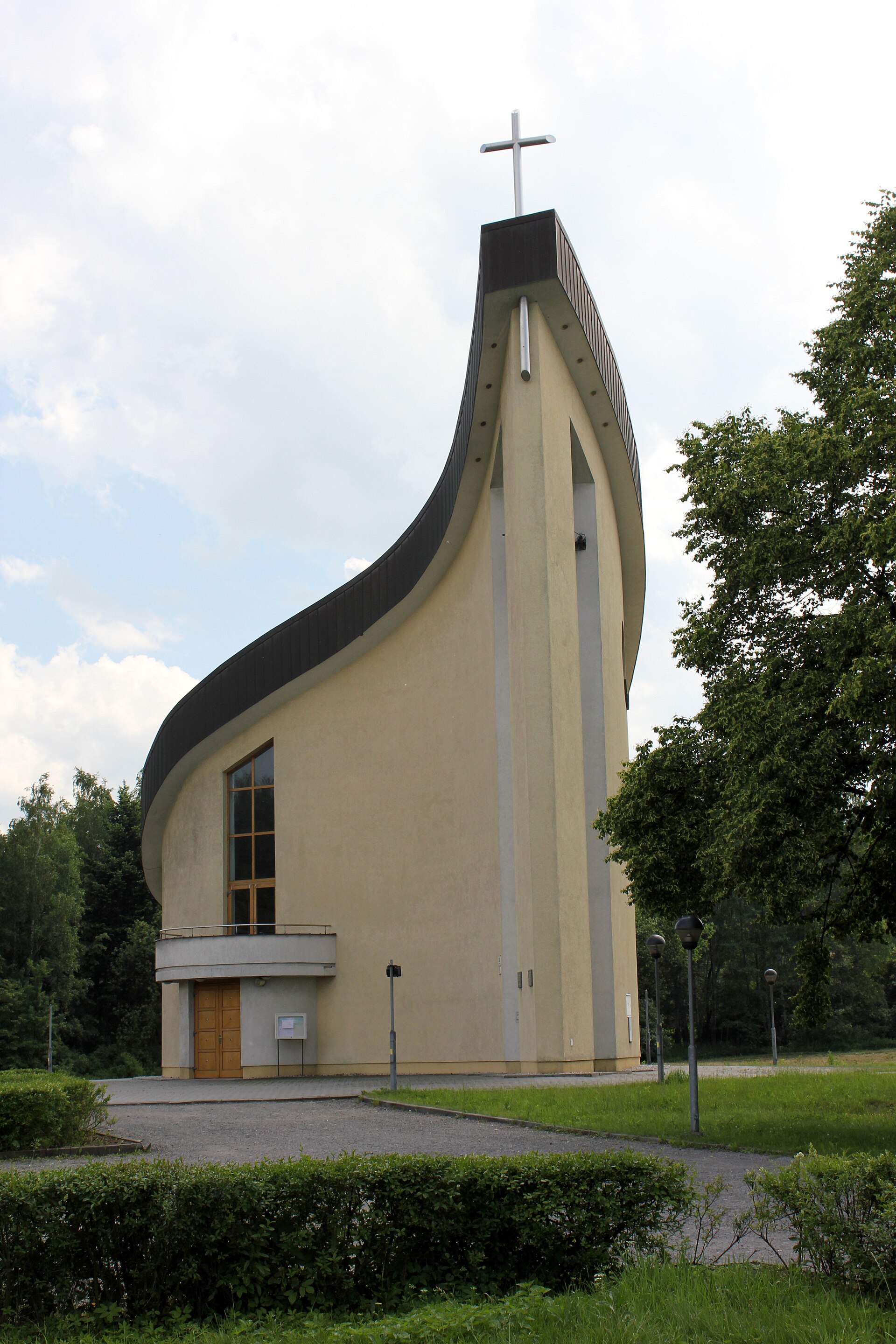
The "Na Niwach" Evangelical Church in Český Těšín is a Lutheran church dedicated to the Apostles Peter and Paul, belonging to the congregation of the Silesian Evangelical Church of the Augsburg Confession. Built in the early 1930s to serve a growing Protestant community on the Czech side of the border river Olza, it remains one of the most notable religious landmarks in the Zaolzie region.
Why was this church built here?
The church's origins trace back to a split within the local Evangelical congregation in 1926. Part of the community decided to build its own place of worship in the Niwy district, which is how the building got its popular name. Construction took place between 1931 and 1932, based on a design by architect Edward David, and the church was completed in the autumn of 1932. Despite the political and border changes that followed World War II, the church retained its Augsburg Evangelical character, largely thanks to the efforts of its then-pastor, Superintendent Józef Berger, who is commemorated inside the church with a memorial plaque. Between 1995 and 2011, the building was shared with another Lutheran congregation, underscoring its continued importance in local religious life.
What can you see inside and outside?
The church is built on a Greek-cross floor plan, giving the interior a spacious, symmetrical layout. Its style blends Neo-Gothic elements with the modernist trends of its era, most visible in the pointed-arch portal of the main entrance and the tall, triple pointed-arch windows that let in abundant natural light. The facade spans more than 24 meters in width, while the building's dominant feature is a 50-meter tower topped with a pyramidal roof, visible from many parts of Český Těšín.
Inside, the altar created by Henryk Nitra draws the most attention as the church's principal artistic feature. The pulpit is placed somewhat unusually, on a gallery (pawłacz) on the left side of the nave — a solution less commonly seen in churches from this period. The interior also houses the memorial plaque dedicated to Pastor Józef Berger, recalling his role in preserving the congregation's identity after the war.
How do you get there?
The church stands in Český Těšín, in the Moravian-Silesian Region, on the Czech side of the border marked by the Olza River. Its coordinates are 49.7418 N, 18.6264 E, making it easy to reach on foot or by car from the town center. Český Těšín borders Poland's Cieszyn directly, and a footbridge over the Olza allows visitors to walk from the Polish old town in just a few minutes. Travelers arriving by train or bus can use the Český Těšín station, from which the church is a short walk through the Niwy district.
When is the best time to visit?
The "Na Niwach" church is best combined with a walk through both halves of the historic Cieszyn/Český Těšín, straddling the Polish-Czech border. Since it is an active place of worship, it's worth checking service or opening hours in advance, as the building isn't always open for casual sightseeing outside of services and congregation events. The surrounding Niwy district is a pleasant place to explore in spring and summer, when longer daylight hours make it easy to pair the visit with a longer walk around Zaolzie.
Frequently asked questions
What denomination is the "Na Niwach" church? It is a Lutheran church, used by the congregation of the Silesian Evangelical Church of the Augsburg Confession in Český Těšín.
When was the church built? Construction ran from 1931 to 1932, based on a design by architect Edward David, and the church was completed in the autumn of 1932.
Why was the church built at this particular spot? It was a direct result of a 1926 split within the local Evangelical congregation — part of the community built its own church in the Niwy district.
What are the architectural highlights of the building? A Greek-cross floor plan, a Neo-Gothic-modernist style, a 50-meter tower, and pointed-arch windows and entrance portal.
Nearby places

Earn badges for the places you visit
Download NextOnTrip, discover new places and check off your trails.