About this place
Klonk is a small yet scientifically remarkable nature reserve tucked into the northern edge of the municipality of Suchomasty in the Czech Republic, roughly 6 kilometres south of the town of Beroun. Sitting within the Bohemian Karst Protected Landscape Area, it carries the official status of a national nature monument.
Why does Klonk matter to geologists worldwide?
Klonk's significance stretches far beyond its modest size. It is recognized internationally as a reference site for defining the transition between two geological periods of the Paleozoic Era: the Silurian and the Devonian. In technical terms, it hosts a Global Boundary Stratotype Section and Point, commonly abbreviated GSSP — an officially ratified location that marks, on a planetary scale, where one geological period ends and the next begins.
How was the Silurian-Devonian boundary actually determined here?
The boundary at Klonk was fixed based on the earliest appearance, within the rock record, of a graptolite species called Monograptus uniformis. Fossils of this organism were identified in a specific rock layer, catalogued as bed number 20. The horizon where this species first shows up in the sequence became the agreed marker separating the Silurian from the following Devonian period.
When and where was this stratotype formally accepted?
The rock section at Klonk earned its status as the reference boundary on 8 February 1972, when the International Union of Geological Sciences ratified it during a meeting held in Montreal. This was not just any approval — it was the very first GSSP ever formally accepted anywhere in the world, effectively setting the template that later boundary stratotypes elsewhere would follow.
What is actually visible at the site?
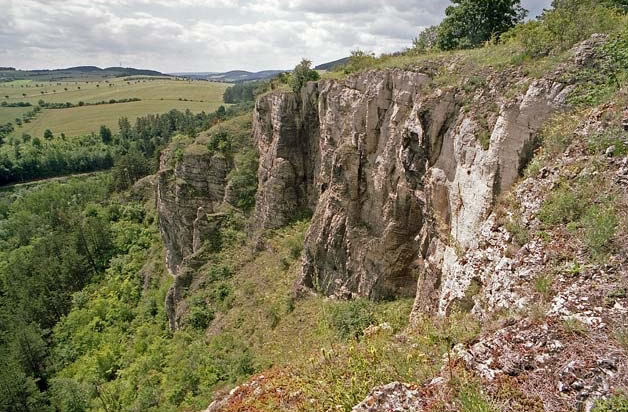
At its core, Klonk is a rock exposure where successive layers of sediment form a legible sequence, letting visitors trace changes that unfolded in the Earth's crust over millions of years. For geologists, earth-science students, and anyone curious about the planet's deep history, the site offers tangible, physical evidence of a pivotal transition — a period when marine life and environmental conditions were shifting in ways that still shape how scientists read the fossil record today.
Because it lies within the Bohemian Karst, the surrounding landscape adds its own appeal: limestone hills, distinctive vegetation, and the quiet, rural character typical of the Suchomasty area.
Frequently asked questions
What exactly is Klonk? Klonk is a national nature monument in the Czech Republic, best known as the location where the boundary between the Silurian and Devonian periods was formally defined.
Where is it located? It lies in the northern part of the Suchomasty municipality, about 6 km south of Beroun, within the Bohemian Karst Protected Landscape Area.
What is a GSSP, and why is Klonk connected to it? A GSSP, or Global Boundary Stratotype Section and Point, is an officially ratified reference site marking the start of a geological period. Klonk holds the distinction of being the first GSSP ever formally approved, back in 1972 in Montreal.
Which fossil helped define the boundary? The first appearance of the graptolite Monograptus uniformis, found in bed number 20, was the key marker used to set the boundary.
Who would find a visit to Klonk most rewarding? Geologists, earth-science students, and anyone fascinated by Earth's history will find it especially compelling, while the surrounding Bohemian Karst scenery also appeals to hikers exploring the wider region.
Nearby places

Earn badges for the places you visit
Download NextOnTrip, discover new places and check off your trails.