About this place
Kodská jeskyně (Koda Cave) is a small, roughly 17-metre-long tunnel cave carved into the limestone massif of the Bohemian Karst (Český kras), within the Koda National Nature Reserve in the Tetín municipal area, Beroun district. Despite its modest size, it ranks among the most significant archaeological sites in this part of central Bohemia.
Where exactly is the cave located?
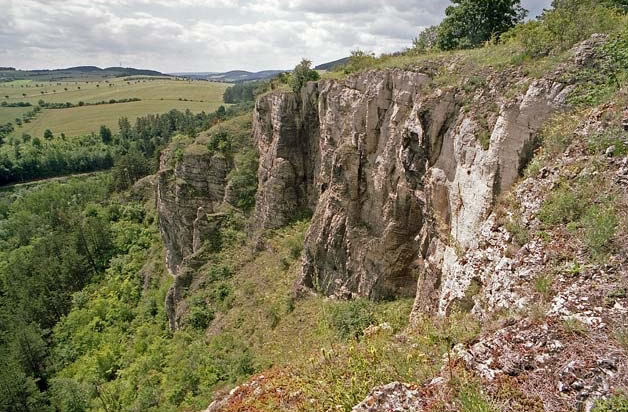
The cave sits within the rocky terrain of Koda, one of the most accessible and most visited stretches of the Bohemian Karst. The wider area belongs to the Český kras Protected Landscape Area, which stretches southwest of Prague around the town of Beroun and Karlštejn Castle. It is classic limestone country, shaped by dissolution and weathering, dotted with caves, rocky valleys, and vegetation adapted to alkaline soil.
How did the cave form?
Unlike many karst caves whose shape is driven mainly by flowing water, Kodská jeskyně formed largely through mechanical weathering — repeated freezing and thawing of water trapped in rock fissures. Over time, these frost cycles gradually cracked and pried apart the limestone, hollowing out the through-passage that runs beneath the hillside today.
Why does the cave matter to archaeologists?
The cave was first examined in the 1920s by the archaeologist Jan Axamit. Excavations carried out over the following decades uncovered numerous finds, including pottery as well as tools made of bone and stone. Study of these objects showed that people used the site over an unusually long stretch of time — spanning the Middle and Upper Palaeolithic, the Neolithic and Eneolithic, the Bronze Age, the La Tène (Celtic) period, and into the Middle Ages. Most of the artefacts were concentrated near the cave's entrance, though the cultural layers themselves have since been largely removed by the excavation work.
This long and varied record of use is what makes Kodská jeskyně a valuable window into the succession of cultures that occupied this part of central Bohemia over thousands of years, even though the cave itself is easy to underestimate on first glance.
What else is worth seeing nearby?
The Koda reserve that surrounds the cave is one of the most popular corners of the Bohemian Karst, characterised by rugged rocky valleys, limestone outcrops, and lime-loving plant communities. Given how small the cave itself is, a visit works best as a brief stop woven into a longer walk through the reserve, which offers far more in terms of viewpoints and traces of the region's geological past. The wider Bohemian Karst also holds several other well-known caves and rock formations, making it easy to combine into a single, longer day out.
Frequently asked questions
How long is Kodská jeskyně? The cave measures roughly 17 metres and takes the form of a tunnel running through the limestone massif.
Who first studied the cave archaeologically? Archaeologist Jan Axamit carried out the first investigations in the 1920s.
From which periods do the archaeological finds date? Traces of human presence span the Middle and Upper Palaeolithic, the Neolithic, the Eneolithic, the Bronze Age, the La Tène period, and the Middle Ages.
Where exactly is the cave located? Within the Koda National Nature Reserve, in the Tetín municipal area, part of the Český kras Protected Landscape Area southwest of Prague.
Is it worth combining the cave with a visit to the surrounding area? Yes — the Koda reserve offers an extensive network of rocky valleys and karst formations well worth exploring beyond the cave itself.
Nearby places

Earn badges for the places you visit
Download NextOnTrip, discover new places and check off your trails.