About this place
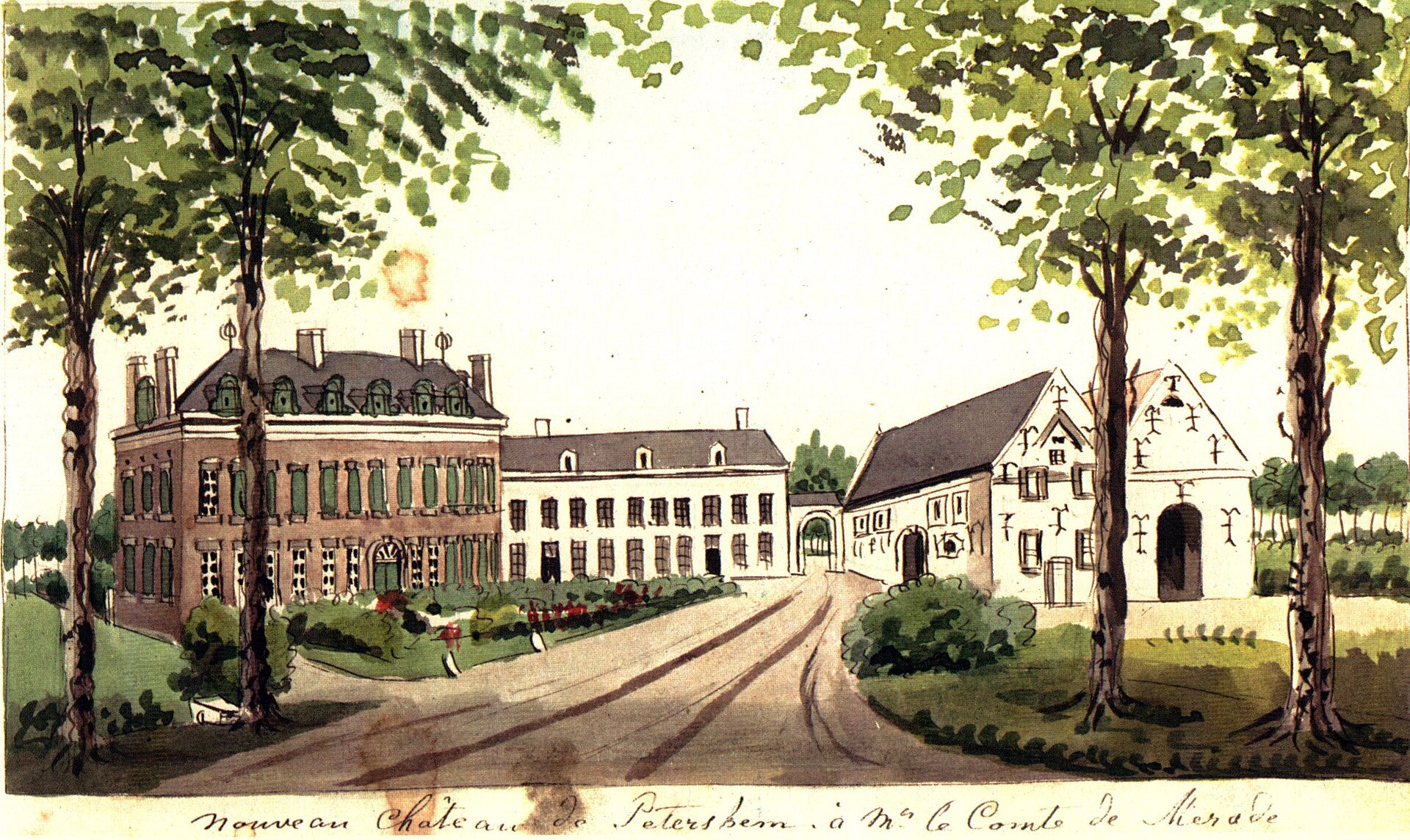
Kasteel Pietersheim is a castle in Lanaken, in the Belgian province of Limburg, with roots reaching back to the late 11th century. The earliest fortified structure on the site is believed to have grown out of a former Roman camp, repurposed as the foundation for a defensive stronghold. The name Pietersheim first appears in written records in 1292, by which point the site already featured a circular rampart encircled by a moat.
What did the earliest stronghold look like?
The original layout followed a pattern common to the region: an earthen ring wall, a water-filled moat, and timber-and-earth buildings at the core. The lordship took its name from the Pietersem family, who held it in these early centuries. Under their rule the fortifications underwent their first significant expansion, though the stronghold remained relatively modest compared to what it would later become.
What happened in 1378?
The year 1378 brought a severe blow: the castle was destroyed by troops from Tongeren together with forces from the Prince-Bishopric of Liège. The destruction did not mark the end of the site, however. Pietersheim was rebuilt and substantially reinforced, emerging with a far more elaborate defensive system — a circular rampart ringed by as many as three concentric moats, an outer bailey, a chapel, and fortified gatehouses. This configuration made the castle one of the sturdier strongholds in the region for centuries afterward.
Who ruled after the Pietersem family?
From the fifteenth century until the end of the eighteenth, the lordship passed into the hands of the de Merode family, one of the most influential noble houses in this part of the Low Countries. It was a long period of ownership stability, during which the castle underwent further alterations and repairs while witnessing the turbulent events of the early modern era.
What conflicts affected the stronghold?
The castle did not escape military conflict. In 1569 it was besieged by forces under Gerard van Groesbeek, the Prince-Bishop of Liège. A decade later, in 1579, it was captured and plundered by troops under Alexander Farnese, Duke of Parma — commander of Spanish forces in the Low Countries during the Eighty Years' War. These episodes underline how strategically significant Pietersheim remained on the frontier between Habsburg and Liège spheres of influence.
What became of the medieval castle?
The fate of the original stronghold was sealed in 1836, when its medieval walls were demolished. Only the old castle chapel survived, which for a time served the decidedly unglamorous purpose of a hay barn — a striking contrast to its earlier religious function, and a reminder of how former noble residences can lose their original significance over time.
Where does today's building come from?
The building that now carries the name Kasteel Pietersheim is not the medieval fortress but a neoclassical residence erected at the start of the twentieth century. It was built on the grounds of the former estate, retaining the historic place name even though architecturally it belongs to an entirely different era — a period when defensive strongholds gave way to representative country houses.
What is happening at the castle today?
In 2017 the municipality of Lanaken sold the castle to a private owner, Gelderburg Estates. The wider Pietersheim estate, where the building stands, borders the Hoge Kempen National Park and remains part of the region's cultural landscape, linking centuries of defensive history with the site's present-day use.
Frequently asked questions
Is Kasteel Pietersheim the original medieval castle? No — the original moated stronghold was demolished in 1836. The current building is a neoclassical residence from the early twentieth century, built on the same site.
Which family held the castle the longest? The de Merode family, who owned Pietersheim from the fifteenth century until the end of the eighteenth.
Did the castle see military action? Yes — it was destroyed in 1378, besieged in 1569, and captured and plundered in 1579.
Nearby places

Earn badges for the places you visit
Download NextOnTrip, discover new places and check off your trails.