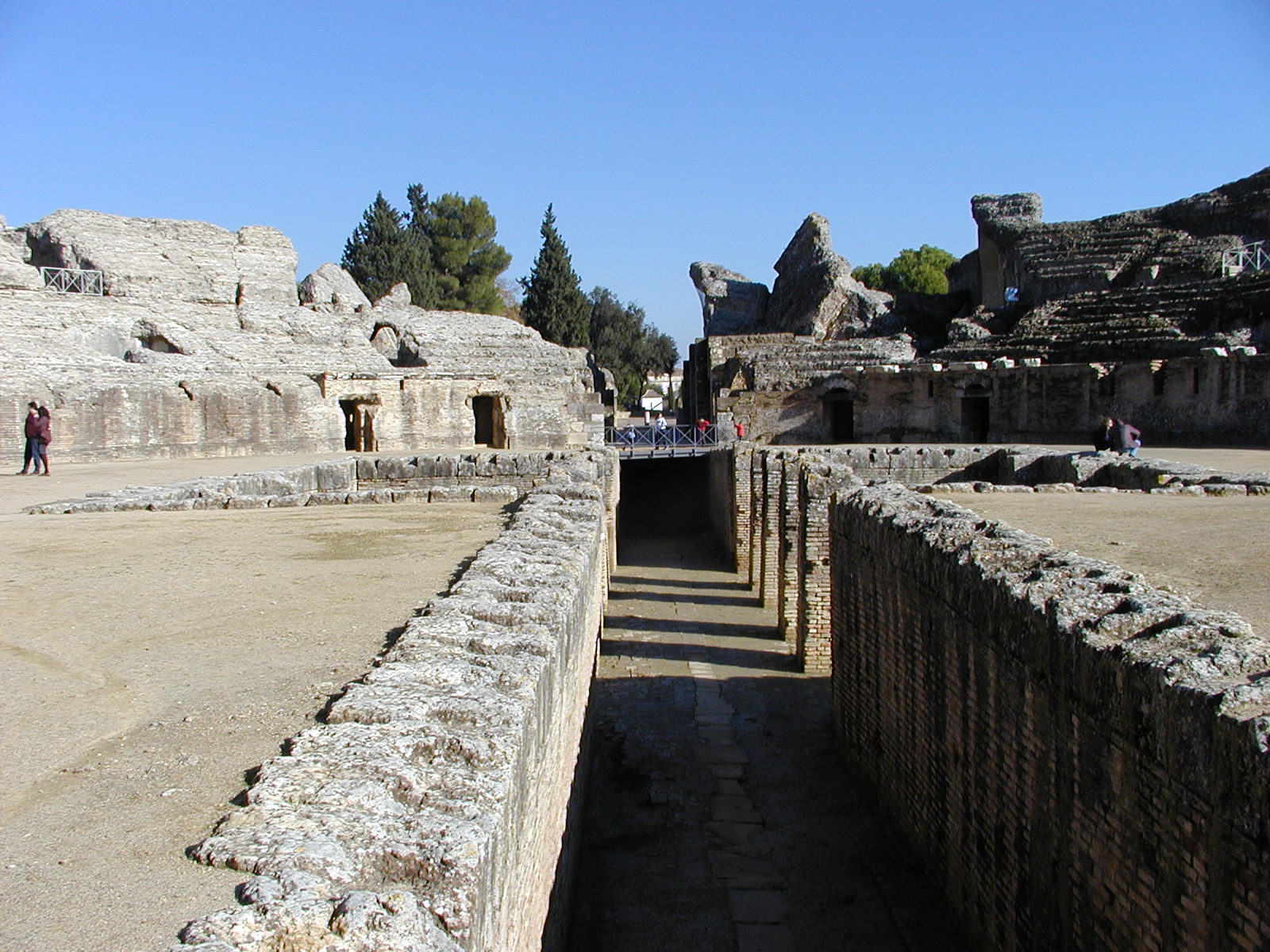
About this place
Italica is one of the most significant archaeological sites in Spain — the remains of an ancient Roman city founded in 206 BC by the general Scipio. The ruins lie within the modern municipality of Santiponce, just a short distance from Seville, and draw visitors interested in ancient Roman history and classical architecture.
Why was Italica founded?
The city was established as a settlement for veterans of the Second Punic War — soldiers of Italic origin who had fought under Scipio's command on the Iberian Peninsula. Its name reflects that origin, honoring the Italic settlers for whom the colonia was named. Over time the settlement grew, attracting further migrants from the Italian peninsula as well as the children of Roman soldiers and native women. Among the original Italic settlers were branches of the gens Ulpia, originating from the Umbrian town of Tuder, and the gens Aelia, from the city of Hadria — two families that would later prove extraordinarily significant to Roman history.
What is Italica's connection to Roman emperors?
Italica was the birthplace of Trajan, one of the most celebrated Roman emperors, who descended from the Ulpii. Hadrian, connected to the Aelii, was also raised in the city; Trajan later adopted him, and Hadrian succeeded him as emperor after his death. The fact that two consecutive rulers of the empire were tied to the same relatively modest provincial town makes Italica a place of exceptional historical significance — a rare case of a provincial colonia that produced not merely officials or officers, but the head of the Roman state itself, not once but twice in succession.
Where exactly is Italica located?
The archaeological site sits within the municipality of Santiponce, in the province of Seville, in the region of Andalusia, close to Seville itself. This location makes Italica easily accessible for visitors based in the Andalusian capital who want to take a short trip out of the city to see the remains of one of the more important centers of Roman Spain, then known as Hispania Baetica.
What is Italica today?
Today Italica functions as an archaeological site open to visitors. Those who come can explore the remnants of an ancient city that, for centuries, served as one of the centers of Roman administration and culture on the Iberian Peninsula. The site's historical weight — as the birthplace of two emperors and a striking example of Roman colonization in Hispania — continues to attract both scholars of ancient history and travelers seeking traces of the Roman presence on the Iberian Peninsula.
Frequently asked questions
When was Italica founded? The city was founded in 206 BC on the initiative of the Roman general Scipio.
Who were Italica's first inhabitants? The first inhabitants were war veterans of Italic origin, later joined by further migrants from the Italian peninsula and by the descendants of Roman soldiers and local women.
Which Roman emperors are connected to Italica? Emperor Trajan was born in Italica, and Hadrian, whom Trajan adopted, was raised there and later became emperor himself.
Where is Italica located? The archaeological site lies within the municipality of Santiponce, in the province of Seville, close to the city of Seville itself.
What is Italica today? It is an archaeological site open to the public, showcasing the remains of an ancient Roman city.
Nearby places

Earn badges for the places you visit
Download NextOnTrip, discover new places and check off your trails.