About this place
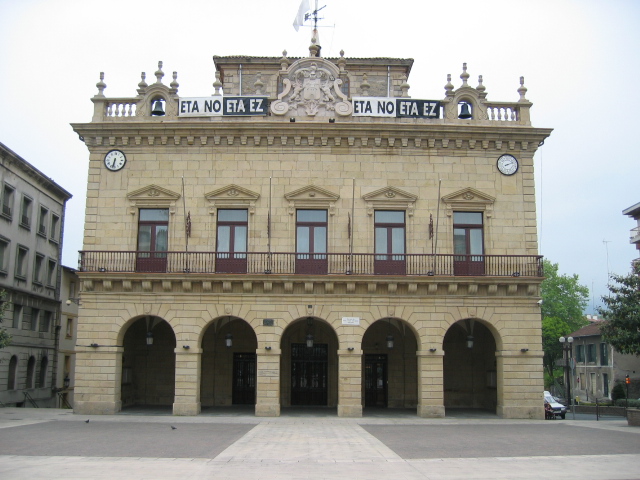
Irun town hall is an 18th-century civic building at the heart of Irun, a Basque town in Gipuzkoa on the Bidasoa river, right on the border with France.
Where does the town hall stand?
The building sits on Plaza San Juan Harria, one of the historic squares of old Irun. The square takes its name from a stone column ("harria" means "stone" in Basque) that has stood alongside the town hall for centuries. The facade follows the Baroque style common to municipal buildings raised across this part of Spain in the 1700s: plain stone walls, a symmetrical row of windows, and a formal entrance set on the upper floor.
When was it built, and who was behind it?
Construction started in 1756 and the building opened in 1763. The engineering oversight fell to Felipe Crame, previously connected to the military works of Plaza in San Sebastián, while Domingo de Olazábal y Ramerí, lord of Aranzate, chaired the municipal council at the time. Having a military engineer design a civic building was not unusual in the Basque provinces of that era, since town councils and garrison administrations often drew on the same pool of specialists.
Did the building survive war and fire?
It did, and that survival is one of the more notable chapters in the town's history. When the Spanish Civil War broke out in 1936, much of Irun burned down, and the fire destroyed many buildings around the square. The town hall itself and the San Juan Harria column beside it came through largely unscathed even as the surrounding blocks were lost. Few structures from the mid-18th century in Irun can claim that kind of continuity, which is part of why the building still anchors the old town today.
What is the town hall used for now?
The building remains in active use as the seat of local government. It houses the mayor's office, the general secretary's office, and part of the municipal services that residents deal with day to day. It is a working administrative building rather than a museum, so visits are generally limited to what can be seen from the square, plus any occasions when the town organizes public events or festivities on the plaza in front of it.
What else is worth seeing nearby?
Plaza San Juan Harria and the surrounding old quarter make a good starting point for exploring Irun's historic center, which — despite the wartime destruction — still traces the street layout from when the town grew into a key crossing point between Spain and France. Irun's own history reaches back much further than the town hall: the area preserves traces of Oiasso, a Roman-Vasconic settlement, making this one of the longest continuously inhabited spots in the region.
Frequently Asked Questions
When was Irun town hall built? Construction began in 1756 and the building was completed and put into use in 1763.
Who designed the building? The works were overseen by engineer Felipe Crame, at a time when Domingo de Olazábal y Ramerí led the municipal council.
Was the town hall damaged during the Spanish Civil War? No — the building and the nearby San Juan Harria column survived the 1936 fire that destroyed much of the surrounding square.
Can visitors go inside the town hall? It is an active government building, so public access is generally limited to office hours and any events open to the public held on the adjoining square.
Nearby places

Earn badges for the places you visit
Download NextOnTrip, discover new places and check off your trails.