- Fountains
- Recreation and entertainment
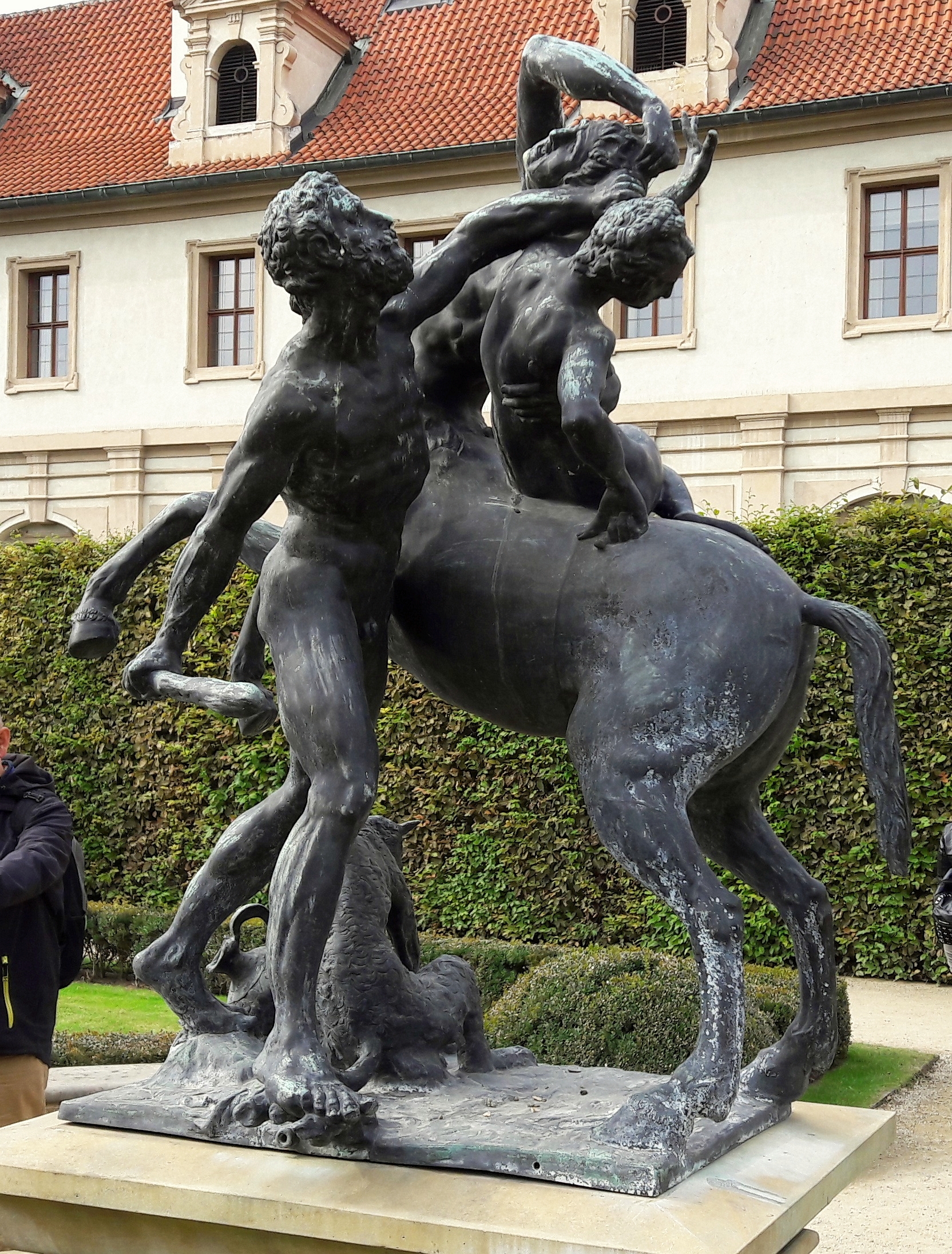
Hercules frees Deianeira from the centaur Nessus by Adriaen de Vries
About this place
The fountain "Hercules frees Deianeira from the centaur Nessus" stands in the Wallenstein Garden (Valdštejnská zahrada) in Prague's Malá Strana district, in the shadow of the monumental sala terrena of Albrecht von Wallenstein's palace. This bronze sculptural group depicts one of the most dramatic scenes from Greek mythology and belongs to the legacy of Adriaen de Vries, the foremost sculptor at the court of Emperor Rudolf II.
Who created this fountain?
Adriaen de Vries (c. 1556–1626) was a Dutch Mannerist sculptor, trained under Giambologna, who joined the court of Rudolf II in Prague and became one of the most celebrated artists of his era. He specialized in bronze casts of extraordinary dynamism and surface detail, and his work is defined by twisting, tension-filled poses — qualities clearly visible in the Prague group of Hercules and Deianeira. De Vries worked for the most important European courts of his day, but Rudolf II's Prague was the true center of his artistic output.
What scene does the sculpture show?
The composition captures a moment from the myth of Hercules: the centaur Nessus, while ferrying Hercules's wife Deianeira across a river, attempts to abduct her. Hercules rushes to the rescue, tearing his wife free from the centaur's grip. The scene is caught mid-motion — the entwined bodies of man, centaur and woman form a pyramidal, tension-charged composition typical of de Vries's Mannerist style, which favored the human body twisted into extreme, dynamic poses.
Why is this a copy rather than the original?
The Wallenstein Garden was built in the 1620s as the residence of Albrecht von Wallenstein, the imperial generalissimo of the Thirty Years' War, and from the outset it was adorned with bronze sculptures by Adriaen de Vries — among the most valuable works of art in Prague at the time. In 1648, at the close of the Thirty Years' War, Swedish troops captured Prague and carried off a large part of the city's art collections, including the original de Vries bronzes from the Wallenstein Garden. They were taken to Sweden, where they remain today in royal collections, including the park of Drottningholm Palace and the National Museum in Stockholm. The sculpture visible in the Prague garden today is a cast made from the surviving originals or period molds — a fate shared by most of the bronze statues now decorating the Wallenstein Garden.
Where exactly is the fountain located?
The fountain stands in the Wallenstein Garden by Valdštejnské náměstí in Malá Strana, directly adjoining the palace complex that now houses the Senate of the Czech Republic. The garden, one of the earliest fully Baroque garden layouts in Prague, is open to the public during the season and ranks among the most picturesque green spaces in the city center.
Frequently asked questions
Is this an original work by Adriaen de Vries? No — the original de Vries bronzes from the Wallenstein Garden were carried off by Swedish troops in 1648 and remain in Sweden today. The sculpture in Prague is a cast made from the surviving models.
When was the Wallenstein Garden created? The garden was laid out in the 1620s for Albrecht von Wallenstein, one of the most powerful military commanders of the Thirty Years' War.
Can the fountain be visited free of charge? The Wallenstein Garden is open to visitors free of charge during the summer season, and the fountain stands within it near the pond and the sala terrena.
What else is worth seeing nearby? The garden adjoins the Wallenstein Palace, now the seat of the Czech Senate, and the monumental sala terrena decorated with frescoes — both part of the same 17th-century residential complex.
Nearby places

Earn badges for the places you visit
Download NextOnTrip, discover new places and check off your trails.