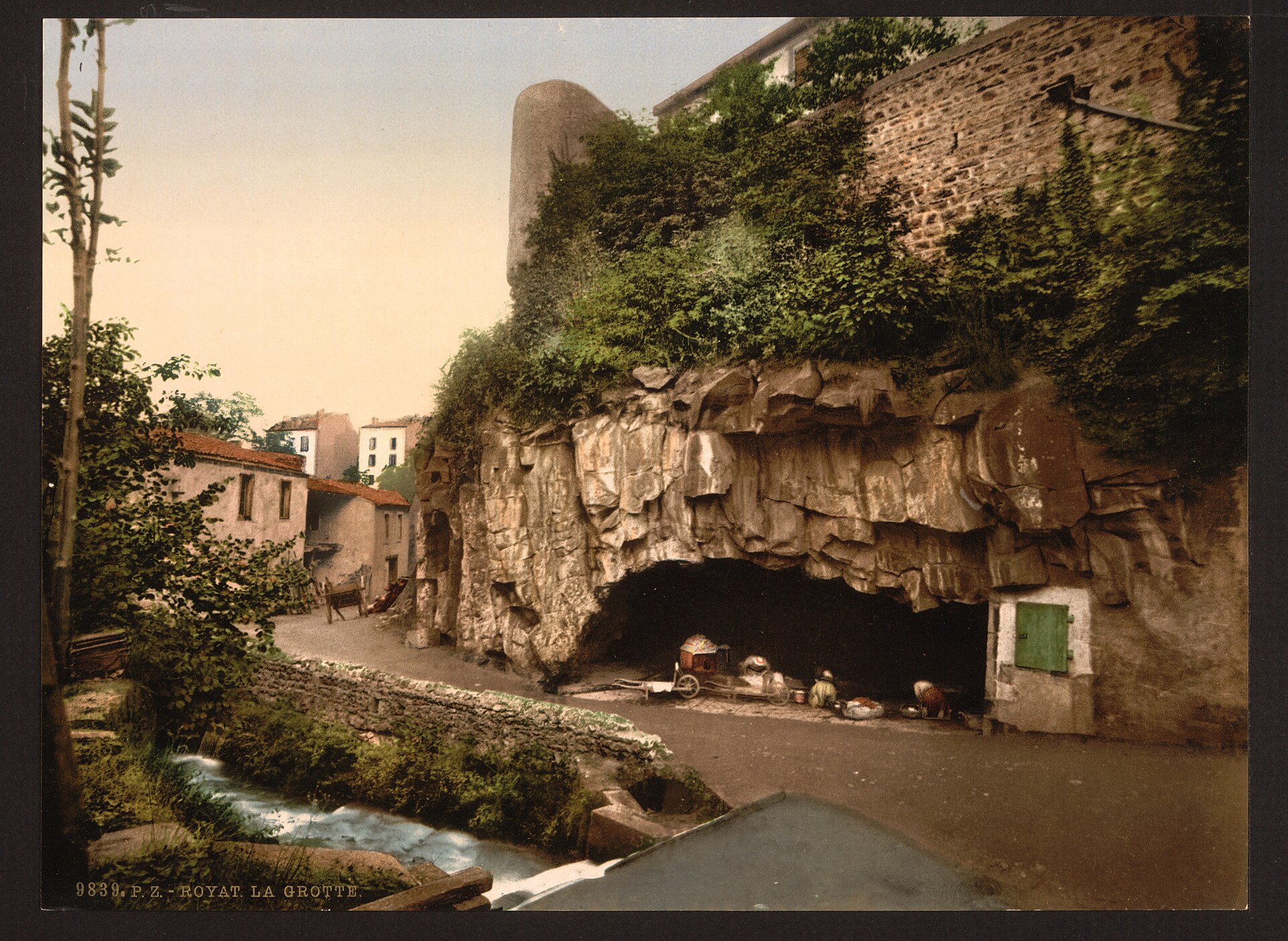
About this place
Grotte des Laveuses, the Cave of the Washing Ladies, sits tucked into the Tiretaine valley in Royat, the well-known spa town just west of Clermont-Ferrand in the Puy-de-Dôme department of Auvergne. It lies within Royat's thermal park, below the hill crowned by the priory church of Saint-Léger — a quiet reminder that this whole corner of the Massif Central was shaped by volcanic fire long before anyone came here to take the waters.
How did the cave form?
The cave owes its existence to a basalt lava flow that poured down from the Petit Puy-de-Dôme during Quaternary volcanic eruptions. As the flow advanced, it buried a small stream running through the valley, and a pocket of steam became trapped beneath the cooling rock. That trapped gas left behind a hollow chamber. Over time the Tiretaine river cut its way back through the hardened basalt, exposing the cavity and carving out the cave visitors can walk into today. Columnar basalt prisms, formed as the lava contracted while cooling, are still visible along the cave walls.
What is inside?
The chamber measures roughly 30 metres long, 10 metres wide and 3.5 metres high. Seven springs emerge directly from the rock, running at a steady, cool temperature of around 10°C, and their waters gather inside the cave before feeding into the Tiretaine. The remains of a rough stone basin, built to collect this water, can still be seen at the back of the cave.
Where does the name come from?
The name refers to a very literal, everyday use of the site: local washerwomen — laveuses in French — once came here to do their laundry in the naturally flowing spring water. The makeshift wash basin they built stuck around long after the practice itself faded, and it left the cave with a name that has outlasted the custom by close to two centuries. The site was distinctive enough to be featured in 1829 in the illustrated volume "Voyages pittoresques et romantiques dans l'ancienne France," by Charles Taylor and Justin Nodier, one of the earlier large-scale publications to bring French landscapes to a wide readership. In 1949, at the request of the town of Royat, the cave was granted protected heritage status.
Getting there and visiting
The cave sits on Rue de la Grotte in Royat and is open year-round, free of charge. It makes for an easy stop on a walk through the thermal park — a short stretch along the Tiretaine also opens onto other caves carved from the same lava flow, including the neighbouring Siméoni cave, once the source that fed the celebrated Fontaine Amboise in Clermont-Ferrand.
Frequently asked questions
Is there an entrance fee? No, access is free and the cave is open throughout the year.
How long does a visit take? It is a small site — seeing the interior and the information panels nearby usually takes no more than ten or fifteen minutes.
Does water still flow inside the cave? Yes, the springs inside the cave are still active and continue to feed the Tiretaine river.
What else is worth seeing nearby? Pair the visit with a walk through Royat's thermal park and a look at the other caves along the Tiretaine, particularly the Siméoni cave close by.
Nearby places

Earn badges for the places you visit
Download NextOnTrip, discover new places and check off your trails.