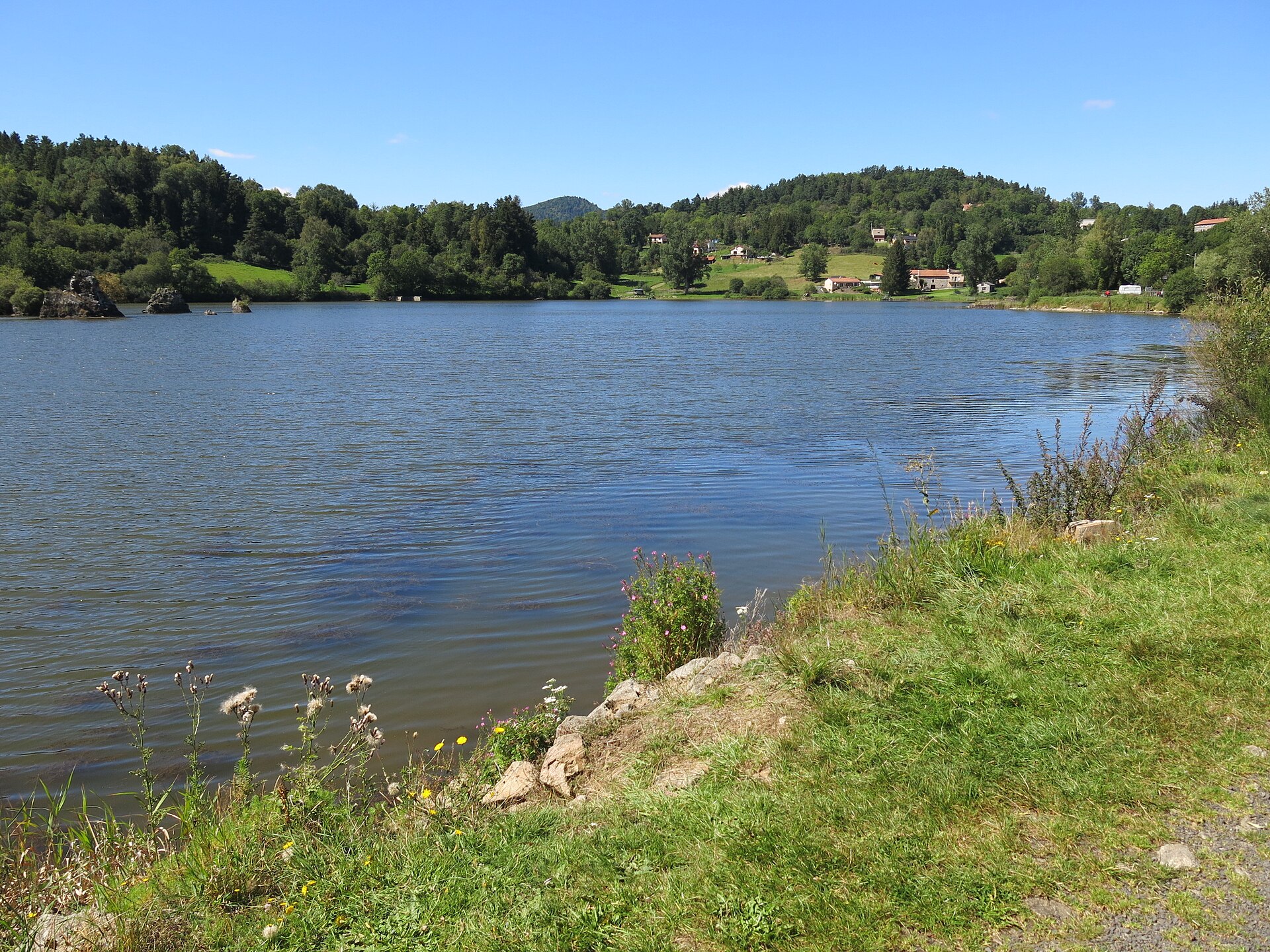
About this place
Lac de la Cassière is a small volcanic lake tucked into the hills of the Aydat commune in the heart of Auvergne, roughly 17 kilometers from Clermont-Ferrand. Sitting at 861 meters above sea level, it lies just 3 kilometers north of the much better-known Lac d'Aydat, within the Chaîne des Puys, a volcanic range listed as a UNESCO World Heritage site. For travelers looking for a quieter alternative to the crowded beaches of its neighbor, Cassière is a discovery in its own right: small, calm, ringed by woodland and meadow, with views toward the cones of extinct volcanoes.
How did this lake form?
Cassière's story goes back to a period of intense volcanic activity in the region. Around 8,400 years ago, Strombolian eruptions from two neighboring volcanoes, puy de la Vache and puy de Lassolas, sent an exceptionally fluid lava flow down the valley of the Veyre river. That lava blocked the valley's main course, damming it to create Lac d'Aydat, today the largest natural lake in Auvergne. The same volcanic episode also blocked a smaller tributary of the Veyre, giving rise to a separate and much more modest body of water: Lac de la Cassière. Both lakes are, in effect, twin outcomes of the same geological event thousands of years ago, even though they differ sharply in scale and character today.
How big and how deep is it?
Cassière covers about 14 hectares, a fraction of the size of Lac d'Aydat. Its depth is shallow: around 1 meter on average, reaching a maximum of about 5 meters. That shallowness is directly tied to one of the lake's more curious features.
Why does the water level change so much?
Cassière is known for rare but pronounced and still not fully explained fluctuations in its water level. On occasion, over the course of several months or even years, the lake has dropped to near-total desiccation. Episodes like this were recorded in the interwar period and again in the early 1990s. Researchers link the phenomenon to the porous volcanic bedrock beneath the lake, through which water can seep away via underground channels, though the precise mechanism remains a subject of ongoing interest among scientists and local residents alike.
Can you swim or fish here?
The lake is privately owned, so swimming is not permitted. Cassière functions instead as a fishery, with organized access for anglers under rules set by the owners. This marks a clear contrast with neighboring Lac d'Aydat, whose beaches draw crowds of swimmers in summer. For visitors, that means Cassière is best approached as a destination for a walk and a viewpoint rather than a place to spend a beach day.
What else is there to do nearby?
The lake sits along walking routes that connect it to Lac d'Aydat and to the nearby volcanoes puy de la Vache and puy de Lassolas, both of which can be explored along with their craters. A popular trail leads to a viewpoint overlooking both lakes, Aydat and Cassière, set against the volcanic backdrop of the Chaîne des Puys. It's a good choice for anyone wanting to combine a bit of geological sightseeing with a quiet walk away from the busier tourist routes.
Frequently asked questions
Is Lac de la Cassière the same lake as Lac d'Aydat? No. They are two separate lakes formed by the same volcanic eruption roughly 8,400 years ago, about 3 kilometers apart. Lac d'Aydat is considerably larger and open to the public, while Cassière is smaller and privately owned.
Can you swim in Lac de la Cassière? No, the lake is private and swimming is not allowed. Fishing is possible, under rules set by the owners.
Why does the lake's water level change? Because of the porous volcanic ground beneath it, water can seep away underground, causing periodic and hard-to-predict drops in the water level, historically recorded several times over the 20th century.
How do you get to the lake? Lac de la Cassière is located in the Aydat commune in the Puy-de-Dôme department, about 17 km from Clermont-Ferrand, and can be reached via walking trails from Lac d'Aydat.
Nearby places

Earn badges for the places you visit
Download NextOnTrip, discover new places and check off your trails.