About this place
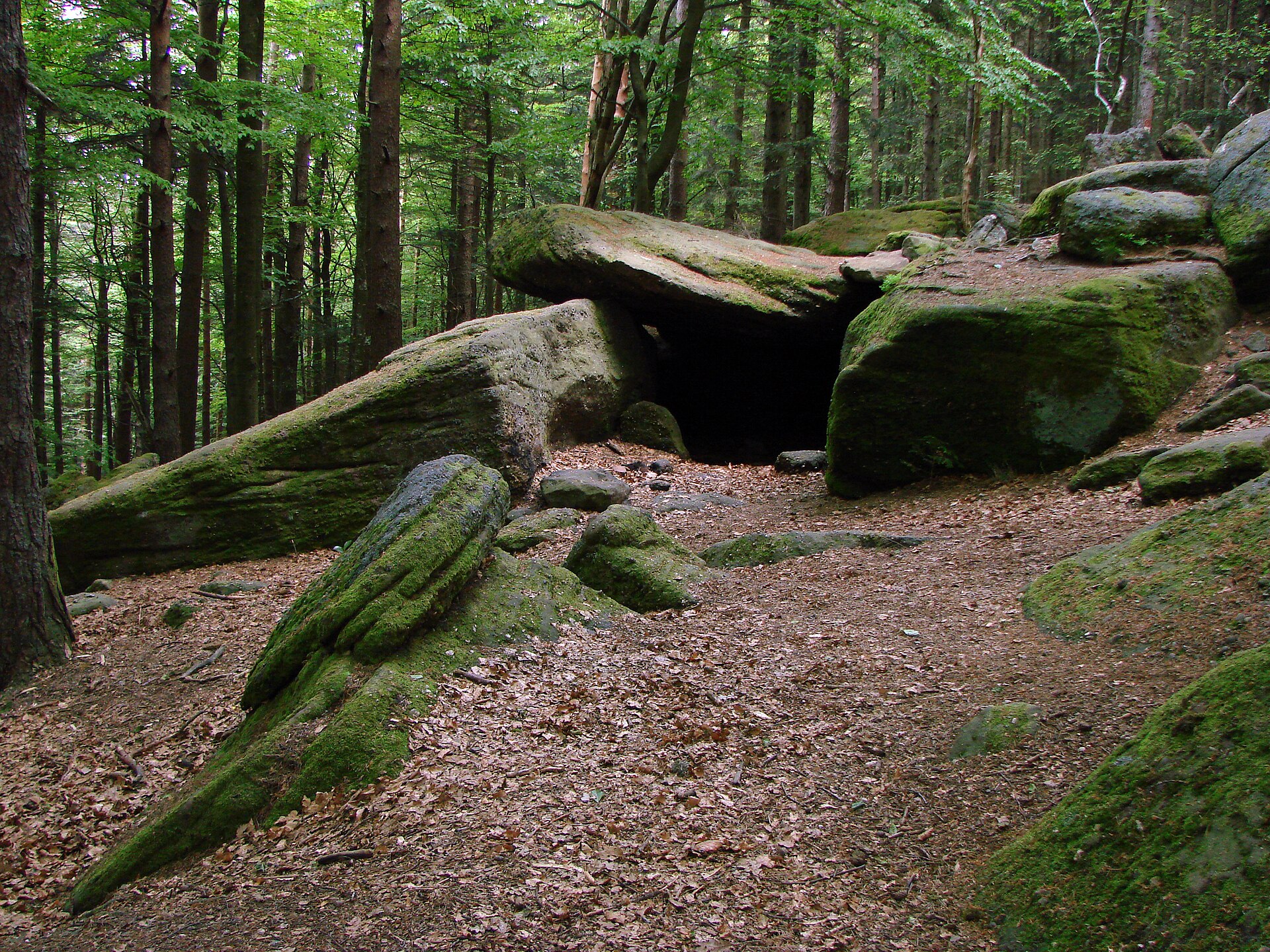
Grotte des Druides is a small natural cave in the Vosges Mountains, within the commune of Barr, in the Bas-Rhin department of Alsace — a region better known for its vineyard-covered hillsides than for underground curiosities. The entrance sits at roughly 770 metres above sea level, in the Kirneck valley, right beside the southern end of the Mur Païen (the Pagan Wall) that once enclosed the summit plateau of Mont Sainte-Odile.
Why is it called the "Druids' Cave"?
The cavity's shape recalls a dolmen, and its name nods to the druidic stones long associated with Celtic ritual sites — which is exactly why generations of hikers assumed it was man-made. Some maps as late as the 1980s still labelled it as a megalithic monument. That changed once speleologists Claude Chabert and Jean-Yves Bigot surveyed the cave in June 1991: their fieldwork confirmed it has nothing to do with prehistoric construction.
How did the cave actually form?
Grotte des Druides is a textbook case of pseudokarst, carved into Vosges sandstone laid down in the Lower Triassic. Rather than water dissolving rock, as in a true karst cave, slabs of sandstone here slid downhill under suction created within cracks in the slope, leaving behind a narrow void. The result is modest in scale — the surveyed passage measures only about 5 metres — so this is more of a geological footnote than a cave to explore at length.
What is its connection to the Pagan Wall?
The entrance opens just a few metres outside the outer line of the Mur Païen, the ring of massive dry-stone blocks that once fortified the plateau below Mont Sainte-Odile. Because of this proximity, most visitors come across the Grotte des Druides while walking the wall rather than seeking it out as a stand-alone destination.
How do you get there?
The easiest starting points are the lower or upper car parks by the convent on Mont Sainte-Odile, or the Tumuli car park along the D426 road between Mont Sainte-Odile and the Bloss crossroads. From either, marked trails lead to the site; the well-rated Sentier du Mur Païen covers roughly 9.8 km with genuine elevation gain for those wanting the full circuit. Visitors after just the wall fragment and the cave can follow a shorter loop of about 1.76 km, taking around 50 minutes at an easy pace with no technical difficulty. Walking the entire Pagan Wall, by contrast, is a full-day outing.
Who should visit?
The site suits hikers who enjoy pairing a walk with a bit of geology and local history, rather than travellers seeking a dramatic cave experience. It works well as a short detour from a visit to Mont Sainte-Odile, and it sits within easy reach of Barr, the wine town at the foot of the Vosges where many visitors base themselves before heading into the hills or along the Alsace wine route.
FAQ
Is the Grotte des Druides a genuine dolmen? No. Despite the dolmen-like shape and druid-referencing name, a 1991 speleological survey confirmed it is a natural pseudokarst formation, not a prehistoric structure.
How long does it take to reach the cave? The short route combining a stretch of the Pagan Wall with the cave takes about 50 minutes one way and requires no special hiking experience.
Where can I park? The car parks by the Mont Sainte-Odile convent or the Tumuli car park on the D426 are the most convenient options.
Is the cave lit or set up for guided visits? No. It is a small, roughly 5-metre natural void with no visitor infrastructure — you view it from outside or step in briefly without special equipment.
What else is worth seeing nearby? The Pagan Wall itself, the summit and convent of Mont Sainte-Odile, and the town of Barr with its vineyards at the foot of the Vosges.
Nearby places

Earn badges for the places you visit
Download NextOnTrip, discover new places and check off your trails.