About this place
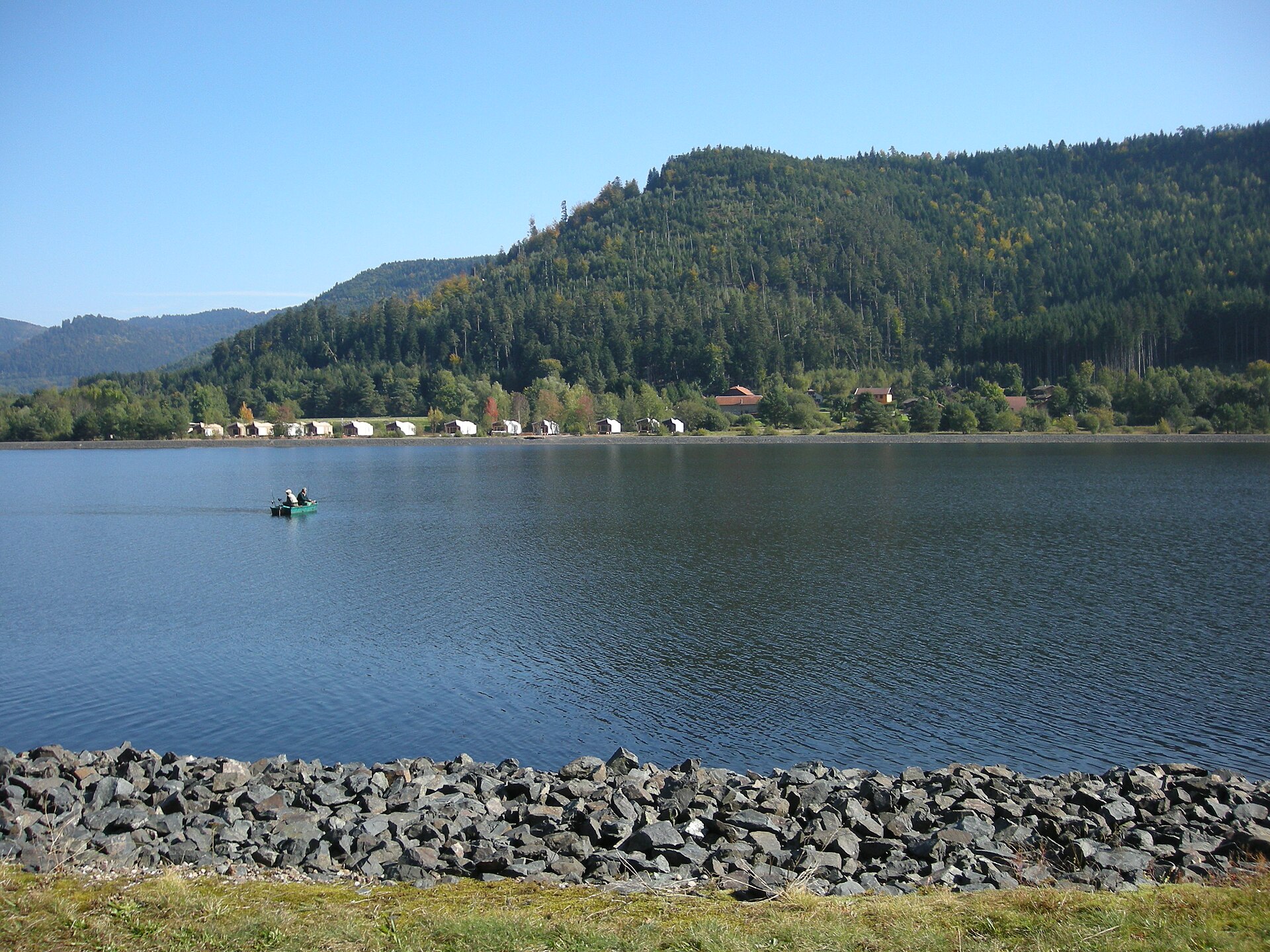
Lac de la Maix is a small glacial lake tucked into the Vosges mountains in eastern France, on the territory of the village of Vexaincourt, at the foot of the Donon massif. Sitting at roughly 680 metres above sea level and about 3 km from the village centre, it is surrounded by forest and the sandstone ridges typical of this part of the Vosges. Unlike many mountain lakes in the region, it was never created by damming a river — it is one of the last true natural lakes left in the massif.
How did the lake form?
The hollow that now holds Lac de la Maix was carved out by glacial action roughly 12,000 years ago, toward the end of the last Ice Age. In the millennia that followed, the basin gradually filled in with peat, which is why the lake's bottom is soft and its water has a dark, slightly murky tone even today. Locals once knew it simply as "la Mer" — the Sea — a name that hints at how large and mysterious the small lake must have felt to villagers living nearby.
What is on the shore?
A chapel stands at the water's edge, built over an old crypt next to the ruins of a hermitage once known as the hermitage "de la Mer." The story goes back to the 11th century, when a monk named Reignier, connected to the abbey of Senones, settled there; Bishop Pibon formally authorised the hermitage in 1090. By around 1250 the place had grown in religious importance, drawing pilgrims seeking solitude in the forest. The chapel visitors see today was built in 1865 out of red sandstone in a Romanesque style, right where the path from Vexaincourt ends, resting on a platform above the preserved crypt, in honour of Reignier, the site's first hermit.
What legends surround the lake?
Lac de la Maix has long been wrapped in local folklore passed down through generations. One well-known tale describes a green meadow that supposedly occupied the spot before the lake existed, where young people from nearby villages gathered on Sundays to dance. According to the story, a mysterious musician appeared one day, playing strange, seductive tunes that drew the youths away from their prayers and duties. As punishment, the meadow is said to have collapsed into the ground along with everyone dancing on it, and water rose to fill the void. Legends of swallowed meadows and punished youth are a recurring motif in Vosges folklore, and this one ties the lake closely to the spiritual legacy of the nearby abbey of Senones.
How do people explore the area on foot?
A short, easy path of about one kilometre circles the lake itself and can be walked in under an hour, offering close views of the water, the ruined hermitage chapel, and the surrounding forest. From there, hikers can continue toward the summit of the Donon, roughly 10 km away and considered one of the most significant peaks in the Vosges. For a longer outing, a marked loop trail of more than 16 km covers the wider area at a moderate difficulty level, typically taking around 4.5 to 5 hours. Autumn is a particularly popular season to visit, when the surrounding foliage turns and reflects in the still water.
Frequently asked questions
Where exactly is Lac de la Maix? In the commune of Vexaincourt in the Vosges mountains, at the foot of the Donon massif, about 3 km from the village centre.
Is the lake natural or man-made? Natural — it is one of the last remaining glacial lakes in the Vosges massif that formed without human intervention.
What is worth seeing at the lake? A chapel built in 1865 over a medieval crypt, and the ruins of a hermitage tied to the abbey of Senones.
How long does it take to walk around the lake? The loop around the water is about one kilometre and takes less than an hour, even with children.
Can you hike from the lake to the Donon summit? Yes, a trail of roughly 10 km leads to the summit of the Donon starting near the lake.
Nearby places

Earn badges for the places you visit
Download NextOnTrip, discover new places and check off your trails.