About this place
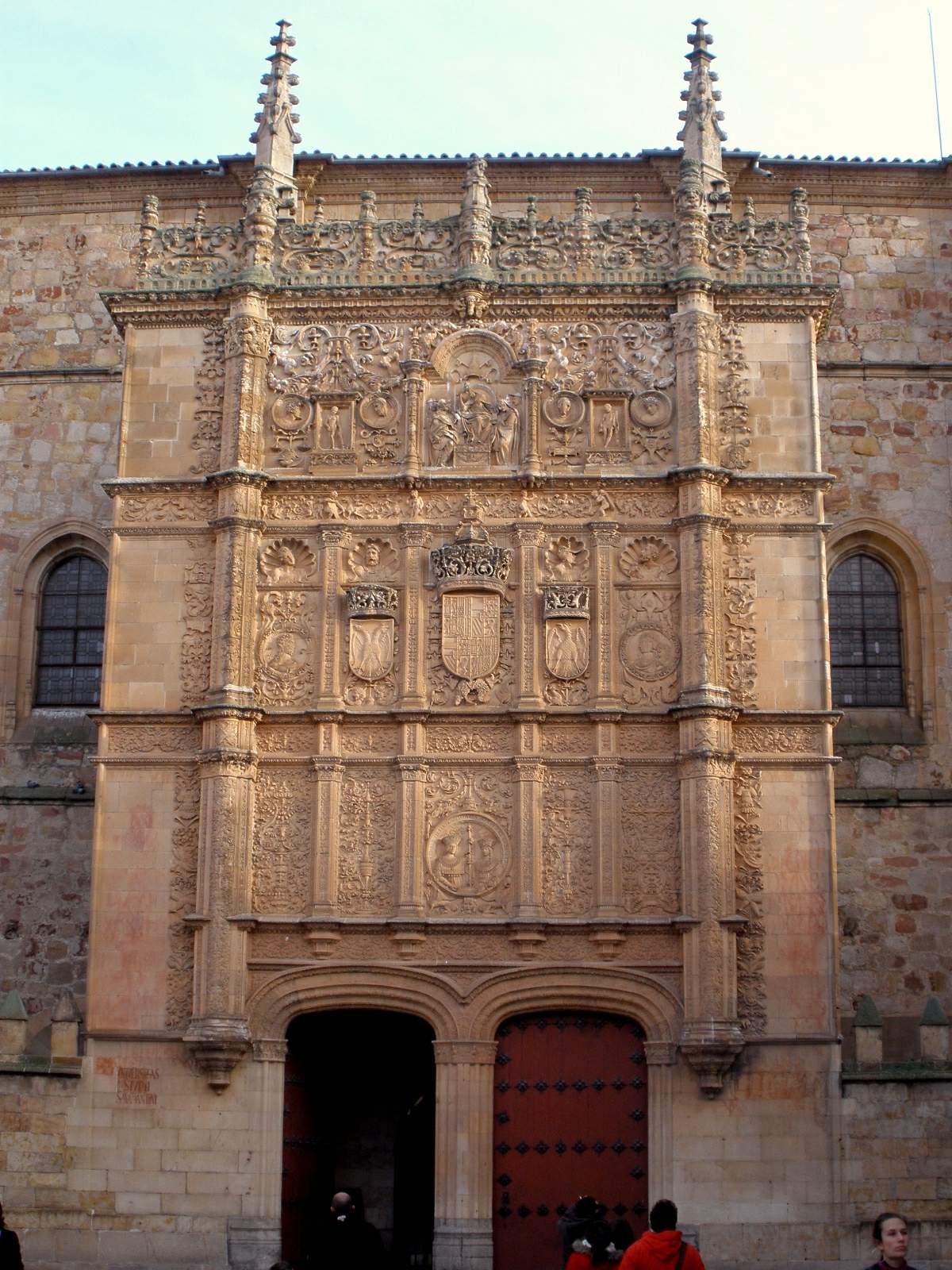
The Facade of the University of Salamanca is the ornate stone screen framing the entrance to Spain's oldest university, and one of the most photographed architectural details in the city.
What exactly are you looking at?
The facade went up in the early 16th century, right at the height of Plateresque style — an ornamental Spanish trend named after platero, the word for silversmith, because its dense carving recalls silverwork. The wall behind it is still structurally Gothic, but the entire surface is layered with Renaissance decoration woven together with flamboyant Gothic flourishes and Moorish-inspired patterns.
The composition is arranged in three horizontal tiers, each separated by a decorative frieze. On the central axis of the lowest tier sits a medallion showing the Catholic Monarchs, Isabella of Castile and Ferdinand of Aragon, holding a scepter. Beside them runs a Greek inscription that translates roughly as: the kings to the university, and the university to the kings — a tribute to the monarchs under whose reign the institution rose to prominence.
The upper tiers are packed with medallions, coats of arms, plant motifs, and small figures, forming one of the densest decorative compositions of the Spanish Renaissance. Art historians consider this facade a defining work of the Plateresque style, with some calling it the foundation stone of the early Spanish Renaissance itself.
Why does everyone hunt for a frog here?
The facade hides one of Salamanca's best-known secrets: a small frog carved into the stonework, tucked among the surrounding ornamentation and genuinely hard to spot without a hint. Local tradition holds that finding it unaided brings good luck, especially to students ahead of exams. The tiny figure has turned into an unofficial symbol of the city, and it's where visitors linger longest, scanning the hundreds of carved details for that one frog.
How do you get there?
The facade faces Patio de Escuelas, a small square right in the historic core of Salamanca, a short walk from Plaza Mayor. The old town is closed to car traffic, so walking is the natural way to arrive — the square sits directly on the route between the cathedral and the other university buildings. The plaza itself is compact, so give yourself a few minutes to view the facade from different distances and angles.
When should you visit?
The facade can be viewed from outside year-round, at any hour, free of charge — it's an exterior wall, not a ticketed exhibit. Early morning or late afternoon light rakes across the stone at an angle that brings out the depth of the carving. During summer and holiday periods, Patio de Escuelas fills with tour groups, so an early start makes for a much quieter visit.
Frequently asked questions
Do you need a ticket to see the facade? No, the square and the facade itself are free and open at all times. Tickets are only required to enter the university's interior spaces, such as the lecture halls and library.
Is the hidden frog really hard to find? Yes — most visitors miss it entirely without a tip. It's small and blends into the dense carving, so it helps to scan slowly or ask a local guide to point out roughly where to look.
How much time should I set aside? Simply standing in front of the facade takes 10 to 15 minutes, but with time spent hunting for the frog and photographing the detail, half an hour is a reasonable plan.
Is the facade part of a larger university visit? Yes, it forms the entrance to the historic University of Salamanca complex, which includes the Fray Luis de León lecture hall and the old library — those interior spaces require a separate paid ticket.
Nearby places

Earn badges for the places you visit
Download NextOnTrip, discover new places and check off your trails.