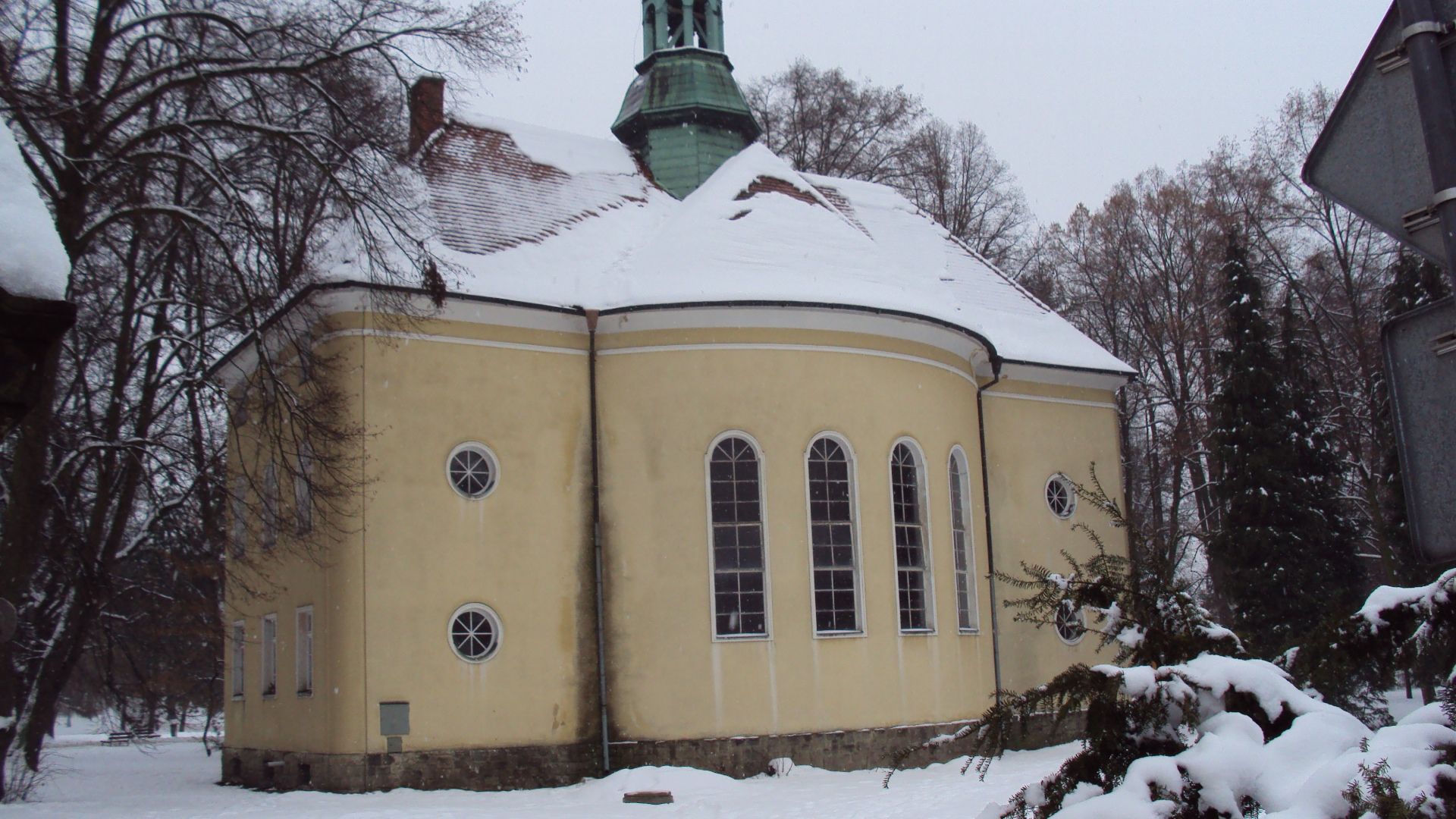
About this place
Evangelical Church in Česká Lípa
The Evangelical Church in Česká Lípa is a small rotunda-shaped church standing in the western part of the town park, close to the former Střelnice railway station. It was built in 1927 for a German Evangelical congregation, though for decades now the building has served an entirely different denomination — and doubles as one of the region's better concert venues.
Who built the church, and why is it shaped like a rotunda?
The building was designed by Richard Brosche, an architect connected to Česká Lípa, and commissioned by the local congregation of the Evangelical Church of the Augsburg Confession. Construction finished in 1927, and the round rotunda form was a deliberate choice, echoing the plain, unadorned style typical of Lutheran church architecture — the circular layout emphasized a congregation gathered around a central point of worship, without the ornamentation common in Catholic churches of the era.
What happened to this congregation before the building went up?
The community's roots reach back to 1883, when a preaching station of the German Lutheran congregation was established in Česká Lípa — a place for regular services, though without its own building. In 1921, this community became a formal branch of the German Evangelical Church based in nearby Nový Bor, giving it the organizational footing needed to build its own church a few years later.
What happened to the church after 1945?
The postwar expulsion of the German population from Czechoslovak border regions left the original Evangelical congregation without its members. In 1946 the building was handed over to the Czechoslovak Hussite Church, and a year later, in 1947, it was renamed Husův sbor (Hus Congregation) in honor of Jan Hus, the namesake of the denomination. In 2015 it received its current name, the Church of Master Jan Hus. Today the building and its adjoining rectory are used by the local Czechoslovak Hussite Church congregation.
Why does this church matter for music, not just faith?
The rotunda's circular shape turned out to have an unusual side benefit: excellent acoustics, rare for a sacred building of this size. As a result, the interior has served for years as one of the better concert spaces in northern Bohemia, used in particular during the International Music Festival Musica Lípa, which hosts chamber concerts here. The building thus plays a double role — a place of worship and a stage for classical music.
How has the building's value been formally recognized?
Because of its distinctive architectural solution — a 20th-century rotunda drawing on Lutheran simplicity — the building was added to the Czech Ministry of Culture's list of national cultural monuments in 2021. That makes it a relatively young addition to this protection category, underlining how unusual its form is compared with other churches in the region.
Can you tell from the outside that this used to be an Evangelical church?
Not at first glance. The building's Evangelical origins are not marked anywhere on its facade or in its surroundings today, which can surprise visitors looking for traces of the former German Protestant community in Česká Lípa. The building's shifting denominational history and repeated renamings make it a striking example of how the turbulent history of this borderland region left its mark on a single sacred structure.
Frequently asked questions
When was the Evangelical Church in Česká Lípa built? In 1927, designed by architect Richard Brosche for the German congregation of the Evangelical Church of the Augsburg Confession.
Where exactly does the building stand? In the western part of the town park in Česká Lípa, near the former Střelnice railway station.
Who uses the church today? Since 1946 it has belonged to the Czechoslovak Hussite Church and operates under the name Church of Master Jan Hus (adopted in 2015).
Why does the church have a rotunda shape? Its form echoes the plain style of Lutheran church architecture, with the circular layout meant to emphasize the congregation gathered around a central point of worship.
What makes this place notable beyond its religious function? Its exceptional acoustics — the church doubles as a concert venue, used among other things during the International Music Festival Musica Lípa.
Is the building a protected monument? Yes, it has been listed among the Czech Ministry of Culture's national cultural monuments since 2021.
Nearby places

Earn badges for the places you visit
Download NextOnTrip, discover new places and check off your trails.