About this place
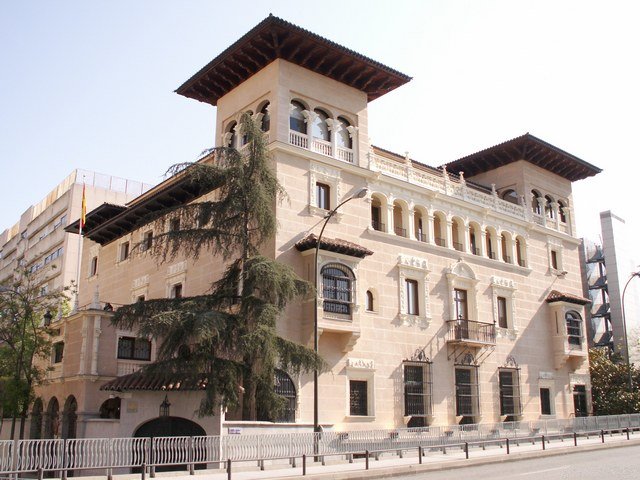
The Embassy of Italy in Spain occupies the stately Palacio de Amboage at Calle de Lagasca 98, in the heart of Madrid's Salamanca district.
What is this building?
The palace was built between 1914 and 1917 to a design by architect Joaquín Rojí, commissioned by Fernando Plá y Peñalver, Marquess of Amboage. The residence sits on a plot of roughly 8,000 square meters, while the building itself covers close to 1,350 square meters of floor space. Work actually began earlier, in 1912, with the construction of the estate's coach house and stables, ahead of the main residence.
Inside, the layout is organized around a covered courtyard that serves as a central hall, surrounded by three floors — ground floor, main floor, and second floor — plus a semi-basement. This arrangement was fairly common among aristocratic residences built in Salamanca at the time, though the scale and ambition of the Palacio de Amboage set it apart from its neighbors.
What architectural style does it show?
Joaquín Rojí drew his inspiration from French Baroque, blending rococo decorative details with neo-Baroque elements. The intent behind the facade and interior finishes was to make the residence look considerably older than its actual construction date. The quality of the design was recognized quickly: in 1918, Madrid's city council awarded it the prize for the best building of the period.
How did the building come to house Italy's embassy?
The palace remained in the hands of the Amboage family until 1939, when it was sold to the Italian state. It has served as the seat of Italian diplomacy in Spain ever since. The top floor houses the diplomatic chancellery, while the other floors contain reception rooms and the ambassador's private residence; the building also hosts the embassy's economic and commercial office.
What can visitors see from the outside?
The building, together with its surrounding garden of about 680 square meters, occupies almost an entire city block bounded by Calle de Lagasca, Juan Bravo, Velázquez, and Padilla — a street grid typical of the early-20th-century Ensanche expansion of Madrid. As an active diplomatic mission, the interior is not open to the public, but the facade and its green surroundings remain one of the more striking examples of residential architecture in the Salamanca district.
How do you get there?
The palace sits right in the center of Salamanca, one of Madrid's most elegant neighborhoods, known for its boutiques and turn-of-the-century apartment buildings. The area is well served by metro and city buses, and a walk through the surrounding streets reveals several similar residences from the same era.
When is the best time to visit?
Since this is a working embassy rather than a museum, the surrounding area is best seen during the day, when Salamanca's street life is at its liveliest — giving visitors a relaxed chance to take in the facade and the block's architecture without hurry.
Frequently Asked Questions
Can you visit the inside of the palace? No — the building functions as an active embassy and diplomatic residence, so the interior is not open to visitors.
Who designed the Palacio de Amboage? Spanish architect Joaquín Rojí designed the building, with construction taking place between 1914 and 1917.
Since when has the building belonged to Italy? Italy purchased the palace from Spain in 1939, and it has housed the embassy ever since.
Which neighborhood is the embassy in? The building stands in the Salamanca district, at Calle de Lagasca 98, bordered by Juan Bravo, Velázquez, and Padilla streets.
Nearby places

Earn badges for the places you visit
Download NextOnTrip, discover new places and check off your trails.