About this place
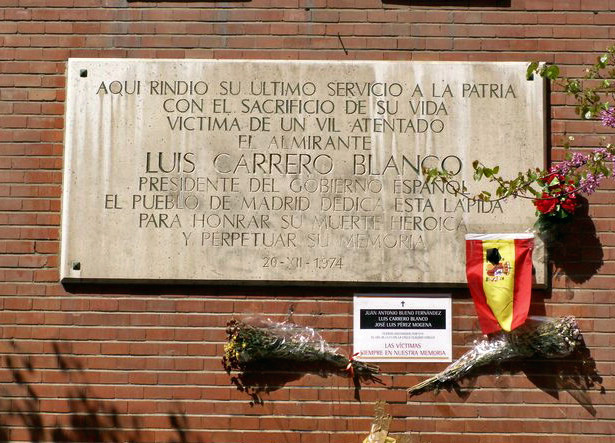
The site of the assassination of Luis Carrero Blanco is located in Madrid and marks one of the most consequential political events in twentieth-century Spanish history.
What happened at this location?
On 20 December 1973, Luis Carrero Blanco, then President of the Government of Spain (the equivalent of prime minister) and the closest political ally of General Francisco Franco, was killed at this spot in Madrid. Members of the Basque separatist organization ETA had dug a tunnel beneath the street and placed an explosive charge inside it. As Carrero Blanco's car passed over the site, the charge was detonated, killing him. The operation carried the code name Operación Ogro (Ogro Operazioa in Basque).
Why is this assassination considered so significant?
The killing of Carrero Blanco is regarded as the most serious single attack against the Francoist state since the end of the Spanish Civil War in 1939. Carrero Blanco was widely seen as the figure meant to guarantee continuity of the regime after Franco's eventual death, which made his sudden killing a severe blow to the existing power structure. The event carried far-reaching consequences for Spanish politics, shaping the final years of Francoism and influencing the pace of the political transition that followed later in the decade.
Who carried out the attack?
Responsibility for the assassination was claimed by ETA (Euskadi Ta Askatasuna), the organization campaigning for Basque independence, which was waging an armed campaign against Spanish authorities throughout the 1970s. The killing of Carrero Blanco became one of the most widely known operations in the group's history, and the code name Ogro has remained closely tied to this episode in Spanish collective memory.
What should visitors know before going?
The site sits in central Madrid, close to coordinates 40.434 N, 3.686 W. It is an ordinary city street rather than a purpose-built tourist attraction — there is no large museum or grand monument here, and today the location functions mainly as a historical reference point for people interested in recent Spanish history. Visitors hoping to grasp the full context should read up beforehand on late Francoism and the Basque conflict, since standing at the site itself does not explain the complexity of the events; it does, however, offer a direct physical connection to the space where one of the pivotal moments of modern Spanish political history unfolded.
It is worth keeping in mind that the topic remains politically and emotionally sensitive in Spain, touching on both the victims of political violence and the decades-long Basque conflict, which only came to a formal end in the second decade of the twenty-first century. Visiting sites of this kind calls for the seriousness appropriate to places of memory, rather than a sensationalized approach to the subject.
Frequently asked questions
When did the assassination of Carrero Blanco take place? It took place on 20 December 1973, in Madrid.
Who was responsible for the attack? The Basque separatist organization ETA was responsible, and the operation was code-named Operación Ogro.
What role did Luis Carrero Blanco hold? He served as President of the Government of Spain, a position equivalent to prime minister, and was regarded as General Franco's closest political ally.
Why is this location historically significant? The assassination is considered the most serious attack on the Francoist state since the end of the Civil War in 1939, and its consequences reverberated through Spanish politics during the country's later transition to democracy.
Nearby places

Earn badges for the places you visit
Download NextOnTrip, discover new places and check off your trails.