About this place
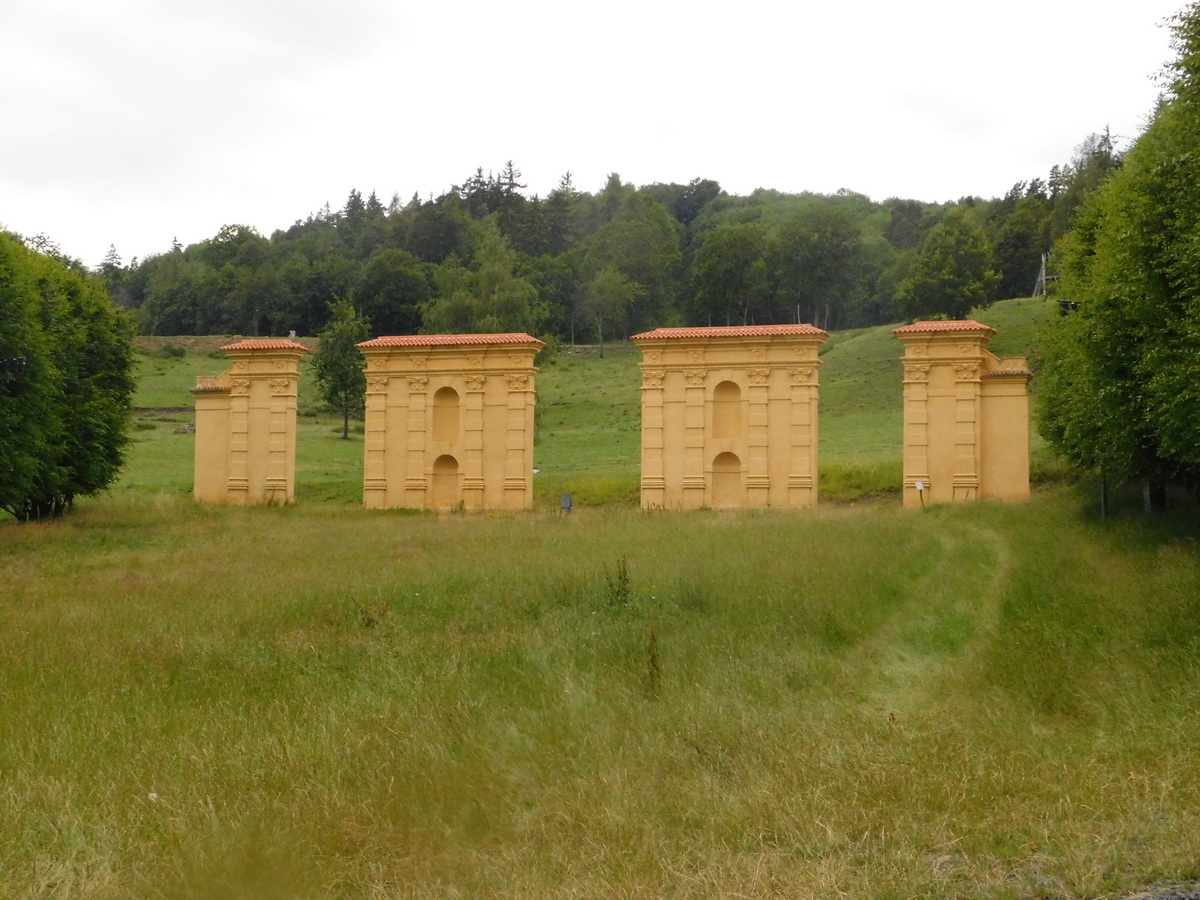
Emanuelův Dvůr is a vanished settlement in the Mašťov municipality, located about 4.5 km southwest of the town, at an elevation of 522 metres, in the eastern part of the Doupov Mountains, within the boundaries of the Doupov Foothills Nature Park. Today the site is known mainly for the ruins of its former houses, which still stand despite the settlement's official abolition in 1979.
Where does the name come from?
The German name of the settlement was Emanuelshof, later recorded as Emanuelsdorf in an 1846 source. Local tradition holds that the name may derive from one of the seven sons of Count Prokop Vojtěch Černín of Chudenice, who lived from 1723 to 1777 and owned the surrounding estates.
What is the history of the settlement?
The first written mention of Emanuelův Dvůr dates back to 1787, appearing in a work by Jaroslav Schaller. At that time the area was split between two estates, Krásný Dvůr and Milčeves, and the settlement itself consisted of ten houses along with a manor farm that included a lordly hunting lodge. Residents made their living chiefly from agriculture: each household worked between three and five hectares of land, growing hardy grain varieties and fodder crops, while also keeping sheep and bees. In winter people supplemented their income through forest work, feather plucking, or labour at the manor sawmill in Bukovina; timber from the surrounding forests was also used in violin making.
By the mid-19th century the settlement had grown — in 1846 it already counted 13 houses and 66 residents. Population peaked in 1880, when 129 people lived in 14 houses. Numbers then declined sharply, falling to just 69 residents by 1900, before recovering somewhat to 107 people across 15 houses by 1930. Interwar census records show the community was overwhelmingly German and Catholic: in 1921, 92 residents were recorded as German nationals, and in 1930, of 107 residents, only three declared Czechoslovak nationality, with nearly everyone else professing the Roman Catholic faith.
The turning point came after the Second World War, when the German population was expelled. Only eight Czech settlers moved in afterward, and they too soon left. From that point the population collapsed — by 1950 only six people remained. Administratively the settlement passed through several jurisdictions: it belonged to the Doupov district after 1848, was recorded as part of the Dobřenec cadastral area within the Kadaň district by 1869, became part of the Kadaňský Rohozec municipality in 1950, and was incorporated into Mašťov from 1961 to 1978. It was formally abolished on 1 January 1979.
What can visitors see there today?
Emanuelův Dvůr is uninhabited today, but the ruins of former houses remain visible, marking where the settlement once stood. It is a typical example of a Bohemian-German borderland community that did not survive the postwar expulsions and the decades of abandonment that followed. For visitors, the site offers a starting point for exploring the history of the Sudetenland's vanished villages, as well as the natural landscape of the Doupov Foothills Nature Park, within whose boundaries it lies.
Frequently Asked Questions
Does anyone still live in Emanuelův Dvůr? No, the settlement has been uninhabited for decades. It formally ceased to exist as an administrative unit on 1 January 1979.
What remains of the original buildings? Ruins of former houses can still be seen on site, remnants of the settlement's residential and farm structures.
Where does the settlement's name come from? It likely derives from the name of one of the sons of Count Prokop Vojtěch Černín of Chudenice, who owned the surrounding estates in the 18th century.
Which municipality did Emanuelův Dvůr belong to? The settlement was part of the Dobřenec cadastral territory and ultimately belonged administratively to Mašťov.
Nearby places

Earn badges for the places you visit
Download NextOnTrip, discover new places and check off your trails.