About this place
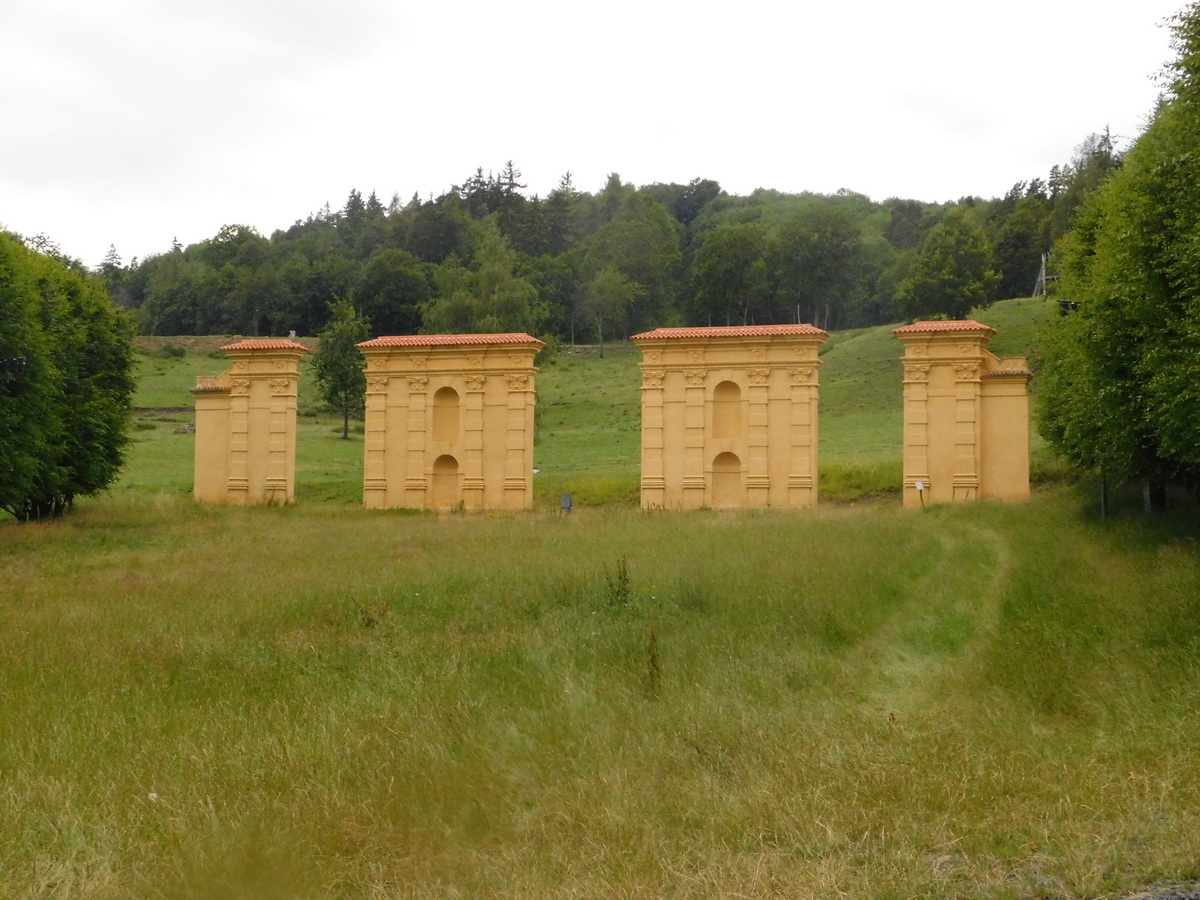
The Illusory Gates (Iluzivní brány) are a Baroque architectural feature in the historic chateau park of Valeč, a small town in the Karlovy Vary Region of western Bohemia, Czech Republic. Their name refers to a clever optical trick: what looks from a distance like a monumental gateway is in fact a set of freestanding wall fragments that never actually join together.
What exactly are the Illusory Gates?
The structure consists of four independently standing blocks of wall, richly decorated with Baroque ornamentation facing into the park. Unlike a conventional gate, there is no lintel or arch connecting the pairs of piers — instead, the blocks simply face one another across the path, creating the strong visual impression of a gateway without any physical structure spanning it. This gap between illusion and reality is exactly where the name comes from.
How to get there?
The Illusory Gates stand in the chateau park in Valeč, in the Karlovy Vary district of western Bohemia. A long tree-lined avenue leads visitors toward them, and its layout was deliberately designed to make the gates appear to draw closer the further one walks — an optical effect that was a hallmark of Baroque garden design. The gates mark the far end of the park's main compositional axis, which begins at the chateau's western façade and runs past a natural open-air theatre (teatron) and a gallery of sculptures before reaching the gates, beyond which the view opens toward the surrounding countryside and a ruin known as Neuhausen.
History behind the gates
The gates were built between 1695 and 1712 at the initiative of Count Jan Kryštof Kager of Štampach, then owner of the Valeč estate. The design is attributed to the architect Francesco Barelli, part of the circle of Italian Baroque builders brought to Bohemia by the aristocracy to design elaborate garden residences of the period. The gates' rich sculptural and stucco decoration was meant to reinforce the theatrical, illusionistic character of the whole park composition — a concept very much in keeping with Baroque landscape design.
What changed over the centuries?
In the 1890s, under estate owner Vinzenz Thurn-Valsassina, the gates underwent a Neoclassical remodeling that altered parts of their original appearance. Tall obelisks originally crowned the structure, but these were removed in 1920. Following the Second World War, and the displacement of the German population from the border regions, many estates in the area — including Valeč's — fell into disrepair, and the gates gradually deteriorated over the following decades. Only at the turn of the 20th and 21st centuries were they reconstructed, restoring their Baroque appearance, though the original obelisks were never put back.
What else is worth seeing nearby?
The Illusory Gates form part of a larger chateau park complex in Valeč, one of the more notable Baroque garden ensembles in the Karlovy Vary region. Walking along the park's main avenue, visitors also pass the open-air theatre and the sculpture gallery mentioned above. The chateau itself, while not fully open for visits today, still makes for a scenic starting point for a walk through the grounds.
Frequently asked questions
Why are they called the "Illusory Gates"? Because despite looking like a real gateway from a distance, the four wall blocks stand independently, with no arch or lintel physically connecting them — the impression of a gate is purely optical, reinforced by the perspective of the avenue leading up to it.
When were the Illusory Gates built? Between 1695 and 1712, commissioned by Count Jan Kryštof Kager of Štampach.
Do the gates look the same today as when they were built? Not entirely — they were remodeled in a Neoclassical style in the 1890s, lost their crowning obelisks in 1920, and were reconstructed at the turn of the 20th and 21st centuries after decades of postwar decay, without the obelisks being restored.
Where exactly are the gates located? In the chateau park of Valeč, in the Karlovy Vary Region of western Bohemia, at the far end of the park's main avenue leading away from the chateau.
Nearby places

Earn badges for the places you visit
Download NextOnTrip, discover new places and check off your trails.