About this place
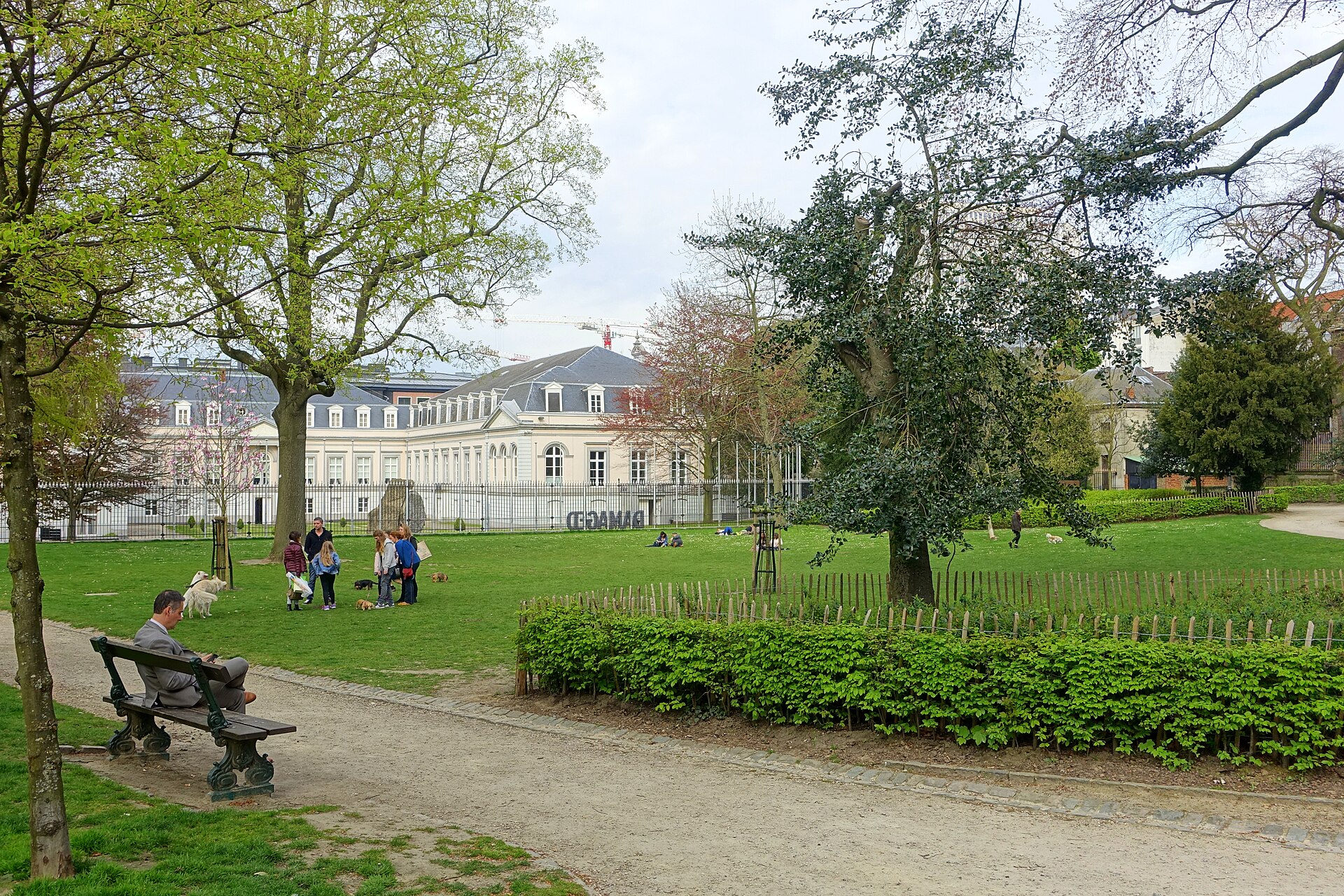
Egmont Park is a small but charming green space in the very heart of Brussels, tucked between Rue aux Laines, Rue du Grand-Cerf and Boulevard de Waterloo. Covering roughly 1.5 hectares and hemmed in on all sides by townhouses, it feels like a hidden pocket of nature tucked away just steps from one of the city's busiest boulevards.
Where does the park get its name?
The name comes from the neighboring Egmont Palace, of whose grounds the park originally formed part. The palace itself was built in the mid-16th century for Princess Françoise of Luxembourg and her son Lamoral, Count of Egmont — a nobleman whose execution during the Spanish rule of the Low Countries made him one of the era's most famous historical figures. His title lives on in the names of both the palace and the park that surrounds it.
How has the layout of the park changed over the centuries?
The estate's history is really a story of repeated redesigns and changing owners. In the 18th century it passed to the House of Arenberg: Leopold Philip of Arenberg first acquired the smaller portion of the estate in 1738, then bought the larger part from his brother-in-law in 1752. Between 1759 and 1762, architect Giovanni Niccolò Servandoni laid out a formal French garden on the grounds, with the geometric avenues and clipped parterres typical of that style.
A further transformation came in the 19th century, when architect Tilman-François Suys reshaped the estate starting in 1830. Between 1830 and 1839 he also designed the neoclassical orangery that still stands at the center of the park today and remains one of its most recognizable architectural features.
The final shift toward the park as we know it today took place around the turn of the 20th century: in 1901–1902, architect Edmond Galoppin converted the old French garden into an English-style landscape park, with a more naturalistic layout of open lawns and freely growing trees, many of which are now well over a hundred years old.
What happened to the palace and park in the 20th century?
The fates of the palace and its garden were closely tied to Belgium's own history. After the Egmont line died out, the estate passed to the Arenberg family. On 31 October 1918, shortly after the end of the First World War, the palace was sold to the City of Brussels, and in 1964 it passed into the ownership of the Belgian state. Today the neoclassical building houses the Belgian Ministry of Foreign Affairs, while the park itself remains open and freely accessible to residents and visitors alike.
What can visitors see in the park today?
Walking through Egmont Park's paths, visitors will come across several statues and monuments, including one of Peter Pan and another dedicated to the Prince of Ligne. At the center of the park stands the neoclassical orangery mentioned above, built in the first half of the 19th century, which lends the whole space a refined, slightly aristocratic atmosphere. The park was restored by the City of Brussels in 2001, preserving its historic character while giving present-day visitors a comfortable place to relax.
Frequently asked questions
Is entry to Egmont Park free? Yes, the park is open to the public and free to enter at any time.
Can visitors see Egmont Palace from the park? The palace stands directly adjacent to the park, but since it houses a government ministry, its interior is not open to the public — its facade, however, can be admired from the park's paths.
How long does it take to see the whole park? Given its small size, a walk through usually takes about 20–30 minutes, though those interested in the architecture and statues may want to linger longer.
Is the park a good place to rest while sightseeing in Brussels? Definitely — thanks to its central location right off Boulevard de Waterloo, it makes a convenient break between visits to other attractions in the city center.
Nearby places

Earn badges for the places you visit
Download NextOnTrip, discover new places and check off your trails.