About this place
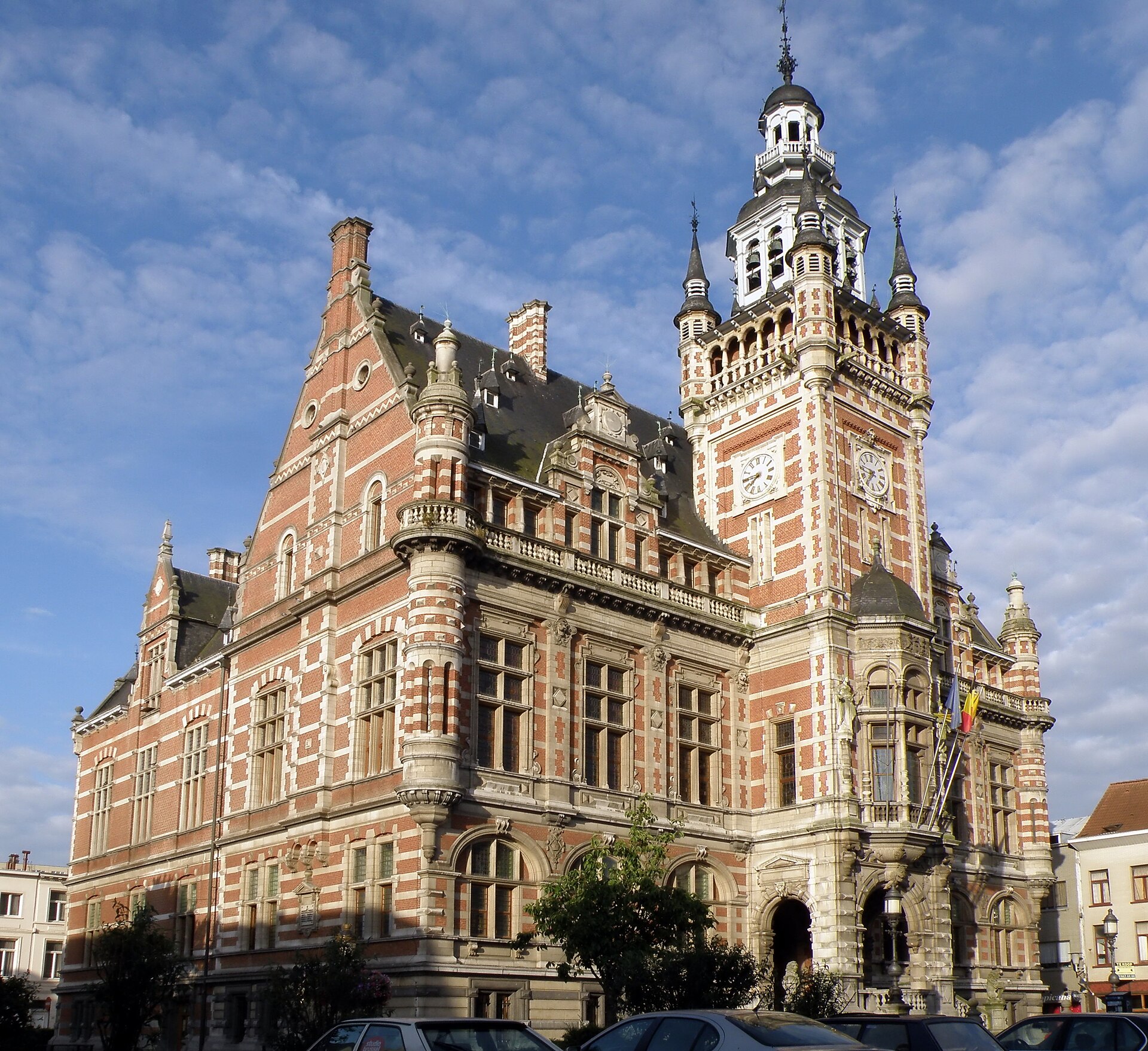
Districtshuis Borgerhout is the former town hall of Borgerhout, now serving as the seat of one of Antwerp's district councils, standing on Moorkensplein at the heart of what was once an independent municipality. The building was raised between 1886 and 1889 to a design by the brothers Leonard and Henri Blomme, who chose the Flemish Neo-Renaissance style then in vogue across Belgium — a style municipalities favored precisely because it let them project prosperity and independence through architecture. Borgerhout, a fast-growing industrial municipality on Antwerp's outskirts at the time, wanted a headquarters that matched its ambitions, and the new town hall was meant to deliver exactly that.
What does the building look like?
A square gatehouse tower dominates the main facade, and inside it hangs a carillon — a set of tuned bells. The tower holds 47 bells with a combined weight of 5,500 kilograms of bronze, making it one of the larger carillons in the region. The richly decorated exterior, with stonework and brickwork detailing typical of the Neo-Renaissance idiom, was designed from the start to serve as the municipality's calling card. Inside, the sculptural work deserves attention too — some of it created by the Dutch sculptor Alfons Baggen, whose decorations still adorn several of the building's ceremonial rooms.
Why isn't it a town hall anymore?
In 1983, Borgerhout was administratively merged into the city of Antwerp, losing its status as an independent municipality. From that point on, the building stopped functioning as a town hall in the full sense — only a district council (districtsraad) sits there now, and the building itself was renamed Districtshuis. In 1975, before the merger even took place, the building had already been listed as a protected monument, which helped preserve its ornate decoration through the decades that followed.
What happens there today?
Today the Districtshuis serves an administrative role — it houses front-desk services for district residents alongside spaces used for ceremonial purposes, including civil weddings. Between 2015 and 2017 the building underwent a thorough renovation to adapt it to the needs of a modern district office while respecting its heritage value; the renovated Districtshuis reopened in early 2018. The works also included energy-efficiency upgrades, allowing the historic structure to function as a contemporary public building. In the years since, the tower and the carillon itself have also been restored, so the bells can keep ringing out over Moorkensplein.
Frequently asked questions
Can you visit the Districtshuis Borgerhout? As a working municipal office, the building is accessible during administration hours, and on occasions such as Open Monumentendag guided tours are organized through the interior, including rooms not normally open to visitors.
What's the difference between a districtshuis and a town hall? A gemeentehuis (town hall) was the seat of an independent municipality's government. After Borgerhout was absorbed into Antwerp in 1983, the building lost that role and became a districtshuis — the seat of one district within a larger city, with a narrower set of powers.
What's the building's most distinctive feature? The gatehouse tower with its 47-bell carillon, visible from afar above the rooftops of Moorkensplein, along with the richly sculpted interior decoration.
Nearby places

Earn badges for the places you visit
Download NextOnTrip, discover new places and check off your trails.