About this place
Cueva de la Lastrilla is an archaeological cave in the Sámano district, part of the municipality of Castro-Urdiales in Cantabria — one of the most important prehistoric sites in the whole region.
Where is the cave located?
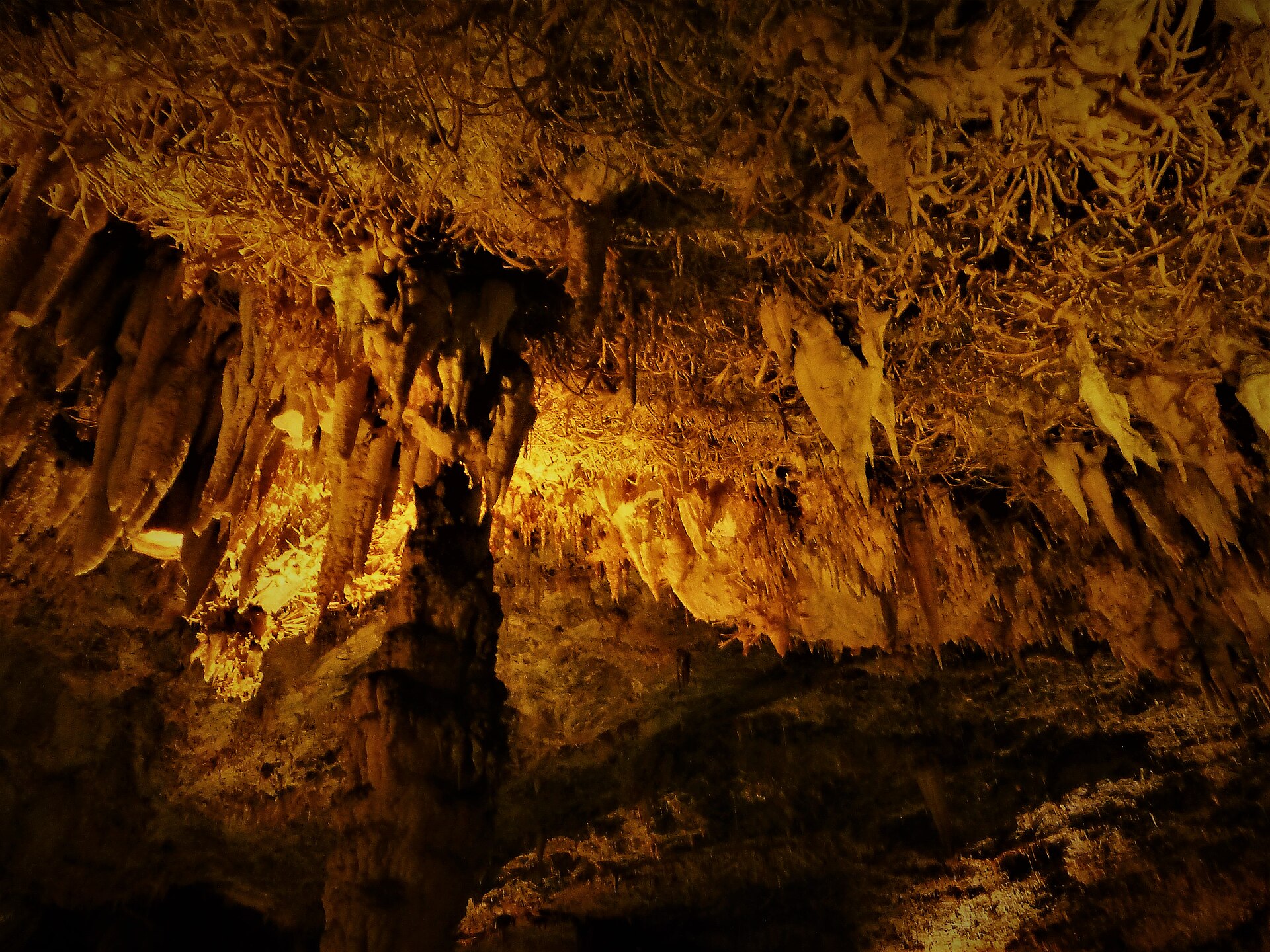
The entrance sits near Sangazo in Sámano, reached by a well-marked track. Lastrilla belongs to a large karst system that, together with the neighbouring Cueva de La Cubilla, forms one of the most extensive underground networks in Cantabria, with more than 13 kilometres of explored galleries.
What will you find inside?
The cave preserves an unusually rich stratigraphic sequence, spanning from the Upper Palaeolithic through to the Roman period. Archaeologists have documented Gravettian and Solutrean material, Chalcolithic and Bronze Age remains, and later historical layers containing ceramics, stone tools and animal bones.
The standout feature is the Upper Palaeolithic rock art. The walls hold red stains and pigment traces, among which three hand stencils in positive technique (red pigment applied directly through a hand pressed against the rock) and a frontal figure of a goat stand out. This art dates back 16,000 to 20,000 years, to the transition between the Upper Solutrean and Lower Magdalenian. The images appear at several points inside the cave, though the clearest ones sit near the upper entrance.
Because of this significance, Lastrilla is included in the international HANDPAS Project — a catalogue of hand representations in Palaeolithic rock art across the Iberian Peninsula.
How do you get there, and when should you visit?
The cave was discovered by the Diputación's road maintenance team in the 1950s, and later studied by the Speleological Group "La Lastrilla," who first documented the paintings. It is currently closed to visitors — access requires prior authorisation from Cantabria's Consejería de Cultura, Turismo y Deporte. A project is underway to partially open the cave to the public in the future.
Until then, Castro-Urdiales and nearby Sámano make a worthwhile base: the town itself offers a medieval old quarter, a working fishing harbour and coastal cliffs, while the surrounding area holds further caves belonging to the same karst system.
Frequently asked questions
Can you visit Cueva de la Lastrilla? Not currently — the cave is closed to the public. A visit must be requested through Cantabria's Consejería de Cultura, Turismo y Deporte, and regional authorities are working on a project for partial public access.
What makes this cave especially valuable? Rock art dating back 16,000-20,000 years: three hand stencils in positive and a goat figure, catalogued in the international HANDPAS Project.
What time periods are represented at the site? The sequence covers the Upper Palaeolithic (Gravettian and Solutrean cultures), the Chalcolithic, the Bronze Age and the Roman period.
Is the cave connected to other caves nearby? Yes, Lastrilla is part of a karst system that includes Cueva de La Cubilla — together they form a network of more than 13 km of galleries.
Nearby places

Earn badges for the places you visit
Download NextOnTrip, discover new places and check off your trails.