About this place
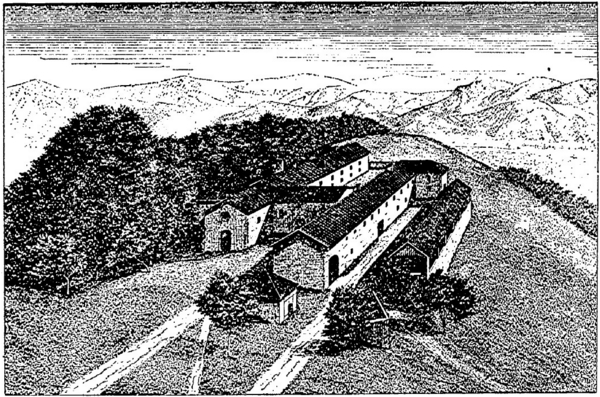
Couvent des Cordeliers de Moirans is the site of a former Franciscan friary in the town of Moirans, in the Isère department of southeastern France. Only fragments of the original buildings survive today, yet the site holds a notable place in regional history as the first Franciscan foundation in the historic Dauphiné.
Why are Franciscans called "Cordeliers" in France?
In France, friars of the Franciscan order became known as Cordeliers, a name derived from the thick knotted cord they wore around their brown or grey habit. The cord was a visible sign of the vow of poverty central to the order, and the term was used for Franciscan houses across the country, not only in Moirans.
When was the friary in Moirans founded?
Franciscan friars settled in Moirans around 1220, making it the earliest house of the order established in the Dauphiné. A Latin inscription once placed above the door of the old conventual church recorded this fact directly: "Prima domus ordinis sancti Francisci en Dalphinatu" - "First house of the order of Saint Francis in the Dauphiné." That inscription remains one of the clearest pieces of evidence for the friary's historical significance.
How did the community live over the centuries?
As a mendicant order, the friars depended partly on alms, but the Moirans community also worked its own land, tending fields, vineyards and meadows attached to the friary. The number of resident friars varied over time, ranging from around four to fifteen. In the 14th century, Humbert II, dauphin of Viennois, banned new construction in the immediate vicinity of the friary and granted the friars use of the moats along the town's ramparts, where they were allowed to raise fish. These privileges helped the community remain undisturbed for several centuries.
What happened to the friary after the French Revolution?
The French Revolution brought the friary's religious life to an end. In 1792, the friars were expelled and the property was sold off as national property. The buildings were partly dismantled afterward, and part of the site was eventually absorbed into an adjoining school. The surviving remnants, no longer in active use, fell into disrepair for a long period before any protective measures were taken.
What survives at the site today?
The remaining vestiges of the friary were listed as a historic monument in 1989. A significant discovery followed in 2004, when restoration work uncovered 14th-century wall paintings that had previously gone unnoticed. This find prompted a dedicated conservation project, and the preserved remains are now presented as a pedestrian passage located behind Moirans' town hall.
Frequently asked questions
Where exactly is the couvent des Cordeliers de Moirans located? It stands in the historic center of Moirans, a town in the Isère department, not far from Grenoble.
Is this the same Cordeliers friary as the one in Embrun? No. The two are unrelated. The Cordeliers friary in Embrun (Hautes-Alpes department) is a separate Franciscan foundation with its own distinct history.
Can visitors see the surviving remains? The preserved fragments have been converted into a public pedestrian passage next to the town hall, allowing visitors to view them from outside while walking through Moirans' historic center.
What is the site best known for? Its two standout features are the 14th-century wall paintings uncovered in 2004 and the Latin inscription that documents the friary's status as the first Franciscan house in the Dauphiné.
Nearby places

Earn badges for the places you visit
Download NextOnTrip, discover new places and check off your trails.