About this place
Constantí Town Hall stands in the heart of Constantí, a small town in the Tarragonès region just north of Tarragona. It is a modest but well-preserved example of early 19th-century civic architecture and a natural stop for anyone exploring the historic centre of the town.
Where is the town hall located?
The building occupies a central spot in Constantí, on the square that has long served as the administrative core of the municipality. Constantí itself sits only a few kilometres from the city of Tarragona, making it an easy addition to a day exploring the Costa Daurada coastline and the region's Roman heritage.
What does the building look like?
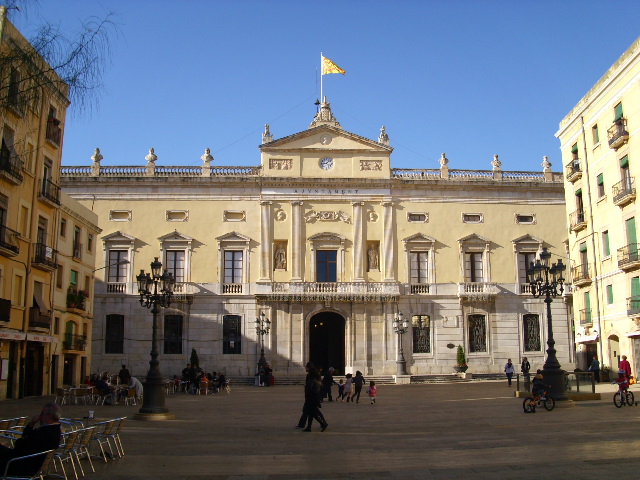
The façade is fully symmetrical, which is the first thing visitors notice from the square. On the ground floor, a stone entrance portal topped with a semicircular arch is flanked by two windows. Every opening on the façade, doors and windows alike, is framed in stone, giving the building a solid, official presence typical of municipal architecture from its era.
The main floor is dominated by a projecting balcony above the entrance, with two flush balconies set to either side, all fitted with iron railings. The top floor carries three smaller windows, and the whole façade is finished with a cornice featuring a truncated pediment at its centre. The building rises to a ground floor plus two upper storeys, and its style is classified as Classicism — restrained in ornament but carefully balanced in proportion.
What is the history behind it?
Constantí's town hall was built in 1817. That date places it within a wave of civic building projects across Catalan towns in the post-Napoleonic period, when many municipalities rebuilt or renovated their administrative seats using simple, symmetrical classicist forms with stone detailing. The building is now protected as a Local Cultural Interest Asset (Bé Cultural d'Interès Local), confirming its status as a recognised piece of Constantí's architectural heritage.
What else is worth seeing nearby?
Constantí is a small town, but it holds one major card: the Roman villa and mausoleum of Centcelles lies within its municipal boundaries, one of the most significant late-Roman monuments in Catalonia, famous for its surviving mosaic dome. Pairing the two makes for a natural half-day route — start with a walk through the town centre to see the town hall's classicist façade, then head to the archaeological site a short distance away. The proximity to Tarragona, with its Roman amphitheatre, ancient walls and cathedral, also makes Constantí an easy addition to a broader day trip through the region.
Frequently Asked Questions
When was Constantí Town Hall built? The building dates from 1817 and was constructed in the Classicism style.
Is the town hall a protected building? Yes, it is listed as a Local Cultural Interest Asset (Bé Cultural d'Interès Local), recognising it as part of the town's protected architectural heritage.
What are the main features of the façade? A fully symmetrical composition, a stone entrance portal with a semicircular arch on the ground floor, a projecting balcony with iron railings on the main floor, and a cornice with a truncated pediment crowning the building.
Can a visit be combined with other nearby attractions? Yes — Constantí is home to the Roman villa and mausoleum of Centcelles, and the town lies just a short distance from Tarragona and its well-known Roman-era monuments.
Nearby places

Earn badges for the places you visit
Download NextOnTrip, discover new places and check off your trails.