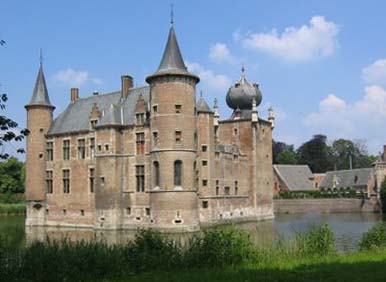
About this place
Cleydael Castle is a moated stronghold in Aartselaar, in the Belgian province of Antwerp, standing at a modest altitude of just 8 meters above sea level amid the flat, green countryside of the Kempen region. Its origins reach back to the mid-13th century, with documentary evidence placing the estate in the hands of the Sanders van Hemessen family as early as 1259, while the site itself was first recorded in writing in 1372, when it belonged to Geeraert van der Elst.
How did ownership of the castle change over time?
For generations, Cleydael was at the center of a dispute between the van der Elst and Sanders families. The conflict grew serious enough to require the direct intervention of Joanna of Brabant, Duchess of Brabant, who mediated between the two houses and ultimately brought about a reconciliation. A decisive turning point came in 1401: following the murder of Filips van der Elst and the resulting financial troubles of his family, the Sanders family regained the castle through purchase.
The following centuries brought new owners and successive waves of renovation. In the 16th century, the estate was restored by Gillis Hooftman van Eyckelbergh. In the 17th century, in 1644, the castle was acquired by Frans Paschier van den Cruyce, then mayor of Antwerp, who six years later, in 1650, marked the entrance of the residence with a family coat of arms — a decorative detail that remains part of the building's historical identity today. Cleydael continued to serve as the seat of the lords of Cleydael until the end of the 18th century.
What happened to the castle in the modern era?
After the First World War, the estate was purchased by Antwerp shipowner Christiaan Sheid, who in the 1950s initiated restoration work aimed at returning the building to its former condition. Following his death, his widow continued to live at the castle for some time; it was during this period that a golf course was established on the surrounding grounds, dominating the estate's function for many years. Only later, once the golf course ceased operation, did the property revert to private ownership, a status it retains today.
What does the castle's architecture look like?
Cleydael is a classic example of a Dutch-style moated castle: a roughly square building surrounded by a moat, featuring one square tower and three round corner towers. Parts of the walls and structure date back to the 14th century, making Cleydael one of the older surviving fortified residences in the Antwerp region. The combination of a central square tower with rounded corner turrets gives the building its distinctive, picturesque silhouette, typical of Flemish noble residences from the late medieval and early modern periods.
Frequently asked questions
Where is Cleydael Castle located? In Aartselaar, in the province of Antwerp, Belgium, at an altitude of 8 meters above sea level.
How old is the castle? The estate is first documented in 1259, and the building itself first appears in written records from 1372; parts of the structure date from the 14th century.
Can visitors tour the castle? It is currently a private property, also used as a venue for events, weddings, and parties.
What is distinctive about Cleydael's architecture? Its square floor plan, surrounding moat, and three round corner towers alongside a single square tower.
Nearby places

Earn badges for the places you visit
Download NextOnTrip, discover new places and check off your trails.