About this place
Church of Santa María del Manzano stands as the main parish church of Hondarribia, a walled town in the Basque Country at the mouth of the Bidasoa river. Its full name is Iglesia de Santa María de la Asunción y del Manzano, and the building sits within the old town's fortified core, close to the border with France.
When was the church built?
Local legend holds that the Count of Armagnac laid the first stone in 1471, setting a diamond ring into the foundations as part of the ceremony. Historians generally place the actual start of construction a few years later, around 1474. The church then took an extraordinarily long time to complete: it was not consecrated until 75 years after work began. The delay came down to Hondarribia's status as a frontier fortress in a near-constant state of war readiness. Local authorities were reluctant to let anything interfere with the town's defenses, and building materials meant for the church were repeatedly redirected to reinforce the surrounding walls instead.
What architectural styles does the church combine?
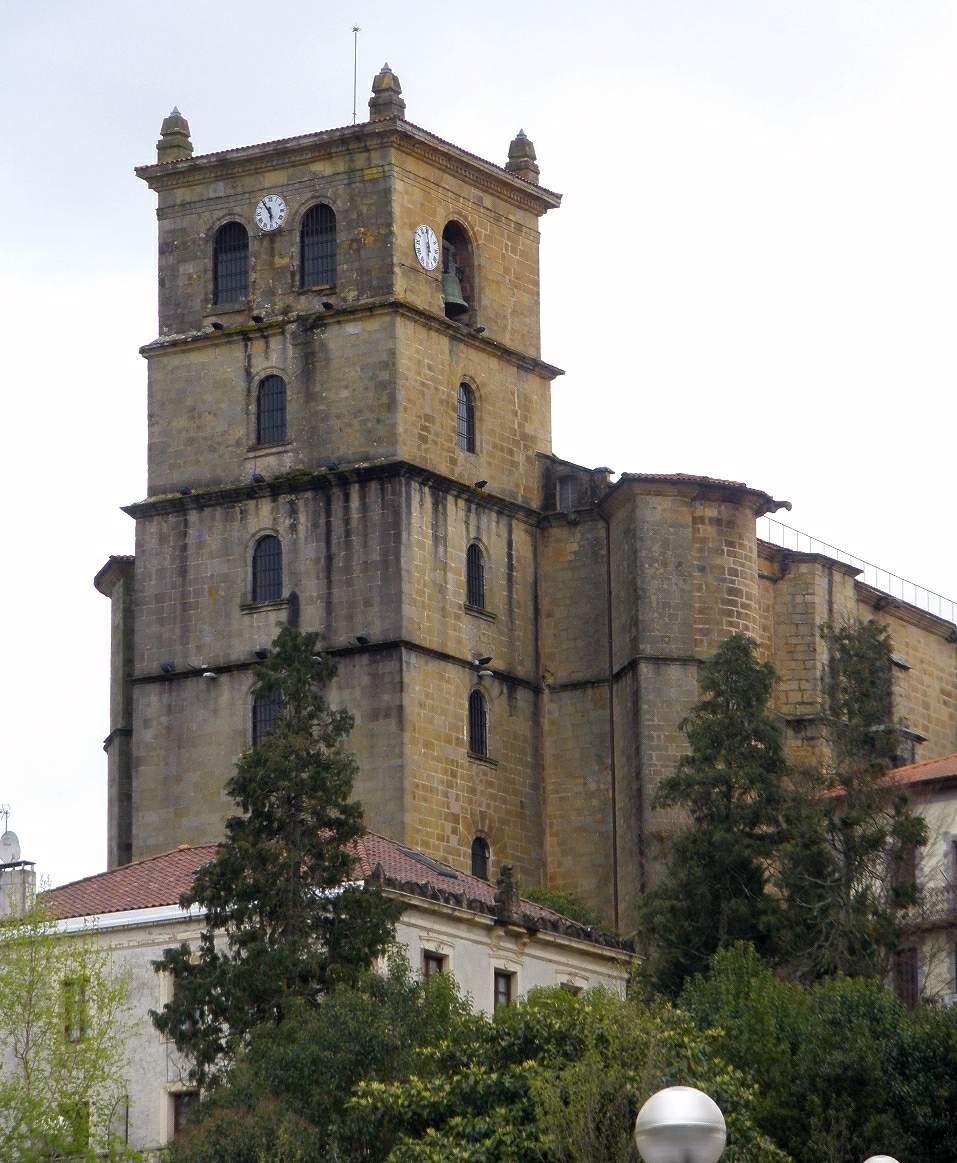
Because construction stretched from the 15th through the 18th century, the building layers late Gothic, Renaissance, and Baroque elements on top of one another. Inside, eight cylindrical pillars divide the space into three naves of roughly equal width, and the interior measures 44 meters long by 28 meters wide, making it one of the larger churches in this part of Gipuzkoa. The sacristy was added in the first half of the 17th century, while the Baroque bell tower dates from the 18th century and was designed by Francisco de Ibero. Walking around the building, visitors can trace three centuries of shifting architectural fashion in a single structure.
Why does this church matter historically?
In June 1660, the church was the setting for a royal wedding with continent-wide consequences. King Louis XIV of France married the Spanish Infanta María Teresa here, with the French king represented by proxy through his minister, Luis de Haro, since the ceremony followed the custom of a proxy marriage. The wedding formally sealed the Treaty of the Pyrenees, which brought a long-running war between France and Spain to an end. Hondarribia was chosen precisely because of its position on the border itself, making the church a fitting stage for a treaty between two crowns. For many visitors, this single historical episode is as much a draw as the architecture itself.
What should visitors look out for inside?
Inside, the three naves and their cylindrical pillars are worth studying alongside the contrast between the older Gothic core and the later Baroque additions, particularly the tower and sacristy. The church sits at the heart of Hondarribia's old town, surrounded by the colorful stone houses with wooden balconies the town is known for, so a visit here pairs naturally with a walk through the rest of the historic quarter.
Frequently Asked Questions
Can visitors go inside the church? It functions as an active parish church, so access to the interior depends on service times and opening hours — it is worth checking locally before planning a visit.
How long did construction take? Building work spanned several decades, from the foundations laid in the 1470s to a consecration that only came 75 years later.
What is the church's connection to the Treaty of the Pyrenees? In 1660 it hosted the wedding of Louis XIV to Infanta María Teresa, the ceremony that formally sealed the Treaty of the Pyrenees between France and Spain.
Where exactly is the church located? It stands within the walls of Hondarribia's old town in the Basque Country, close to the border between Spain and France.
Nearby places

Earn badges for the places you visit
Download NextOnTrip, discover new places and check off your trails.