About this place
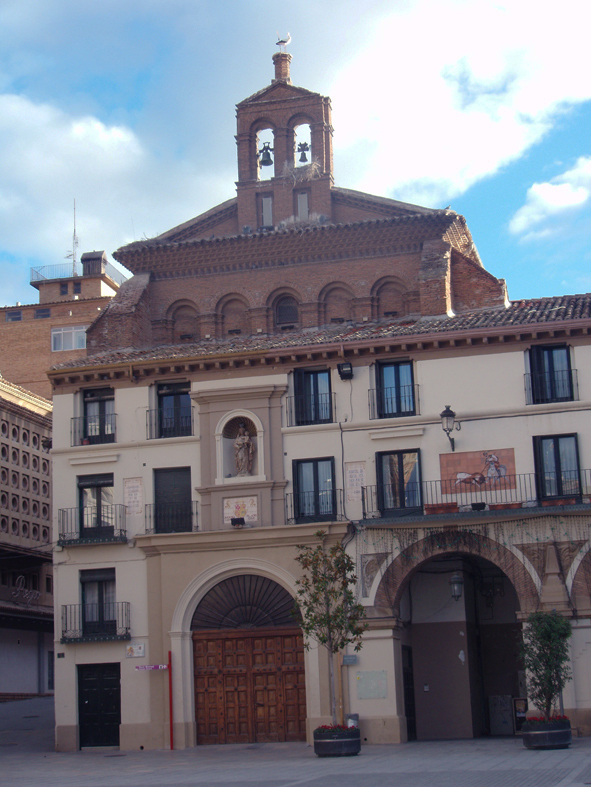
The Church of Santa María de Gracia in Tudela is a 16th-century place of worship standing on Plaza Nueva, one of the city's most distinctive squares in the Navarre region. Built as part of a hospital complex, it still carries its original Gothic-Renaissance character, pairing a plain exterior with a surprisingly rich interior.
Where does this church come from?
The story starts in the mid-1500s. In 1549, friar Miguel de Eza y Veraiz founded the Hospital de Santa María de Gracia, a charitable institution that later gained its own church on the same grounds. Construction ran from 1568 to 1572, on a plot that had previously belonged to an old Franciscan convent standing just outside the city walls — the same area now occupied by Plaza Nueva. The church was formally consecrated on 7 January 1575.
What can you actually see there?
The layout is simple but imposing: a single, tall nave without a transept, split into four bays and closed off by a pentagonal apse. The whole structure runs roughly 35 meters long — a considerable size for what was originally a hospital church rather than a cathedral.
The entrance facade dates to 1575 and was designed by Pedro Vergé and Diego Romero. It's built directly into the urban composition of Plaza Nueva, so looking at the church also means looking at one of Tudela's most attractive public squares.
Inside, the main altarpiece is the standout feature. Dating from the 17th century and executed in a late-Mannerist style, it was carved by Juan de Gurrea in 1635 following a design by Jerónimo de Estarragán. Because the altarpiece arrived decades after the building itself, it adds a second historical layer — visible proof of how later patrons kept investing in the church long after its walls went up.
How do you get there, and where exactly is it?
The church sits right in the historic center of Tudela, between Plaza Nueva and Calle Don Miguel de Eza — an easy walk from the Santa María cathedral and the rest of the old town. Its coordinates are roughly 42.0614° N, 1.6054° W. A visit pairs naturally with a walk across Plaza Nueva itself, one of the city's liveliest gathering spots.
When is the best time to visit?
Tudela sits in the Ebro valley, where summers run hot, so spring (April to June) and early autumn (September–October) are the most comfortable seasons for exploring on foot. Because this is an active parish church rather than a museum, it's worth checking local opening hours before you go, since access follows the schedule of religious services rather than fixed tourist hours.
Why stop here at all?
The Church of Santa María de Gracia isn't Tudela's headline monument — that title belongs to the cathedral — but that's exactly what makes it worth a look. It shows a different side of the city: architecture built around charity and healthcare rather than civic or ecclesiastical power. It's a natural add-on for visitors who've already seen the cathedral and want a sense of how everyday care and worship were organized in Renaissance-era Tudela.
Frequently asked questions
When was the Church of Santa María de Gracia built? Construction took place between 1568 and 1572, and the church was consecrated on 7 January 1575, as part of a hospital complex founded in 1549 by Miguel de Eza y Veraiz.
What architectural style does the building represent? It's a 16th-century example of Gothic-Renaissance architecture: a single nave, four bays, and a pentagonal apse closing off the sanctuary.
What's the most notable feature inside? The main altarpiece from 1635, carved in late-Mannerist style by Juan de Gurrea to a design by Jerónimo de Estarragán.
Where exactly is the church located? Between Plaza Nueva and Calle Don Miguel de Eza, right in the heart of Tudela, close to the old town and the Santa María cathedral.
Nearby places

Earn badges for the places you visit
Download NextOnTrip, discover new places and check off your trails.