About this place
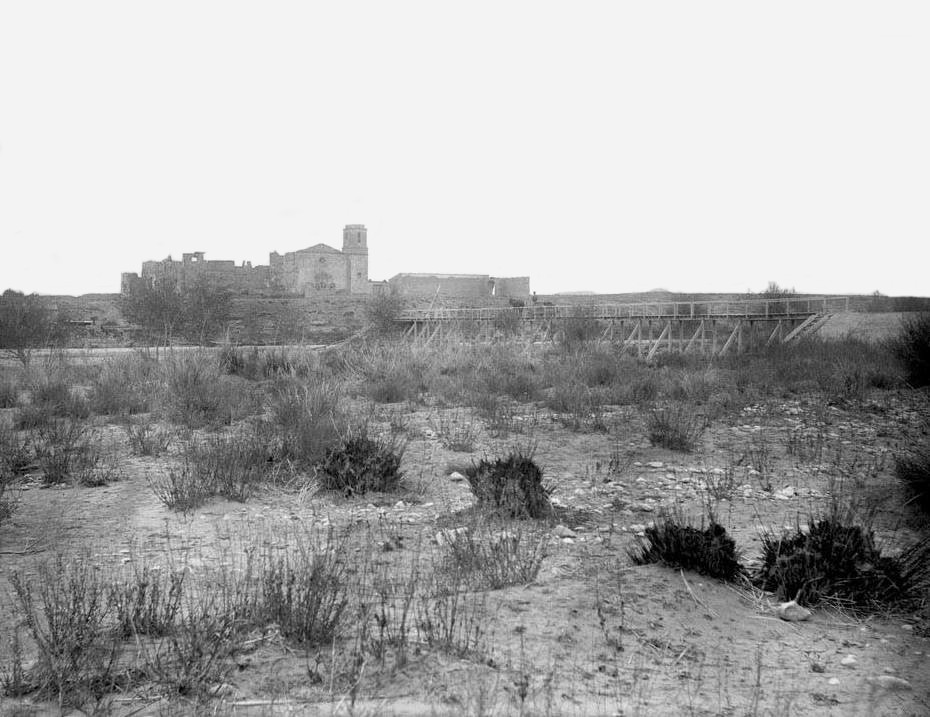
The Church of San Miguel in Fraga, popularly known as "Lo Castell" (The Castle), crowns the highest point of this town in Huesca province, right on the border between Aragon and Catalonia. Despite the castle-like nickname, the site never functioned as a fortress in the true sense — what visitors see today as "castle ruins" are actually the remains of a Gothic parish church built at the turn of the 13th and 14th centuries. The hill itself has a much older story: before the church, the site held a Muslim settlement, and before that, Visigothic and Roman occupation. These layered histories make the hilltop above Fraga one of the most interesting heritage sites in the Bajo Cinca district.
What can you see today?
A good part of the original Gothic perimeter walls survives, along with four pointed arches that once framed the church's single nave, and a fragment of a doorway with preserved moldings. The church was built as a simple masonry structure with one nave, typical of modest religious architecture in the region at the time. The grounds around the building were once enclosed by a wall and doubled as the parish cemetery.
In recent decades the ruins have been carefully restored and reimagined: a new structure designed by architect José Manuel Pérez Latorre now wraps around the old Gothic walls, protecting them while giving the site a new life as an exhibition space. The restored building reopened to the public in 2007 with a monographic exhibition dedicated to painter Miguel Viladrich.
How do you get there?
The Church of San Miguel sits on a hill overlooking Fraga's old town, an easy walk from the historic center. Fraga lies directly on the AP-2 motorway connecting Zaragoza with Lleida and Barcelona, making it a convenient stop for travelers moving between Aragon and Catalonia. The final approach to the hilltop involves a short but somewhat steep climb, so comfortable footwear is recommended.
Why is a church called a "castle"?
The building served its religious purpose until the Carlist Wars of the 19th century. Because of its strategic position — the highest point in town, overlooking the Cinca river valley — it was converted into a defensive stronghold and even used as a gunpowder store. A protective wall was added around it at that time, and fragments of that wall still stand today. It was from this period onward that locals began calling the site "Lo Castell," even though it had never truly been a castle.
The painter who moved into the ruins
One of the most unusual chapters in the building's history unfolded between 1914 and 1932, when the abandoned church became the home of painter Miguel Viladrich Vila, an artist deeply interested in the traditional culture and folk dress of Fraga. The town council granted him the building with the idea of turning it into a Museum of Customs and Costume. The project was never finished — with the outbreak of the Spanish Civil War, Viladrich went into exile in Argentina. His legacy is now honored through the permanent exhibition set up in the restored interior since 2007.
When is the best time to visit?
Spring and early autumn are ideal, since temperatures in the Cinca valley are milder than during peak summer. The hilltop offers panoramic views over the town and the surrounding farmland, making it an especially rewarding spot at sunset.
Frequently asked questions
Is it actually a castle? No — despite the popular nickname "Lo Castell," the structure is the ruin of a medieval Gothic church that only took on a defensive role in the 19th century, during the Carlist Wars.
How much does it cost to visit? The site now functions as an exhibition space run by the town of Fraga; it's worth checking current visiting conditions and opening hours with the local tourist information office.
What's worth seeing inside? The surviving Gothic arches, remnants of the perimeter walls, and a permanent exhibition on painter Miguel Viladrich, who lived here between 1914 and 1932.
How long does a visit take? Exploring the ruins and exhibition typically takes 30 to 45 minutes; allow extra time for the climb up the hill and to enjoy the panoramic views over Fraga.
Nearby places

Earn badges for the places you visit
Download NextOnTrip, discover new places and check off your trails.