About this place
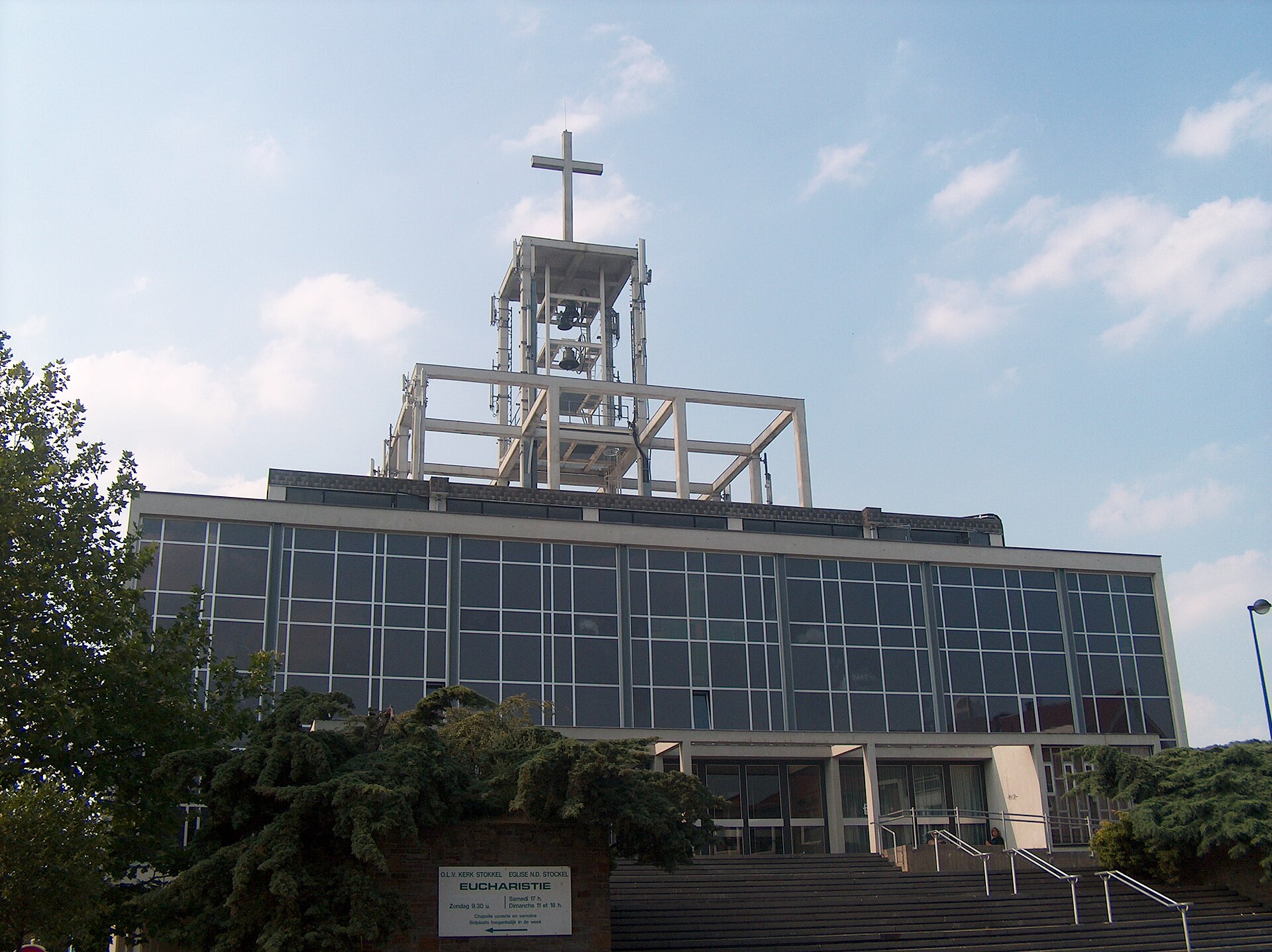
The Church of Our Lady of Stockel stands in the Stockel neighborhood of Woluwe-Saint-Pierre, one of the municipalities forming the eastern edge of Brussels. The building visitors see today, raised in glass and concrete in a distinctly modernist style, was completed and put into service in 1962, taking the place of a much older place of worship that had stood on the same spot for centuries.
Where does the name Stockel come from?
The hamlet's name reaches back to the medieval period — the earliest surviving reference to "Stocla" turns up in a document from 1154 listing estates belonging to Park Abbey, an influential Premonstratensian monastery near Leuven. At that stage Stockel was little more than a small farming settlement on the fringes of the larger towns nearby, and it gradually grew up around a local place of devotion.
How did the first chapel come about?
Records confirm that a chapel dedicated to Our Lady — sometimes referred to as the Chapel of the Visitation — already existed by 1326. This modest Gothic building became the anchor point around which the growing hamlet took shape; village life in Stockel effectively organized itself around it. Interestingly, the chapel spent a long stretch of its history as a pilgrimage destination, visited by people seeking a cure for hernias, long before it settled into its later role as an ordinary parish church serving an expanding community.
What changed after the Napoleonic reforms?
The Concordat of 1801, which reshaped the administrative structure of the Catholic Church across French-controlled territory at the time, kept the Stockel chapel under the authority of the Saint-Pierre parish of Woluwe. A few years afterward, in 1808, the chapel of Our Lady of Stockel was formally attached to the Woluwe-Saint-Pierre parish — an arrangement that would define the local church administration for a long time to come.
Why was a new church built in the 1960s?
The building that had served the community into the twentieth century actually dated from the 17th century. As Woluwe-Saint-Pierre grew rapidly in the decades following the Second World War — shifting from a quiet suburban area into a denser, more populous part of the Brussels metropolitan region — the old, small chapel could no longer keep pace with the needs of its congregation. The decision was made to construct a new church, which was consecrated and opened in 1962. Its architects turned to materials characteristic of postwar religious modernism in Belgium — glass and reinforced concrete — producing a structure that stands out sharply against the traditional brick parish churches common elsewhere in the region.
What should visitors know before stopping by?
The church sits right at the heart of the Stockel neighborhood, on a street whose name references it directly (Rue de l'Église / Kerkstraat), surrounded by the residential fabric typical of Woluwe-Saint-Pierre. The parish of Our Lady of Stockel remains active today, and the building itself functions as one of the recognizable landmarks of this part of the city — its bold modern form standing in quiet contrast to a story that stretches back to the Middle Ages.
Frequently asked questions
Is today's church the same building as the historic chapel? No. The current church dates from 1962 and replaced an earlier 17th-century building, which itself had succeeded the medieval chapel first recorded in 1326.
Why did pilgrims once visit the old chapel? For a long period the site was regarded as a pilgrimage destination associated with the healing of hernias, before it settled into its later function as a straightforward parish church for the growing village.
What architectural style was used for the current building? The 1962 church was built from glass and concrete, materials typical of the postwar modernist approach then common in Belgian religious architecture.
Since when has Stockel belonged to the Woluwe-Saint-Pierre parish? The formal attachment dates from 1808, although administrative dependence on the Saint-Pierre parish of Woluwe already existed earlier, under the terms of the 1801 Concordat.
Nearby places

Earn badges for the places you visit
Download NextOnTrip, discover new places and check off your trails.