About this place
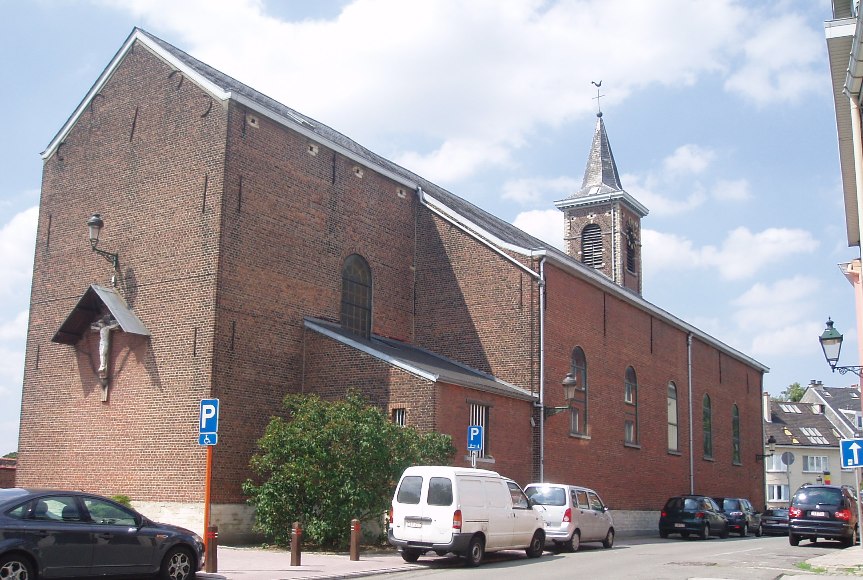
The Church of St. Anne in Auderghem (Dutch: Oudergem) is a modest neoclassical parish church that served for sixty years as the only church in this Brussels municipality. It stands on a site once known as Schietheyde, in the district that later took its name — Sainte-Anne/Sint-Anna.
Why was the church built?
At the start of the 19th century, the residents of Auderghem belonged to the parish of Saint-Clément in neighboring Watermael-Boitsfort, and the local community was served only by a small chapel dedicated to St. Anne. As population grew along the main road, that chapel became too small. In 1843, at the request of local residents, an independent parish was established and a larger church building was raised — the first parish located within Auderghem itself. The design was drawn up by Louis-Jacques Spaak (1804–1893), architect for the province of Brabant.
What does the building look like?
The church is a deliberately austere structure in the neoclassical style, built of red brick on a stone base. The main façade is topped with a small square tower and decorated with two stone statues set into niches with round arches. Its simplicity sets it apart from more ornate churches of the period — the architect favored restraint over decorative excess.
What can visitors see inside?
The interior houses two striking baroque side altars, made of wood covered in marble, dating from the second half of the 18th century. They arrived at Sainte-Anne in 1875, having originally stood in the celebrated Notre-Dame du Sablon collegiate church in central Brussels. These altars are the most valuable furnishings in the building and form a clear contrast with the plain neoclassical architecture surrounding them.
The church also holds two organs. The older, neoclassical instrument was commissioned in 1871 from organ builder Henri Vermeersch. Owing to its historical and artistic value, it was formally protected by a decision of the Brussels-Capital Region on 22 December 2005. A second instrument, located in the right transept, dates from 1983 and was built by Jan Boon; the two organs are used alternately during services.
What role does it play in the neighborhood?
The church lent its name to the surrounding district, known as Sainte-Anne d'Auderghem or Vieux Sainte-Anne. This part of the municipality has kept a more village-like, intimate character that contrasts with the more urbanized areas of Auderghem elsewhere. Since 2005 the church has been listed as a protected monument by the regional authorities, underscoring its recognized historical and artistic significance for the local heritage.
Frequently asked questions
When was the Church of St. Anne in Auderghem built? The current building dates from 1843, replacing an earlier chapel of the same name that had become too small for the growing parish.
Who designed the church? It was designed by Louis-Jacques Spaak, architect for the province of Brabant, who lived from 1804 to 1893.
What is the most valuable feature inside the church? Two baroque side altars from the second half of the 18th century, moved here in 1875 from the Notre-Dame du Sablon church in central Brussels.
Is the church officially protected as heritage? Yes, its historic 1871 organ was formally granted protected status in 2005, reflecting the recognized heritage value of the building as a whole.
Nearby places

Earn badges for the places you visit
Download NextOnTrip, discover new places and check off your trails.