About this place
The Chapel of the Calvary sits on a hillside above L'Ènova, a small town in the Valencia region of Spain. The site brings together a hermitage and a row of wayside chapels marking the Stations of the Cross, making it one of the town's most recognisable historic and scenic spots.
How do you get to the Chapel of the Calvary?
L'Ènova lies in the province of Valencia, close to the Albaida river. The Calvary stands on rising ground at the edge of the built-up area, near coordinates 39.044144, -0.483481, and is reachable on foot from the town centre in roughly fifteen minutes, or by a short drive. Part of the approach follows the Senda Històrica Paisatgística, a local heritage trail that links L'Ènova's main historic sites, so visitors often combine the Calvary with other stops along the way.
What will you see there?
The complex is made up of two parts: the hermitage itself, known as the Ermita del Salvador, and a series of small wayside shrines (casalicis) that mark the Stations of the Cross leading up the hill. The hermitage has a Greek-cross floor plan and is built of masonry and tile, with its interior covered by a dome resting on pendentives. A small bell tower rises above the facade. Building material from the remains of an old medieval, Andalusian-era castle that once stood on the same hill — the Yénova castle — was reused in its construction, so traces of that earlier fortress are effectively embedded in the chapel's walls.
The Calvary was built at the turn of the 20th century, between 1897 and 1900, on the initiative of the parish priest Romà Quilis. Residents raised it as an act of thanks to the Holy Christ of Health (Sant Crist de la Salut) for the end of the cholera epidemic that had struck the town in 1885. Construction was financed through alms collected during rosary processions held in the streets of L'Ènova — the townspeople effectively paid for the whole complex themselves, coin by coin. An existing Way of the Cross was adapted at the same time and folded into the new layout.
Today the Calvary is registered on the local heritage inventory as a Property of Local Relevance (Bé de Rellevància Local) and forms one of the stops on L'Ènova's Historical-Landscape Trail.
When is the best time to visit?
Because the site sits on an exposed hillside with little shade along the path, spring and autumn are the most comfortable seasons for the walk up. In summer, the middle of the day can get hot, so early morning or late afternoon visits are more pleasant. The Calvary is open year-round, free of charge, and needs no booking — it's a site you can drop into whenever you pass through.
Who is this place for?
The Chapel of the Calvary suits travellers interested in the local history and religious architecture of the Valencia region, as well as anyone looking for a short, quiet walk with a good viewpoint. It isn't a crowded headline attraction — rather a modest, still-living devotional site that reflects the town's own history.
Frequently asked questions
Is there an entrance fee for the Chapel of the Calvary? No, it is a public site and free to visit at any time.
How long does it take to walk up from the town centre? Around fifteen minutes on foot from central L'Ènova, depending on your starting point.
Why was the Calvary built on this particular hill? The hill had previously held the old Yénova castle, and material from its remains was reused to build the hermitage.
Does the hermitage still hold religious services? The site is primarily a devotional and historic landmark, originally raised to mark the end of the 1885 cholera epidemic; today it functions mainly as a heritage site and stop on the local trail.
Nearby places
-

Ermita de Santa Anna, Xàtiva
la Llosa de Ranes
-
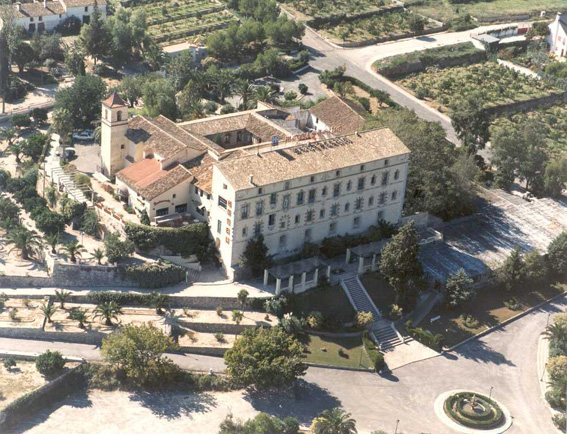
Monestir de Santa Maria d'Aigües Vives
Carcaixent
-
Monastery of la Murta
Alzira
-
Ermita dels Sants de la Pedra de Cullera
Cullera
-
Convent of the Handmaids of the Sacred Heart of Jesus
Benirredrà
-
Església de Sant Pasqual Bailón de Benissili
la Vall de Gallinera
Earn badges for the places you visit
Download NextOnTrip, discover new places and check off your trails.