About this place
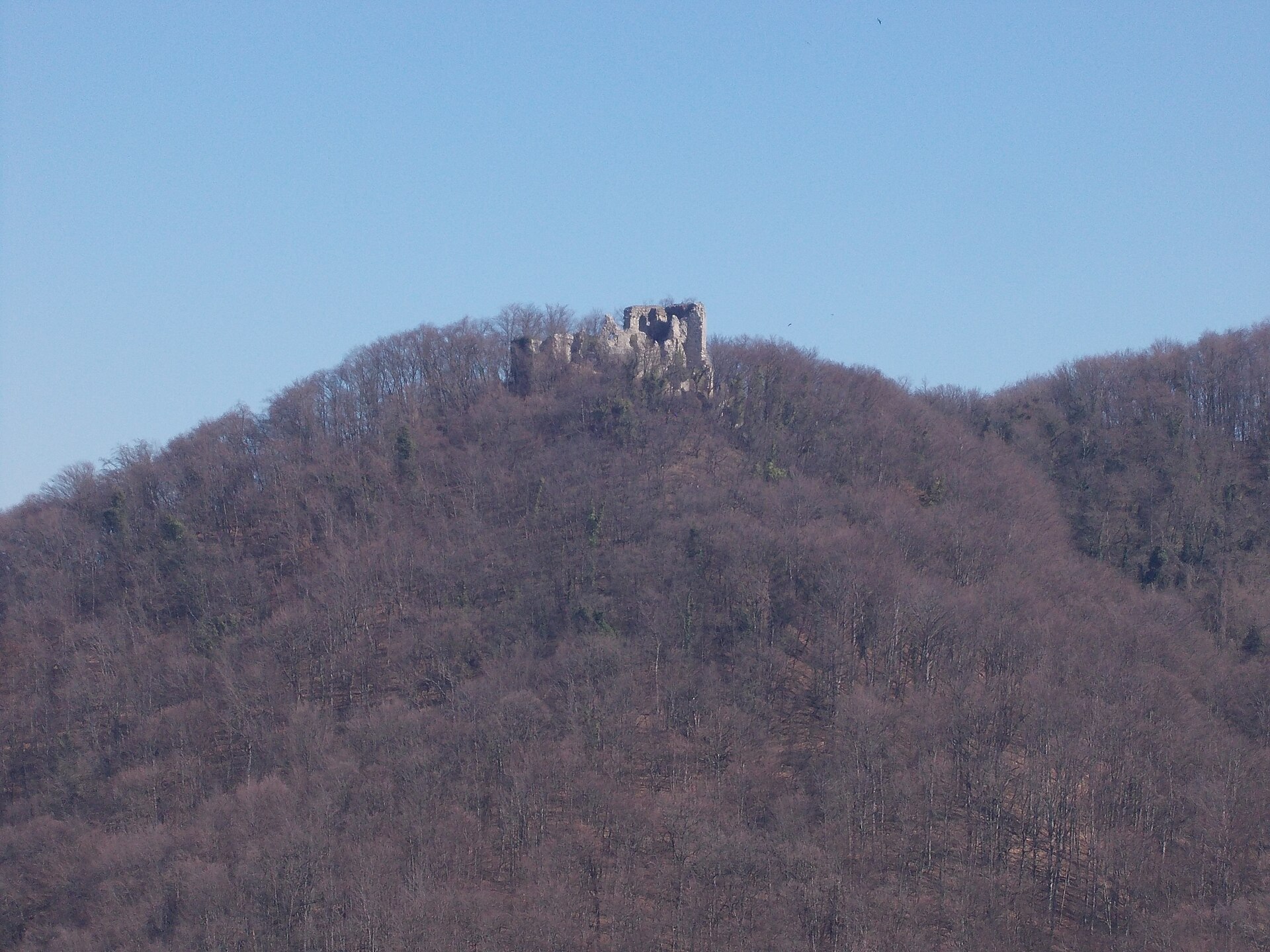
Cesargrad is a medieval castle in northwestern Croatia, in Krapina-Zagorje County, in the Hrvatsko Zagorje region. It stands northwest of the small town of Klanjec, on the Sutla River, right at the Slovenian border. Today it is a sprawling permanent ruin and one of the larger fortresses in the country.
Where is Cesargrad?
The castle sits in hilly borderland in the Sutla valley, where the river marks the Croatian-Slovenian frontier. The nearest town is Klanjec, associated with Antun Mihanović, who wrote the lyrics of the Croatian anthem. The site lies at roughly 46.06 N, 15.72 E. The easiest way to get here is by car from Klanjec or from Zagreb through Hrvatsko Zagorje.
What is the history of the castle?
The earliest reliable mention dates to 1399. King Sigismund of Luxembourg then granted the county of Zagorje to Herman II, Count of Celje, together with an already existing castle at the heart of the largest estate in the area. Nothing visible survives from the period before the Counts of Celje, so without archaeological excavation it is hard to say what the original building looked like.
After the Celje family died out in 1456, the castle passed between a series of owners from Styria and Slavonia. By the end of the 15th century it belonged to the Erdődy family.
What happened in 1573?
On 29 January 1573, during the Great Peasants' Revolt, the castle was attacked, seized and burned. It was rebuilt soon afterwards. The episode is among the best-known moments in its past and part of the wider story of the uprising in northern Croatia.
How did the Erdődys expand the castle?
Under the Erdődys the complex was enlarged considerably and the old core was thoroughly rebuilt. Cesargrad counts among the largest castles in Croatia and has some of the strongest defensive structures in the country, with walls more than seven metres thick. Toma Erdődy built a new residence, Novi Dvori, in 1603. Despite renovation, the castle is again described as a ruin in the early 17th century.
Has the site been researched?
Yes. The Croatian Conservation Institute carried out archaeological work in 2008 and 2010. It confirmed the site's research potential and allowed documentation of its present condition to begin. For visitors this means the place is still being uncovered, and further conservation depends on later stages of work.
Frequently asked questions
Where exactly is Cesargrad? Northwest of Klanjec, on the Sutla River at the Slovenian border, in Krapina-Zagorje County.
What period is the castle from? The first reliable mention is from 1399, when it belonged to the Counts of Celje. An earlier origin is not confirmed by documents.
Who owned the castle? First the Counts of Celje, after 1456 a succession of Styrian and Slavonian owners, and from the late 15th century the Erdődy family.
Is the castle a ruin? Yes, it is a sprawling ruin that was archaeologically investigated in 2008 and 2010.
What else is worth seeing nearby? Klanjec and its links to Antun Mihanović, plus other castles and small towns of Hrvatsko Zagorje.
Nearby places

Earn badges for the places you visit
Download NextOnTrip, discover new places and check off your trails.