About this place
The Gouffre de Réveillon (Cave of Réveillon) sits roughly two kilometres east of Alvignac, a small village in the Lot department of Occitanie, only a few kilometres from the famous clifftop town of Rocamadour. It belongs to the dense karst landscape of the Quercy region, where a limestone plateau hides networks of passages, shafts and underground rivers beneath a dry, rolling surface.
What kind of cave is this, exactly?
Réveillon isn't a show cave in the usual sense — the French word "gouffre" describes a vertical or steeply sloped karst sinkhole, a point where surface water disappears underground. It was carved into Jurassic limestone by the Salgues stream, which collects runoff from a small catchment a few kilometres east near Alvignac before vanishing into the ground at this exact spot. That pattern is the signature of Quercy karst: rivers run on the surface, suddenly sink from view, and often resurface several kilometres away as a spring.
Speleologists divide the system into three zones: an active section where the stream still flows, a semi-active section that floods only at certain times, and a fossil section that is now permanently dry. The layout traces how the underground river has shifted course over thousands of years of erosion.
What's inside?
The entrance, on the left bank of the stream just above a small waterfall, opens into a narrower, maze-like network known as the "new Réveillon". Its best-known feature is a twelve-metre shaft dropping to the lowest known point of the system; beyond it, a tight passage leads to the so-called Salle du Livre (Book Room), a chamber partly choked by a rockfall and named for the layered, page-like structure of the rock exposed on its walls.
This is a destination for trained cavers, not casual sightseers — the passages are narrow, partially obstructed, and require caving gear and experience to negotiate safely.
How do you get there, and can you visit?
Unlike the nearby Gouffre de Padirac, the Réveillon system is not developed for tourism. Access underground is restricted and requires prior permission, and exploration is carried out mainly by local caving clubs. For an ordinary visitor, the real draw is the surrounding countryside — the dry valleys, oak woodland and limestone plateaus typical of Quercy — best explored from a base in Alvignac or Rocamadour, both of which sit on marked hiking trails through the area.
A short history
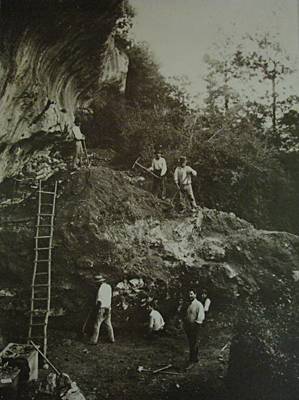
The Réveillon system has been explored since the late 19th century. Édouard-Alfred Martel, a pioneer of French speleology, is among the earliest documented explorers of the site, working here around 1890 as part of his broader survey of Quercy's karst, which also included the neighbouring Gouffre de Padirac. Successive generations of cavers have since returned to map further galleries, including the "new Réveillon" network described above.
When's the best time to visit the area?
Because the cave itself is off-limits to general visitors, timing a trip really means timing a walk in the surrounding countryside. Spring and autumn bring the mildest weather in the Lot, while summer can turn hot and dry across this part of southern France. The Salgues stream is at its most visible after rain, outside the driest summer weeks.
Frequently asked questions
Can you tour the Gouffre de Réveillon like a regular show cave? No. It has no visitor trail or facilities — access is largely limited to caving clubs with permission from the landowner.
How is Réveillon different from the Gouffre de Padirac? Padirac is a large, commercially developed system with lifts and boat rides for tourists. Réveillon is a smaller, undeveloped karst sinkhole studied mainly for its geology and explored by cavers.
Where does the water in the cave come from? It's the Salgues stream, which flows on the surface for a few kilometres from around Alvignac before disappearing underground at the gouffre — a classic sinking-stream pattern seen across the Quercy karst.
What's the best way to plan a visit nearby? Base yourself in Alvignac or Rocamadour and combine a walk through the local countryside with a visit to one of the region's larger show caves, such as the Gouffre de Padirac.
Nearby places

Earn badges for the places you visit
Download NextOnTrip, discover new places and check off your trails.