About this place
Castillo de Luesia is a medieval fortress overlooking the town of Luesia in the province of Zaragoza, Aragon. Its ruins sit on a narrow rocky ridge roughly 46 metres long, visible from a distance as you approach the town.
How do you get there?
Luesia lies in the northern part of Zaragoza province, in the foothill belt of the Pyrenees, within the Cinco Villas region. Reaching it by car means following local roads that connect Cinco Villas with the rest of Aragon, with Ejea de los Caballeros as the nearest larger town. The castle itself stands on a hill right above Luesia's built-up area, so from the town centre it's a short but steep walk up to the ruins.
What is the history behind it?
The fortification's origins trace back to the Muslim frontier era, when the site was known as Hisn Lawuasa. By 911 it already belonged to Sancho I, king of Navarre, who repaired and strengthened it. What survives today, however, is generally attributed to a later rebuilding under Sancho el Mayor (Sancho III), the eleventh-century ruler of Navarre.
The settlement itself was repopulated in 1125 on the order of Alfonso I the Battler, and shortly afterward granted to the monastery of San Juan de la Peña. In 1247, King James I gave the castle to Lope Jiménez de Luesia in exchange for several farmsteads in Mallorca, and by 1261 it belonged to Johannes de Grimons. In the fifteenth century it passed to the Fernández de Heredia family, and in the sixteenth century to the archbishops of Zaragoza. The castle therefore served not only a military role but also administrative and ecclesiastical functions, changing hands as the region's fortunes shifted.
What will you actually see on site?
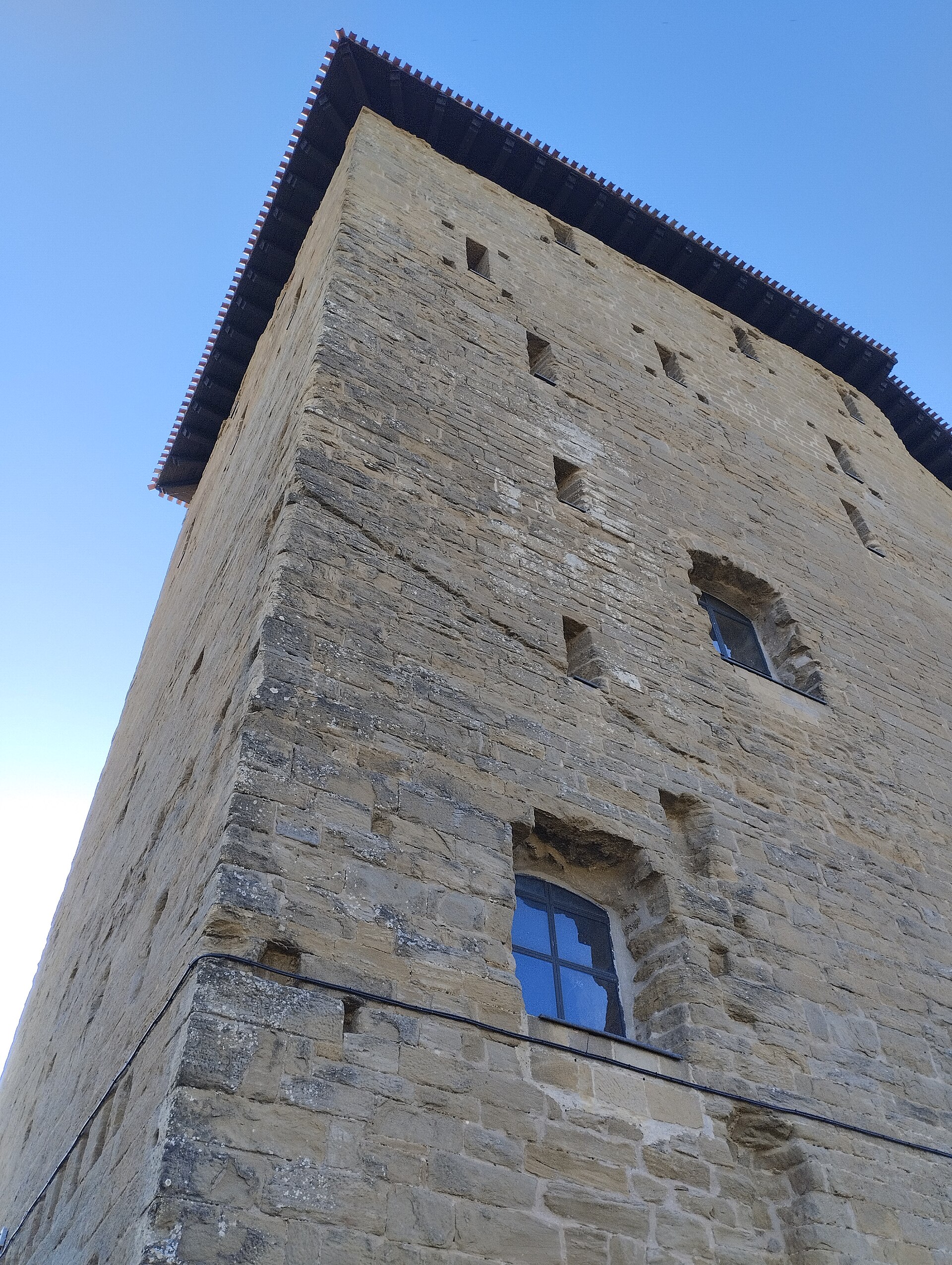
Little survives from the original layout. The castle consisted of two defensive enclosures at different heights, of which the upper one remains only in fragmentary traces. The best-preserved element is a tower at the eastern end of the ridge — pentagonal on the outside and trapezoidal inside. Built from well-cut ashlar masonry, it originally rose four storeys, a fact evident from the surviving notches that once supported floor beams.
The tower has lost its battlemented top, but its entrance survives as a round arch, with a window set above it and several arrow slits used for defence. The whole site is today in a ruined state, though consolidation work carried out in 2004 and 2005 helped secure the walls against further decay. The castle is listed among Aragon's assets recognised as Bien de Interés Cultural.
When is the best time to visit?
Given its exposed, rocky setting, spring or autumn are the most comfortable seasons to visit, when temperatures in Cinco Villas are milder — summer heat on the open ridge can be draining, and the steep, stony climb is best tackled in sturdy footwear. From the viewpoint by the tower, the panorama takes in Luesia and the rolling foothill landscape of the Pyrenees.
Frequently asked questions
Is entry to the castle free? Yes, the ruins are freely accessible as part of Luesia's landscape — there is no ticket office or entry fee.
How long does a visit take? Walking up to the tower and around the remaining walls typically takes 30 to 60 minutes, depending on your pace and how long you linger over the views.
Can you go inside the tower? The tower is ruined and missing its upper battlements, so visits are limited to viewing it from outside and through its entrance openings — caution is advised.
Are there other sights worth seeing in Luesia? Yes, the town retains medieval-era streets and churches that pair well with a visit to the castle as part of a wider stop in Cinco Villas.
Nearby places

Earn badges for the places you visit
Download NextOnTrip, discover new places and check off your trails.