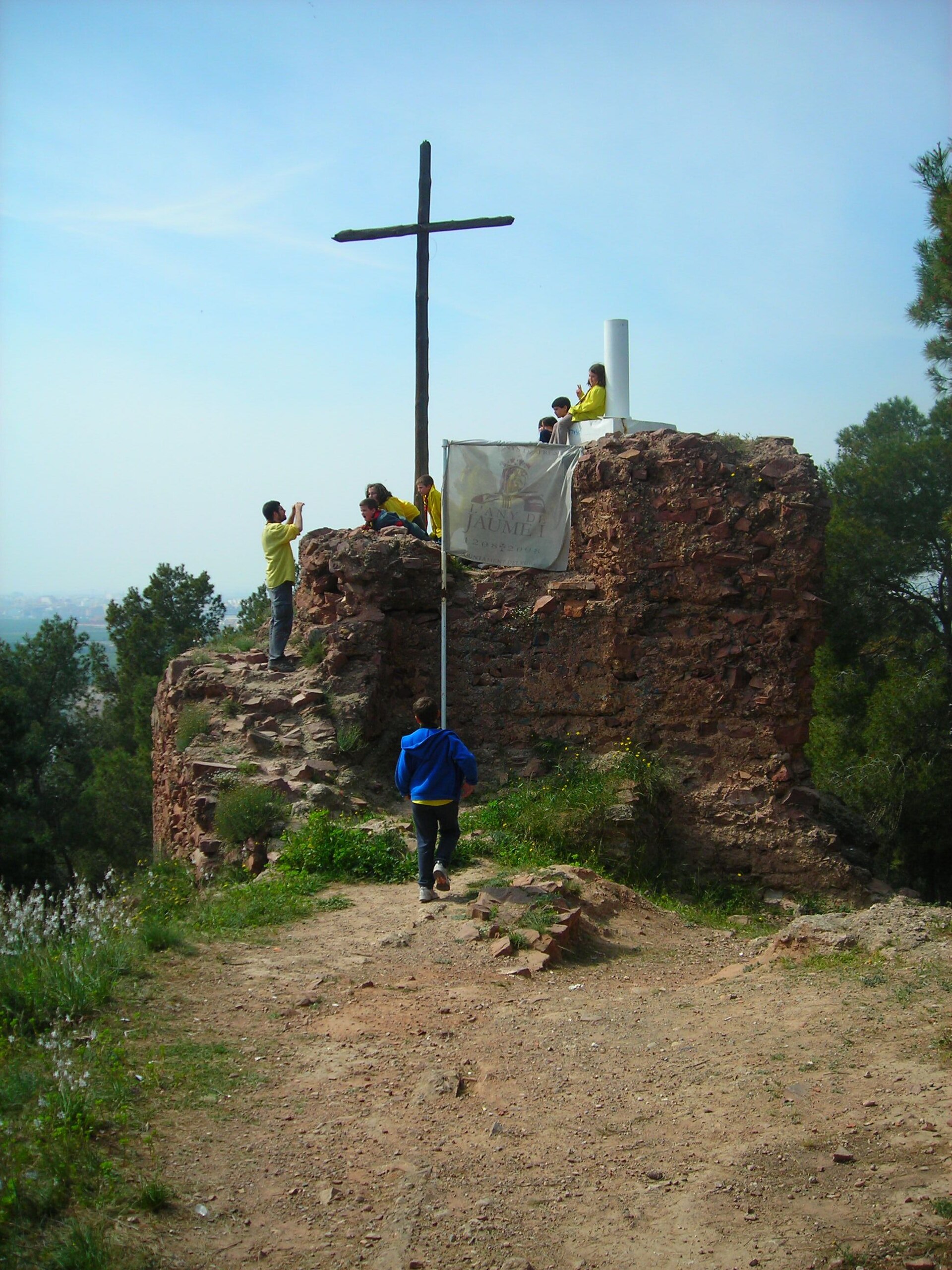
About this place
Castell del Puig is the ruined medieval castle standing on the hill above El Puig de Santa Maria, a small town roughly fifteen kilometers north of Valencia. Little remains today beyond scattered wall fragments, yet this hilltop was the exact spot from which King James I of Aragon (Jaume I) planned the conquest of Muslim Valencia — making it one of the pivotal sites in the region's history.
Where did the fortress on the hill come from?
Arab settlers first fortified the hill in the 11th century. In 1093 the castle was captured by El Cid, who rebuilt it, reinforced its defenses, and surrounded it with a walled village — one episode in the turbulent struggle for control of Spain's eastern coast during that era. After El Cid's death the stronghold reverted to Muslim hands and spent the following centuries guarding the northern approach to Valencia. It was also known by the names Castell de Yubayla and Cebolla, from the Arabic Enesa.
What role did the castle play in the conquest of Valencia?
After conquering Mallorca in 1229, James I set his sights on Valencia and identified the hill of Puig as the ideal staging ground for the campaign. Zayyan, the Muslim ruler of Valencia, recognized the strategic value of the fortress and had it demolished to keep it out of Christian hands. James I pressed ahead regardless: in late April 1237 he sent troops to rebuild the castle on the hill, and command of the garrison, in the king's absence, fell to his uncle Bernat Guillén d'Entença.
It was in this same area that the Battle of Puig (also called the Battle of Enesa) took place — an engagement that tipped the campaign decisively toward the Christian forces and opened the road to the capture of Valencia itself in 1238. The fortress on the hill of Puig is regarded today as one of the true turning points of the entire campaign.
What happened to the castle afterward?
The fortress did not survive intact for long. In 1365, King Peter IV of Aragon ordered it torn down, likely for strategic reasons tied to conflicts of the time on the Iberian Peninsula. From then on, only ruins remained on the hilltop. In 2002 the site was granted Bien de Interés Cultural (BIC) status, Spain's designation for heritage assets of special historical significance.
In 2026, marking the 750th anniversary of James I's death, the Diputación de Valencia awarded the municipality of El Puig de Santa Maria 100,000 euros to fund restoration work on the castle remains — an investment intended to bring out the site's potential as a cultural and historical attraction.
How to get there and when to visit?
El Puig de Santa Maria sits only about fifteen kilometers from Valencia, so the easiest way to reach it is by car or local commuter train, since the town lies along the main route linking Valencia and Sagunto. The castle hill rises above the town, offering sweeping views over the surrounding plain and the nearby Mediterranean coast. Spring and autumn are the best times to visit, when temperatures are milder than in high summer — a walk up the hill, modest as the remaining walls are, still traces the story of one of the Reconquista's defining moments.
Frequently asked questions
What remains of the castle on the Puig hill? Mostly wall fragments and remnants of the fortifications survive today — the fortress was demolished on the orders of Peter IV of Aragon in 1365.
Why does this castle matter so much in Valencia's history? It was from here that James I planned and carried out the conquest of Muslim Valencia, and the Battle of Puig fought nearby in 1237 opened the way to the city's capture in 1238.
What was the castle called before? It was also known as Castell de Yubayla and Cebolla, names dating back to the Muslim period (from the Arabic Enesa).
Is the castle currently being restored? Yes — in 2026, on the 750th anniversary of James I's death, the municipality received 100,000 euros from the Diputación de Valencia to restore the remains of the fortress.
Nearby places

Earn badges for the places you visit
Download NextOnTrip, discover new places and check off your trails.