About this place
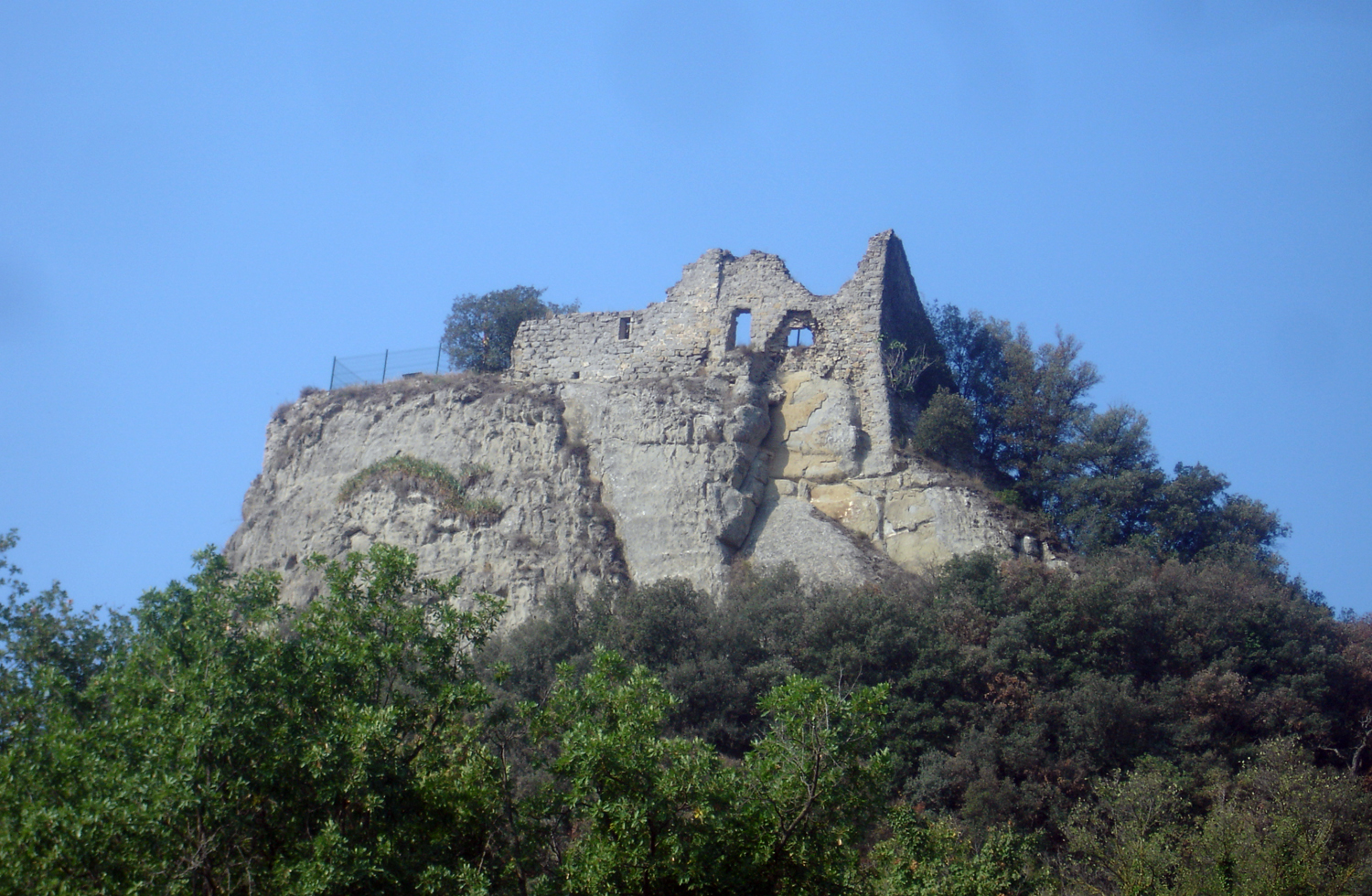
Castell de Duocastella is a medieval fortress ruin in the municipality of Sora, in the Osona comarca of Catalonia. Also known as Castell de Boixader, it is listed as a Cultural Asset of National Interest (Bé Cultural d'Interès Nacional) and ranks among the most evocative historical remains of the Bisaura region.
How do you get there?
The ruins sit roughly 4 km north of the village of Sora, crowning a hilltop that rises to 952 metres above sea level. The site is reached on foot along a trail that climbs from the village through the pastures, woods and rocky slopes typical of this Pre-Pyrenean landscape. The approach is genuinely uphill, so sturdy footwear and water are worth carrying, especially in the summer months.
What will you see on site?
What remains of the old stronghold are foundations and low courses of wall, tracing the outline of a large fortified enclosure that once ringed almost the entire hilltop. On the south-western side, a section resembling a tower survives, with an opening in the wall that looks like an arrow slit. The castle can no longer be reconstructed in full, but the layout of what remains still conveys the scale of the original fortification.
Beyond its historical interest, the summit is a natural viewpoint, opening onto the hills and valleys of the Bisaura, one of Osona's quieter and more scenic corners.
What is the history behind it?
Castell de Duocastella is first documented in 1023, when Countess Ermessenda pledged it, together with several other castles, to her son Berenguer Ramon I, Count of Barcelona. The Duocastella family, which gave the castle its name, is recorded from 1109 as comital vassals holding lordship over it.
The role of castellan was held first by the Joanet family, and later, through marriage, by the Sant Agustí family. Lordship of the castle subsequently passed to the Freixenet family and then to the Manlleu family. In 1224, the Manlleu ceded all rights over the fortress to the Order of the Hospital (the Knights Hospitaller), closing the most significant chapter of the site's medieval history.
When is the best time to visit?
The ruins stand in open countryside and are accessible year-round, though spring and autumn offer the best conditions for the hike and for enjoying the views, with milder temperatures than the height of summer. In winter, the climb can be more demanding given the altitude and mountainous character of the Bisaura region.
Frequently Asked Questions
What is Castell de Duocastella? It is the ruin of a medieval defensive castle in the municipality of Sora, also known as Castell de Boixader, recognised as a Catalan Cultural Asset of National Interest.
How do you reach the ruins? The castle stands atop a hill (952 m) about 4 km north of Sora. It is reached via a walking trail that climbs from the village.
What has survived of the castle? Foundations and low sections of the perimeter walls, along with a tower-like remnant featuring an arrow-slit-like opening on the south-western side.
Where does the castle's name come from? From the Duocastella family, documented from 1109 as comital vassals who held lordship over the fortress.
Nearby places

Earn badges for the places you visit
Download NextOnTrip, discover new places and check off your trails.