About this place
Casa da Fonte stands in O Castro de Ferreira, part of the parish of Ferreira de Pantón in the municipality of Pantón, Lugo province, Galicia. Listed among Galicia's civil heritage sites as a casa grande — a former manor house — the property sits right at the heart of Ribeira Sacra, the terraced-vineyard canyon country carved by the Sil and Miño rivers.
How do you get there?
Pantón lies roughly an hour's drive from both Lugo and Ourense, reached via the winding local roads that thread through Ribeira Sacra's vineyard slopes. What makes the location genuinely notable is that a stretch of the Camino de Invierno — the "Winter Way," a historic branch of the Camino de Santiago — runs directly through the property. Medieval pilgrims used this lower route along the Sil valley to avoid the snowbound mountain pass at O Cebreiro, and today it still serves walkers and cyclists tracing the same path.
What will you actually see?
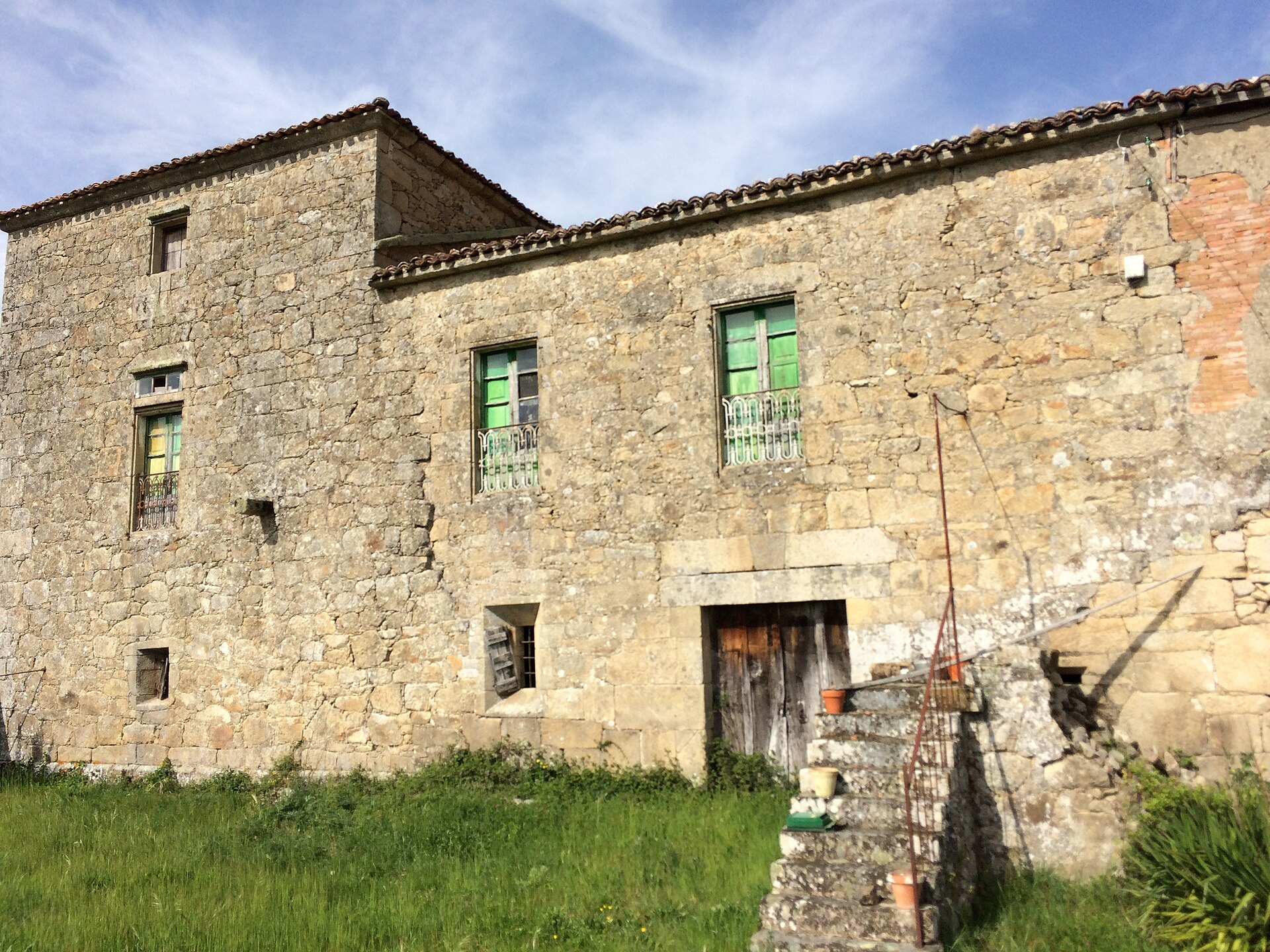
The main house was restored in 2015 and now operates as a rural guesthouse, built in the solid stone style typical of the area, with thick granite walls and a traditional pitched roof. Standing beside it is a far less fortunate structure: the estate's old adega, a wine cellar built in 1756 — the date is carved into a stone shield above the entrance. This two-storey granite building, roughly 19.7 by 7 metres, was constructed from dressed ashlar stone with rounded corner blocks, with a smaller annex later attached to the main volume.
Today the cellar is a ruin. Its roof and upper floor have collapsed, though the walls — up to 7 metres tall in places — still stand, along with a slender column that once supported the entrance portico. Because of the risk that this column could give way entirely, the building was added to Spain's Red List of Endangered Heritage (Lista Roja del Patrimonio) in March 2020; it carries no formal legal protection, leaving its long-term survival uncertain. For visitors, that means a rare chance to see nearly three centuries of unrestored wine-making architecture up close, before it deteriorates further.
When should you visit?
Spring and autumn are the best seasons for Ribeira Sacra, with mild temperatures and the region's most dramatic scenery — come autumn, the terraced vineyards turn deep red and gold, drawing photographers and wine tourists alike. Summers can run hot in the river valleys, while winter brings damp, misty conditions, the same conditions medieval pilgrims were trying to dodge by taking this lower route instead of the mountain pass. It's worth pairing a visit with the nearby monasteries and viewpoints overlooking the Sil canyon, all within easy reach.
Frequently asked questions
Can you go inside Casa da Fonte? The main house functions as a private rural guesthouse rather than a public attraction. The ruined 1756 wine cellar next to it, however, can be viewed from outside as part of Ferreira de Pantón's historic landscape.
What exactly is the adega next to the house? It's the estate's former wine cellar, built in 1756 from dressed granite. It now stands roofless and partly collapsed, and has been placed on Spain's national list of at-risk heritage sites due to the danger of further collapse.
Why does the Camino de Invierno pass through here? The Winter Way was developed as an alternative to the high mountain crossing at O Cebreiro. Pilgrims traveling in winter took this lower path through the Sil valley instead, passing directly through the Pantón and Ferreira area.
What else is worth seeing nearby? Ribeira Sacra offers terraced vineyards, viewpoints over the Sil and Miño canyons, and Romanesque monasteries, all reachable within a short drive from O Castro de Ferreira.
Nearby places

Earn badges for the places you visit
Download NextOnTrip, discover new places and check off your trails.