About this place
The Cárcel Eclesiástica in Coria is an 18th-century former ecclesiastical prison tucked away on Calle Oscura, one of the narrow shaded streets of the town's old quarter. It's easy to walk past without noticing it, yet the building tells a distinctive story about the judicial power once held by the bishops of Coria and how the Church policed its own within this corner of Extremadura.
What was an ecclesiastical prison?
For centuries, the Diocese of Coria held its own judicial authority separate from civil courts. Clergy and others who fell under canon law and committed offenses weren't sent to the town's regular jail — they were held instead in a dedicated ecclesiastical prison, a building where, as local tradition puts it, "lack of faith" and breaches of church discipline were atoned for.
Who built it, and when?
The prison was commissioned by Juan José García Álvaro, Bishop of the Diocese of Coria from 1750 to 1783, remembered locally as a generous patron of building works across the town. Construction is dated to 1760. Historians note it may have been rebuilt on the site of earlier ecclesiastical prisons, since the practice of holding clergy in a separate lockup in Coria likely predates this particular structure — the 18th-century building may simply be the latest version of a function the site had served for some time.
What does the building look like today?
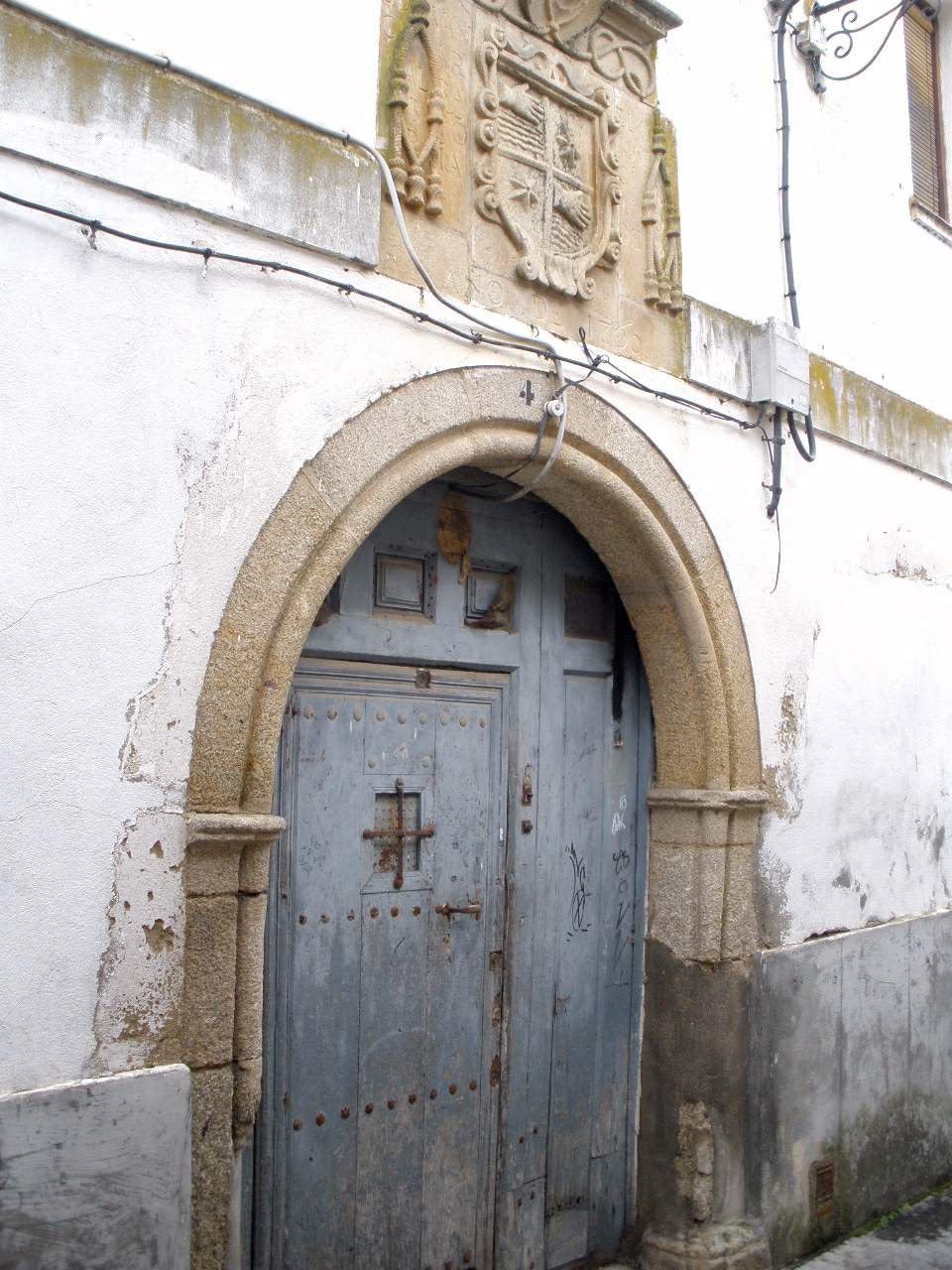
The Cárcel Eclesiástica stands on the narrow Calle Oscura — literally "Dark Street," a name that fits the shadowed character of this part of the old town. The building rises over two floors, whitewashed on the outside in the manner typical of Extremaduran architecture of the period. Stone is used sparingly and only where it matters structurally or visually: on pilasters, corners, window and door surrounds, the entablature, and the entrance.
The entrance is the building's clear focal point — an oversized semi-circular arch cut in fine ashlar masonry. Above it sits the coat of arms of its patron, Bishop García Alvarado, together with the date of construction, which is how historians have been able to tie the building precisely to this bishop and this year. The façade has been altered significantly over the centuries, but it still preserves enough of its original fabric to reveal the Baroque character of the 18th-century design.
Can you visit inside?
The building survives today mainly as a piece of the town's historic streetscape — its exterior, with the arched portal, coat of arms and whitewashed walls, is the main reason to seek it out on a walk through Coria's old center. It sits well within a walking route that also takes in the cathedral and the nearby Museo de la Cárcel Real (Royal Prison Museum), which is easy to confuse with this building because of the similar name but is, in fact, a separate site with a different history and purpose.
Frequently asked questions
What's the difference between the Cárcel Eclesiástica and the Cárcel Real in Coria? They are two distinct buildings. The Cárcel Real (Royal Prison) fell under civil authority and today operates as a town museum. The Cárcel Eclesiástica answered to the bishop and the diocese, and was reserved for cases under canon law.
When was the building constructed? It is attributed to Bishop Juan José García Álvaro, with construction dated to 1760 — a date recorded in the inscription beneath the coat of arms above the entrance.
Where exactly is it located? On Calle Oscura, within Coria's historic center, a short walk from the cathedral and the town walls.
Can you go inside the building? The main draw is the exterior architecture — the arched portal, the coat of arms, and the whitewashed façade — rather than an interior visit, since the building does not operate as a museum.
Nearby places

Earn badges for the places you visit
Download NextOnTrip, discover new places and check off your trails.