About this place
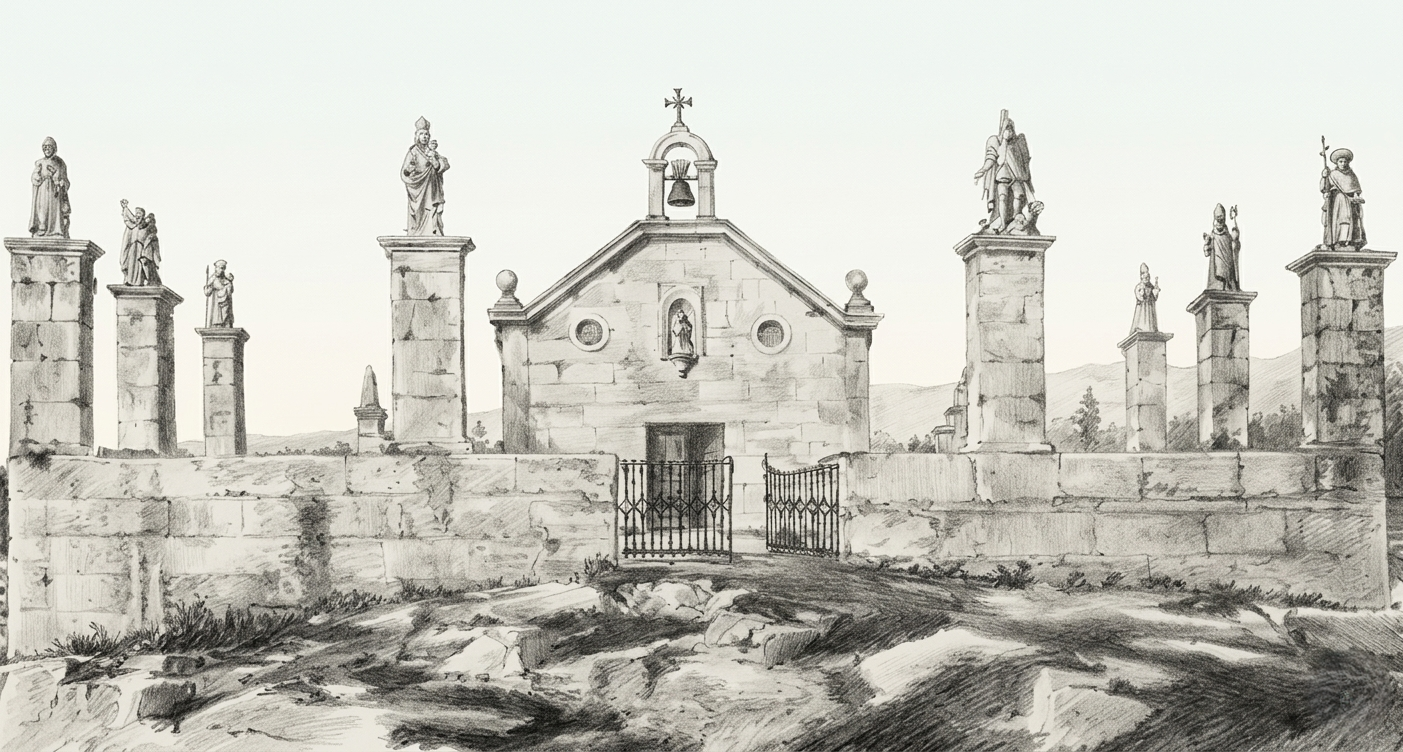
San Miguel de Tambo Chapel stands on the island of Isla de Tambo (Illa de Tambo in Galician), set in the middle of the Ría de Pontevedra within sight of the Marín shoreline. Behind its modest stone walls lies nearly a millennium and a half of religious history, shaped by monks, hermits, pirates and sailors.
How did religious life on the island begin?
The island's sacred story reaches back to the 6th century, when Martín de Dumio, a bishop central to the Christianization of Galicia, founded the first place of worship here. A century later, Fructuoso de Braga turned the foundation into a Benedictine monastery, which eventually became a priory dedicated to Santa María de Gracia, the Virgin of Grace. Between the late 13th and early 16th centuries the island supported a hermit community: first three knights from Pontevedra settled there, later joined by Franciscan friars seeking isolation away from the mainland.
Why is the chapel dedicated to Saint Michael today?
The turning point came in 1589, when Francis Drake's forces, already raiding the Vigo and Pontevedra estuaries, reached Tambo as well. The monastery was destroyed, and the corsair himself is said to have thrown the statue of the Virgin of Grace into the sea. Local tradition holds that fishermen recovered the image and built it a new chapel in nearby Combarro, where it is still venerated. The island itself waited until the 18th century for its own rebuilding, when the chapel was raised again and rededicated to Saint Michael the Archangel, patron of sailors — a fitting choice for a community whose life depended on the sea.
What remains to see on site?
Visitors today can still make out the remnants of the old monastic church dedicated to Saint Michael, along with a notable fountain that hints at the monastic community once living there. The island is now under environmental protection and open to the public through guided visits that follow a circular walking route covering its main historical and natural landmarks, including the San Miguel chapel. The tour combines this layered history with the island's woodland and coastal habitats, both remarkably preserved given its small size.
Does the chapel still hold any religious significance?
It does, on a limited but meaningful scale. Every year on September 29th, the feast of Saint Michael the Archangel, pilgrims and residents from the surrounding coastal towns travel to the island for a service that has been part of local maritime tradition for generations. Outside that date, the chapel functions mainly as a stop on the visitor route, standing as a marker of the island's long and turbulent past.
Frequently Asked Questions
Where exactly is the San Miguel de Tambo Chapel located? The chapel sits on Isla de Tambo, an island in the Ría de Pontevedra, between the towns of Marín and Poio.
How old is the religious site on Tambo island? The first religious foundation dates to the 6th century, but the current chapel dedicated to Saint Michael was rebuilt in the 18th century, after the destruction the island suffered in 1589.
Why did the earlier monastery on the island disappear? It was destroyed in 1589 by forces under the corsair Francis Drake, who also devastated other sites around the Vigo and Pontevedra estuaries.
Are there still religious celebrations held on the island? Yes — every September 29th, the feast of Saint Michael, patron of sailors, draws pilgrims from nearby coastal towns to the island.
Nearby places

Earn badges for the places you visit
Download NextOnTrip, discover new places and check off your trails.