About this place
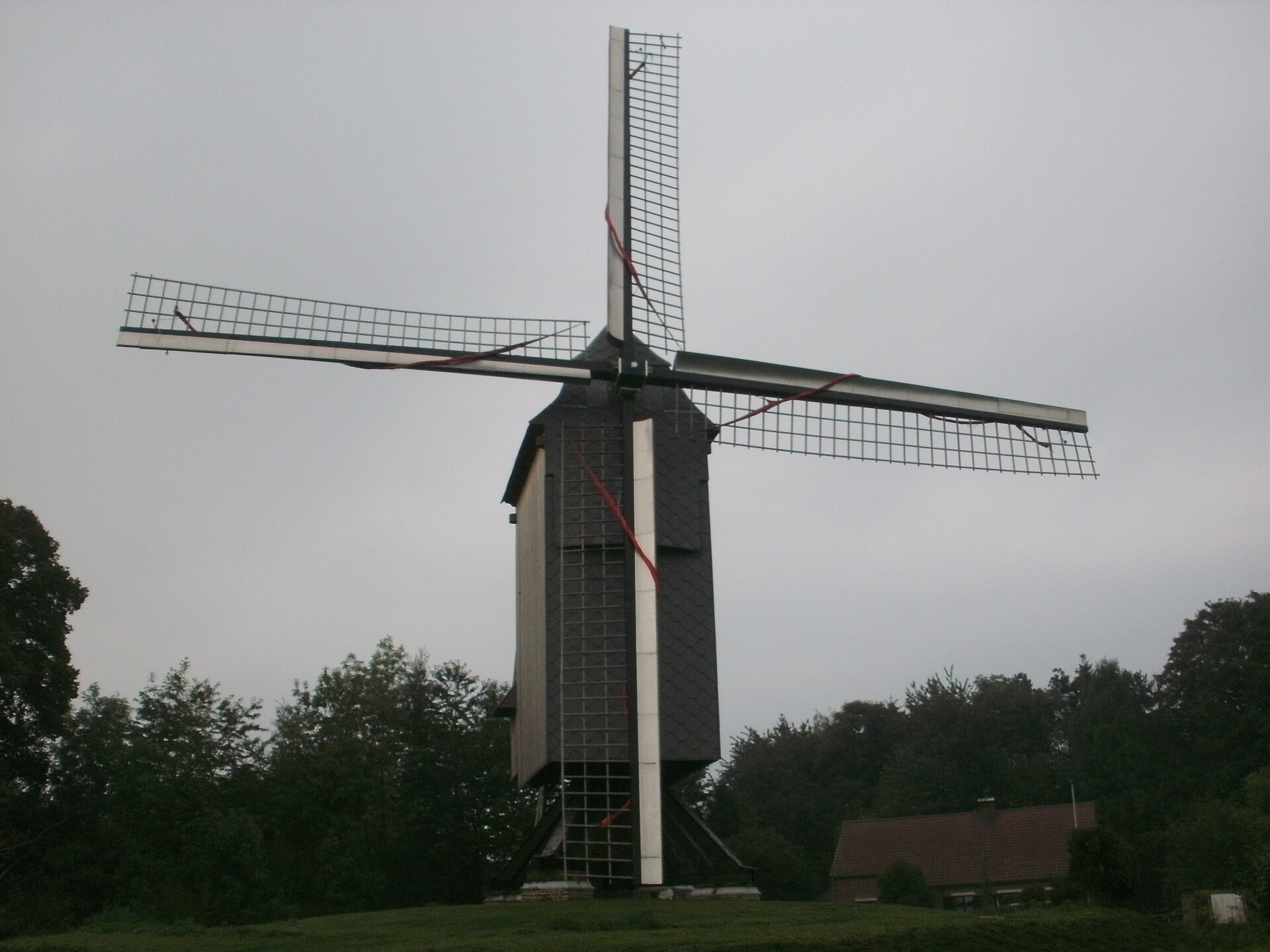
Buysesmolen is a wooden post mill (staakmolen) standing in Sint-Antelinks, a village that is part of the municipality of Herzele in East Flanders, Belgium. The mill is used for grinding grain and stands as one of the symbols of the local industrial heritage in the Herzele area.
How long has a mill stood on this site?
The site has a very long history connected to windmills — a windmill already operated at Sint-Antelinks as far back as the 13th century. For centuries the mill belonged to the Norbertine abbey of Ninove, reflecting the close ties between milling and religious institutions that were typical of medieval and early modern Flanders. It was only during the period of French occupation that ownership changed, as the mill passed into private hands, ending a centuries-long dependence on its ecclesiastical owner.
Who owned the mill in the 19th and 20th centuries?
In 1839 the Buysesmolen came into the possession of the Buyse family, from whom the mill takes its current name. The family managed the mill for more than a century, until in 1975 they sold it to the Belgian authorities — specifically to the Flemish Region. Earlier, in 1944, the mill had been listed as a protected monument, a step intended to shield it from demolition or uncontrolled alteration during the difficult postwar period.
What happened to the mill in the 1960s and 1970s?
In the 1960s, plans were drawn up for the restoration of the historic structure, but before they could be fully carried out, the mill suffered a dramatic fate. During the hot summer of 1976, in the course of a violent storm, the Buysesmolen collapsed. It was a serious blow to local heritage — the wooden post-mill structure, by then decades removed from its last major rebuild, could not withstand the force of the storm.
How was the Buysesmolen rebuilt?
For several decades after the collapse, the site remained without a working mill. The turning point came in 2003, when the owner of the site — the Flemish Region — concluded a long-term lease agreement with the municipality of Herzele. That agreement opened the way for a full reconstruction of the windmill. The rebuilding work was carried out in 2007–2008 by the milling company Molenbouw Thomaes nv, based in Beveren-Roeselare, a firm specializing in the reconstruction of traditional Flemish windmills. The reconstruction covered both the wooden post-mill supporting structure and the milling mechanism needed to grind grain.
When was the rebuilt mill officially opened?
The culmination of several years of work came with a ceremonial relaunch of the mill: on 15 August 2009 the Buysesmolen was formally inaugurated. The date symbolically closed a period of more than thirty years during which the site of the collapsed windmill had waited for reconstruction, restoring to Sint-Antelinks a characteristic feature of its rural landscape.
Frequently asked questions
What is the Buysesmolen? It is a wooden post mill (staakmolen) used for grinding grain, located in Sint-Antelinks in the municipality of Herzele.
Since when has a mill stood on this site? A windmill has stood at this location since the 13th century, though the current structure is the result of a 2007–2008 reconstruction.
Why did the mill need to be rebuilt? The original structure collapsed during a storm in the summer of 1976.
When did the rebuilt mill open to visitors? The reconstructed mill was ceremonially inaugurated on 15 August 2009.
Where does the mill's name come from? The name comes from the Buyse family, who owned the mill from 1839 until its sale to the Belgian state in 1975.
Nearby places

Earn badges for the places you visit
Download NextOnTrip, discover new places and check off your trails.