About this place
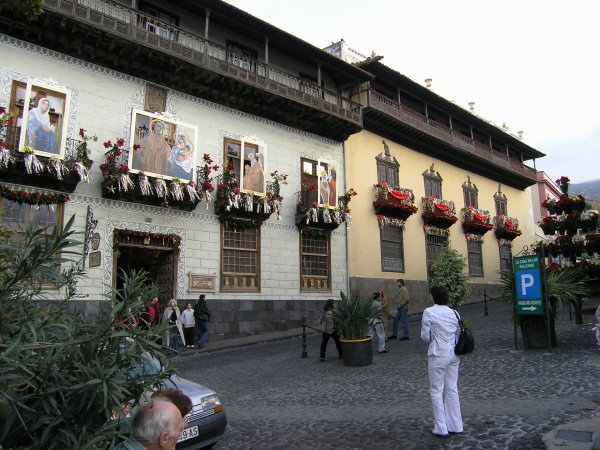
The buildings at numbers 52 and 54 on Calle Calvario form a pair of historic houses in La Orotava, Tenerife, recognized as one of the most representative examples of traditional Canarian domestic architecture from the colonial period. Facing the site of the former San Sebastián Hospital in the town's historic center, both buildings have been listed as a Cultural Heritage Asset of the Canary Islands since 2002.
Where did these buildings come from?
The story of both houses dates back to around 1725. Built at the initiative of the priest Ignacio Hernández del Álamo, the pair was originally intended to serve as a women's convent residence and a hospital-affiliated lodging linked to the neighboring San Sebastián Hospital. Neither of these original purposes was ultimately fulfilled, and over time the buildings were repurposed, serving various residential and practical functions throughout the 19th and 20th centuries.
Why were they declared a heritage site?
In May 2002, under Decree 63/02 issued by the Government of the Canary Islands, both townhouses were granted Bien de Interés Cultural status in the Monument category. The designation recognized them as a paradigmatic example of Canarian domestic architecture from the first half of the 18th century, representing a local variant of Mudéjar-influenced building traditions that combined Iberian elements with adaptations developed by settlers on the islands.
What defines this architectural style?
The buildings display features typical of Canarian residential construction: wooden balconies projecting from the façade, roof eaves protecting the walls from rain, and finely crafted carpentry work. These construction solutions, rooted in traditions brought to the islands by early settlers, responded to the local climate and to the materials available at the time, chiefly timber from the Canary Islands' pine and laurel forests.
Despite three centuries of use and numerous adaptations made to meet residents' changing needs during the 20th century, adaptations that significantly affected the buildings' original structure, both houses have retained a legible architectural form. It is precisely this endurance through transformation that keeps the houses at Calle Calvario 52 and 54 an important record of island domestic architecture from earlier centuries.
Where exactly are they located?
The buildings stand on Calle Calvario, in the historic center of La Orotava, a town known for its dense colonial-era urban fabric and numerous historic residences. Their proximity to the former San Sebastián Hospital, with which both houses were historically connected, underlines their role in the area's earlier urban layout.
Frequently asked questions
Can the interiors be visited? The available sources do not specify current access arrangements for the interiors; the buildings form part of the town's historic fabric, so visitors should check locally for up-to-date details before planning a visit.
Why are the two buildings referred to together? Numbers 52 and 54 were erected at the same time, under the same initiative and with the same original purpose, which is why they are treated as a linked pair within the heritage listing.
What does "Mudéjar-influenced" mean in this context? It refers to a building style that combined elements brought from the Iberian Peninsula with construction solutions developed locally in the Canary Islands, visible here in the wooden balconies and carpentry details.
Nearby places

Earn badges for the places you visit
Download NextOnTrip, discover new places and check off your trails.