About this place
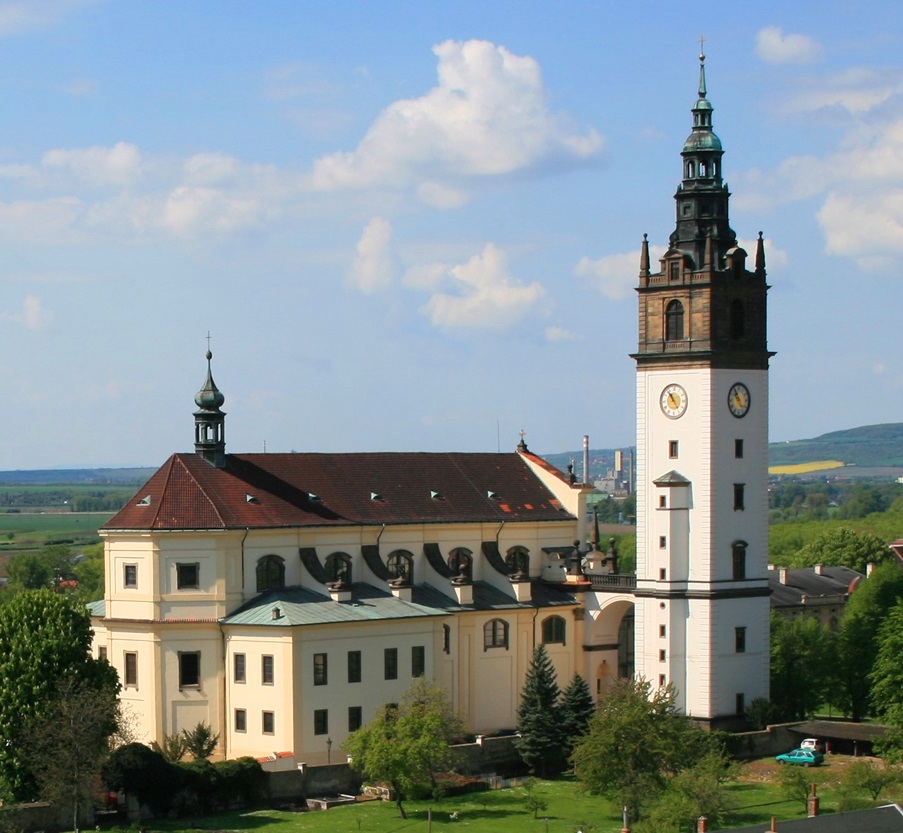
The Bishop's Residence of Litoměřice is a Baroque palace crowning Dómský vrch, the cathedral hill at the heart of the town, standing right beside the Cathedral of St. Stephen. It has served as the seat of the bishops of Litoměřice since 1655 and still does today, which means the interior is closed to visitors — the palace is best appreciated from the outside, as part of the historic ensemble around Dómské náměstí.
Why was a bishop's palace built on this particular hill?
The site was already an ecclesiastical center centuries before the palace existed. Back in the 11th century, Prince Spytihněv II founded a collegiate chapter here, and church buildings gradually accumulated on the hill around it. Everything changed in 1655, when the Pope carved a new Diocese of Litoměřice out of the Archdiocese of Prague. The old chapter buildings could no longer serve as a proper bishop's court, so a purpose-built residence became necessary.
Who commissioned it, and when was it actually built?
The residence was commissioned by Bishop Jaroslav Ignác of Šternberg and designed by Giulio Broggio, a builder-architect who had settled in Litoměřice and became one of the region's leading Baroque figures — his family later shaped much of the town's church architecture for two more generations. The main structure went up between 1689 and 1694, though associated work continued afterward: the decorative stone gate leading into the courtyard, for instance, wasn't finished until 1701. The result is an early Baroque, two-story building with a castle-like presence, flanked by two shorter wings set at right angles on its western and eastern sides. The main façade faces the Elbe (Labe) river.
What is inside the residence?
Upstairs, the principal hall is covered by a painted ceiling from 1691 depicting the miracle of Moses. In the western wing sits the Chapel of St. Lawrence, with its own ceiling painting dated 1692. On the ground floor, a vaulted sala terrena rests on two central pillars — a garden-facing reception room typical of Baroque residences of this scale. Deep cellars run beneath the entire building. The palace also holds a substantial bishop's archive and a historical library, greatly enriched by the collecting habits of Emanuel Ernest of Waldstein, the sixth bishop of Litoměřice, alongside a valuable painting collection.
How has the building changed since the 17th century?
The palace visitors see today is not exactly the one completed around 1700. Structural reinforcement of the southern façade was carried out in 1827. Around 1870, a covered passage was added connecting the residence directly to the cathedral, letting bishops move between the two without stepping outside. In 1883, an arched underpass was built on the northern side. The twentieth century brought the most extensive intervention: a comprehensive renovation in 1958 restored the entire structure, including the ceiling paintings, and the façades themselves were refreshed again during the 1990s.
What can visitors actually see up close?
Since the interior remains off-limits, the main draw for anyone walking past is the stone gateway into the courtyard, completed in 1701. It's carved with three Baroque statues and a cartouche bearing a Latin inscription — easily the most ornate detail of the whole complex that can be viewed without special access. Together with the cathedral, the bell tower, and the chapter consistory building, the residence forms one of the most architecturally coherent corners of Litoměřice, and it's worth pausing at Dómské náměstí just to take in how the ensemble fits together.
Frequently asked questions
Can you go inside the Bishop's Residence? No. The building remains the working seat of the Bishop of Litoměřice and is not open to the public.
Who designed the residence? Giulio Broggio, a Baroque architect and builder based in Litoměřice, who worked closely with Bishop Jaroslav Ignác of Šternberg.
Since when has Litoměřice been a bishop's seat? Since 1655, when the Diocese of Litoměřice was established out of the Archdiocese of Prague.
What is the carved gate at the residence? A 1701 stone gateway into the courtyard, decorated with three Baroque statues and a Latin inscription cartouche — the only close-up detail accessible to visitors.
Where exactly is the residence located? On Dómský vrch (Cathedral Hill) at Dómské náměstí, directly next to the Cathedral of St. Stephen and its bell tower.
Nearby places

Earn badges for the places you visit
Download NextOnTrip, discover new places and check off your trails.