- Sacred Monuments
- Basilica
- Sanctuaries
Basilica of the Most Holy True Cross
About this place
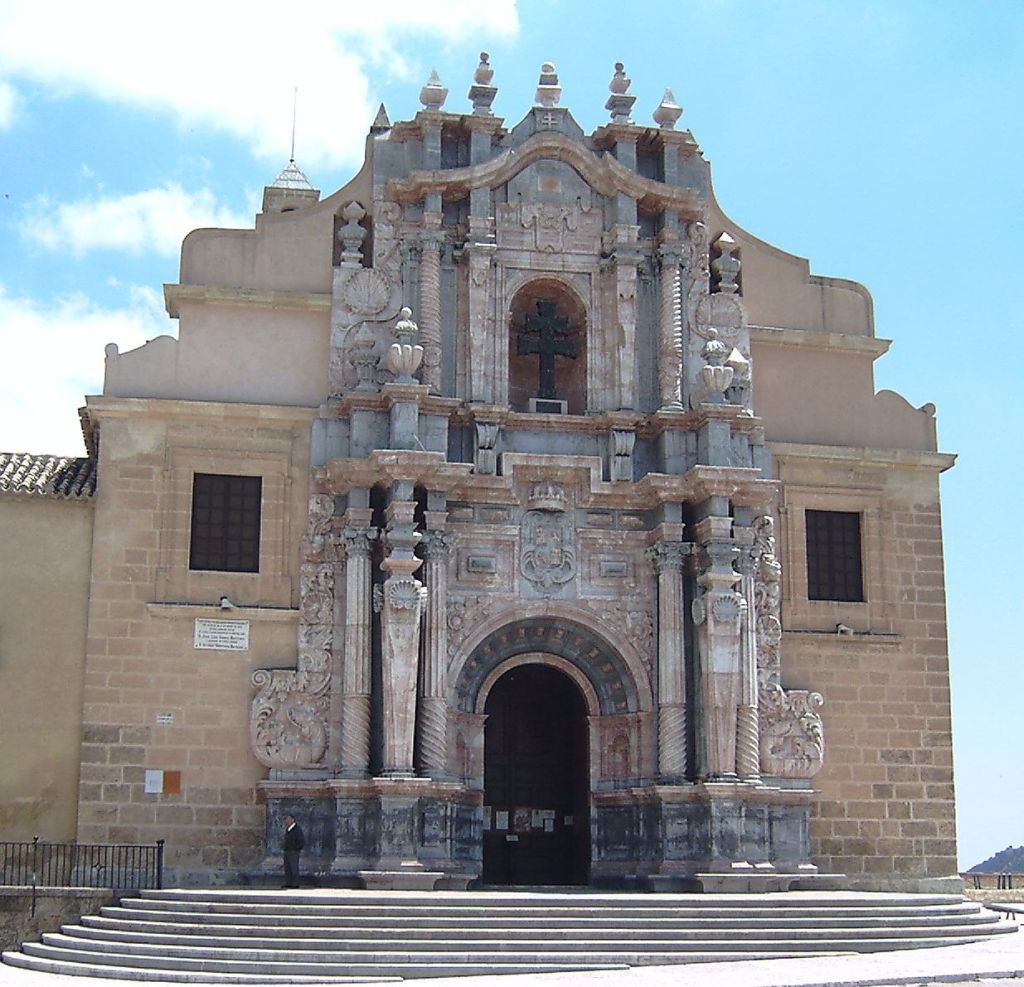
The Basilica of the Most Holy True Cross (Real Basílica de la Vera Cruz) sits atop the hill in Caravaca de la Cruz, enclosed within the walls of the town's castle, and ranks among the most significant Catholic shrines in the Murcia region. It houses the Lignum Crucis, a relic believed by tradition to be a fragment of the wood from the cross on which Christ died.
What is kept inside the sanctuary?
At the heart of the basilica stands a chapel holding the reliquary shaped like a double-armed cross — the distinctive emblem known as the Cross of Caravaca. The church was raised over an earlier medieval chapel that had guarded the relic for centuries. The interior follows the early Baroque style, with decoration befitting a major pilgrimage site.
When was the current building constructed?
Work on the present church began in 1617, designed by Fray Alberto de la Madre de Dios, an architect connected to the Spanish royal court. Construction stretched on for decades, and the basilica was finally completed in 1703. In 1944 the building was declared a Historic-Artistic Monument, a status that today corresponds to a Property of Cultural Interest. In 2007, Pope Benedict XVI granted it the title of minor basilica.
Where does the legend of the Cross of Caravaca come from?
Tradition holds that on 3 May 1231, while Caravaca still lay under Muslim rule, a priest named Ginés Pérez de Chirinos — held captive by the local ruler Ceyt-Abuceyt — was about to celebrate Mass without a cross. At the exact moment the liturgy required one, a double-armed cross is said to have descended from heaven, carried by angels. The event, regarded as a miracle, is said to have led the ruler and his court to convert to Christianity. According to historical accounts, the cross itself had previously belonged to Patriarch Robert, the first bishop of Jerusalem, who lived at the end of the eleventh century.
Why is Caravaca de la Cruz called a Holy City?
In 1998, Pope John Paul II granted Caravaca de la Cruz the status of Holy City (Ciudad Santa), one of only five such places in the world, alongside Rome, Jerusalem, Santiago de Compostela and Santo Toribio de Liébana. The distinction allows the town to celebrate a Jubilee Year every seven years, drawing pilgrims from across Spain and beyond. As the keeper of the relic, the basilica sits at the center of these celebrations.
How should visitors plan a visit?
The sanctuary forms part of the castle complex overlooking the town, so a visit pairs naturally with a walk along Caravaca's walls and towers. It's worth setting aside time both for the church interior and for the surrounding hilltop, which offers views over the old town and the hills of Murcia beyond.
Frequently asked questions
What is the difference between the basilica and Caravaca Castle? The castle is the entire fortress crowning the town's hill, while the basilica is the church built within its walls around the relic of the True Cross — two distinct, adjoining structures.
What exactly is the Lignum Crucis? It is the name given to the relic — a fragment of wood kept in a double-armed cross-shaped reliquary — that tradition links to the cross of Christ.
When is the best time to visit for the religious celebrations? The most intense festivities take place during the Jubilee Year, declared every seven years since 1998, and around 3 May, the anniversary of the cross's legendary descent.
Does the title of minor basilica matter for visitors? Granted in 2007 by Pope Benedict XVI, the title underscores the site's spiritual standing and carries certain liturgical privileges, but for a visitor it mainly confirms the sanctuary's exceptional status within the wider Church.
Nearby places

Earn badges for the places you visit
Download NextOnTrip, discover new places and check off your trails.