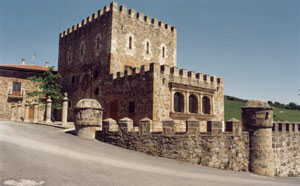
About this place
Avellaneda Assembly House stands right on the boundary between Zalla and neighbouring Sopuerta, in the heart of the Basque Encartaciones region (Bizkaia). For centuries it hosted the general assemblies of the surrounding villages, and today it houses the Museum of Encartaciones, ranking among the province's most significant historic landmarks.
How do you get there?
The building sits in the Kadagua river valley, about a dozen kilometres from Bilbao, right at the administrative border between Zalla and Sopuerta. It makes a natural stop while touring Encartaciones, a region known for its green valleys and historic small towns. Driving from Bilbao takes roughly 20–25 minutes, and the surrounding area is also well suited to a longer walk linking several nearby villages.
What will you see?
The earliest record of a building on this site dates back to 1535, when a prison stood here. Construction of the actual assembly house began in 1592 and was completed in 1635, the year the coat of arms was placed on the facade. Over time the site grew into a whole complex of buildings from different periods — mainly the 17th and 18th centuries — including the residence of the corregidor's lieutenant (1597, rebuilt in 1750) and an inn where assembly members stayed overnight (1771).
The suppression of the Juntas of Encartaciones in 1806, when a royal decree required the surrounding villages to attend the Juntas of Gernika instead, ended the building's administrative role and left it abandoned for decades. Restoration only began in 1901, commissioned by the Provincial Council of Bizkaia; architect Antonio de Carvelaris aimed to recover the facade's original Renaissance appearance.
Another key chapter came in 1932, when architect Diego de Basterra carried out renovations that included building a local school and adapting part of the complex into a small history museum — opened in 1933 as the Museum of Encartaciones, still operating today. The tower that now defines the building's silhouette was added during works carried out between 1942 and 1953. A final, comprehensive restoration followed in 1989.
The site also holds a place in the 20th-century history of Basque regionalism: on 9 August 1931, days after an assembly in Portugalete, representatives of the Encartaciones villages met in nearby Sopuerta to draft the basis for a demand for regional autonomy from Spain's Second Republic.
When should you visit?
Since the main draw is the museum interior, plan your visit around its opening hours, on a weekday or a weekend outside the height of summer heat — Encartaciones can get quite warm in July and August, while spring and autumn are pleasant for walking the surrounding valleys too. Pairing the visit with a stop in nearby Sopuerta, which shares the administrative border with the building, is an easy way to round out the trip.
Frequently asked questions
What is the Avellaneda Assembly House? It's a historic assembly house where representatives of the Encartaciones villages met from the 16th century onward. It now houses the Museum of Encartaciones.
Where exactly is it located? On the border between Zalla and Sopuerta, in the Kadagua river valley, in the province of Bizkaia, about a dozen kilometres from Bilbao.
When was the current building constructed? Work on the assembly house began in 1592 and finished in 1635, though earlier structures on the site date back to 1535.
Can you visit the interior? Yes — the building houses the Museum of Encartaciones, which presents the history of the region and of the Juntas themselves.
Nearby places

Earn badges for the places you visit
Download NextOnTrip, discover new places and check off your trails.