About this place
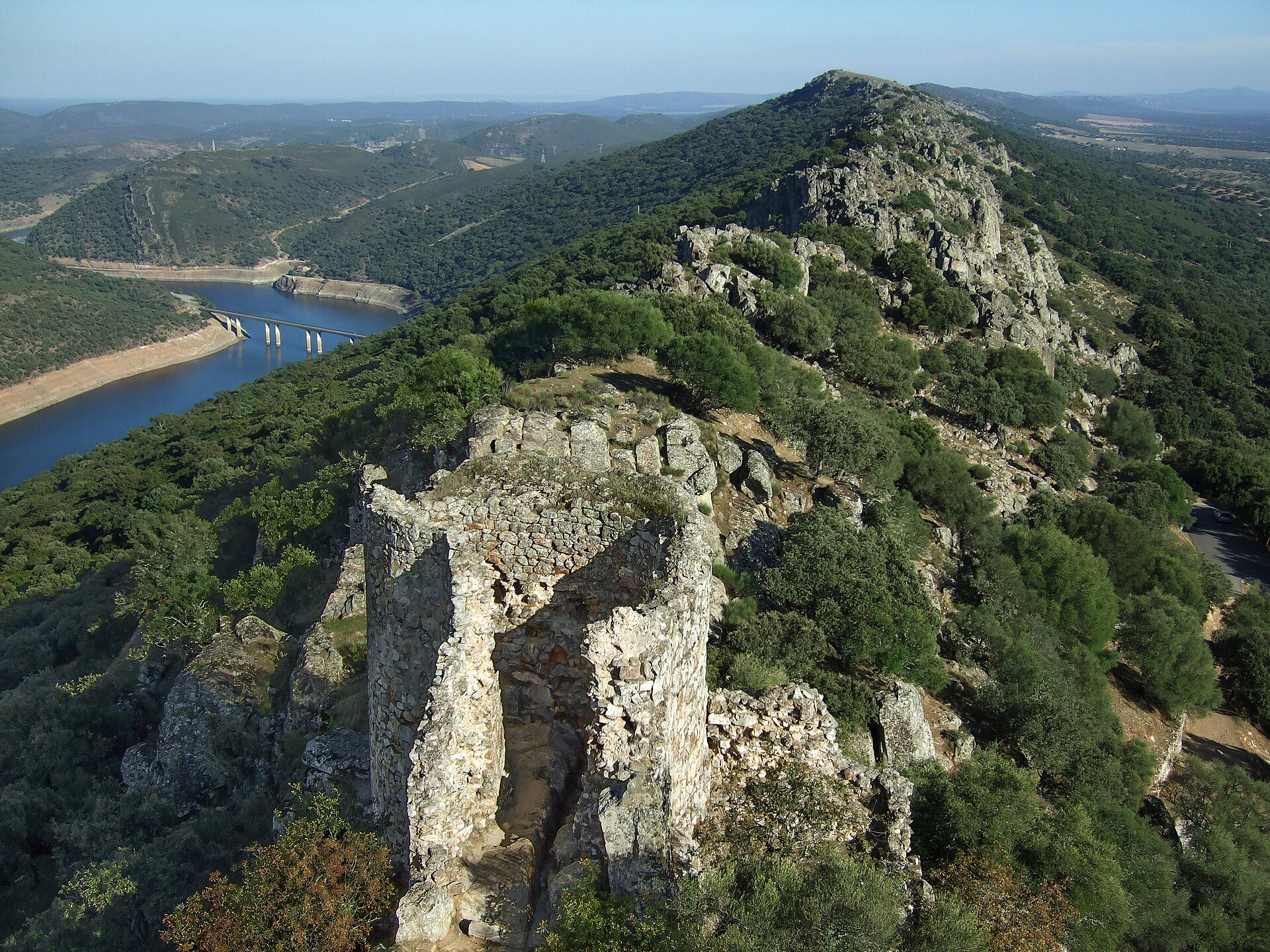
Albalat Castle stands above the left bank of the Tagus River next to Romangordo, a small village in the province of Cáceres, in Spain's Extremadura region. What remains today is the keep of a Muslim-era fortress that once guarded one of the few natural fords on the middle stretch of the river.
How do you get to Albalat Castle?
Romangordo sits in the Campo Arañuelo district, in the northeastern part of Cáceres province. The easiest way in is via Navalmoral de la Mata, the district's main town, roughly a 30-minute drive away (around 31 km). Regional buses also connect the two towns, though a car is more practical, since the castle and the adjoining excavation site sit on a hilltop outside the village. Coming from Cáceres or Trujillo takes longer, but the route runs through the scenic Tagus valley, making it worth combining with a fuller day out in the area.
What is the history behind the castle?
Arabic sources refer to the site as Madinat al-Balat, or Majadat al-Balat, as early as the 10th century. It was fortified under the Cordoban caliph Abd al-Rahman III to secure the Tagus frontier against pressure from the Christian kingdoms to the north. The location was no accident: this was the point where the old Roman road linking Emerita Augusta (present-day Mérida) and Toledo crossed the Tagus, at one of the very few places the river could be forded. Whoever held this crossing controlled the movement of people and troops along the entire border.
Through the 10th and 11th centuries, Albalat served as the seat of a Muslim administrative district stretching from the Gredos mountains down to Medellín. In the 12th and 13th centuries the fortress was rebuilt in stone as the Tagus became an active frontline between Muslim forces and the advancing Christian reconquest. After the Christian conquest in the 13th century, under Ferdinand III, the surrounding lands became known as the "Campana de Albalat," a name covering the territory of what are now the villages of Romangordo, Casas de Miravete and Higuera de Albalat.
What will you see on site?
Only the keep, or torre del homenaje, survives above ground from the original fortress — the single most imposing feature of the stronghold, with views over a bend in the Tagus and the surrounding hills. Next to it, Spanish and French archaeological teams have spent more than a decade excavating the adjoining town, uncovering houses and streets from the medieval Islamic settlement that once grew up at the foot of the fortress.
Romangordo itself is worth a stop regardless of the castle: the village is known for trompe-l'oeil murals painted on house facades, a trick-of-the-eye tradition that makes buildings look quite different from what they actually are. That mix of medieval history and street art makes Romangordo a distinctive stop on a route through Extremadura.
When is the best time to visit?
Spring and autumn are the most comfortable seasons, since summer heat in the Tagus valley can be intense. Access to the archaeological site itself is limited — guided visits are organized occasionally, usually tied to open days, with sessions typically offered in the morning and again in the late afternoon. Since there is no fixed year-round visiting schedule, it is worth checking current dates with the Romangordo town hall before planning a trip.
Frequently asked questions
Can you visit Albalat Castle on your own? The keep and the hilltop can be viewed from outside at any time, but entering the excavation area itself usually requires joining an organized guided visit.
How much of the original fortress has survived? Only the keep tower remains standing from the original construction; the rest of the walls were lost over the centuries.
Why was this location so strategically important? It controlled one of the few fords on the Tagus, at the point where the ancient Roman road between Mérida and Toledo crossed the river, making it a key point on the Christian-Muslim frontier.
What else is worth seeing in Romangordo? Take time to walk through the village and look at the trompe-l'oeil house facades — a local curiosity that draws visitors independently of the castle's history.
Nearby places

Earn badges for the places you visit
Download NextOnTrip, discover new places and check off your trails.