About this place
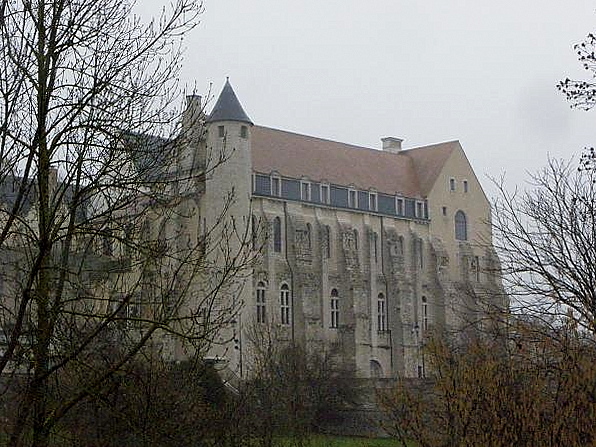
Saint-Séverin Abbey in Château-Landon is a former community of Augustinian canons regular in Château-Landon, a small town in the Seine-et-Marne department of France. Its crypt, painted with rare Romanesque murals, and its fortress-like silhouette make it one of the more distinctive medieval monuments of the region, listed as a monument historique since 1937.
How far back does the abbey's history go?
The site's origins trace to the early sixth century. After Saint Séverin died in 506, Childebert I — son of Clovis — ordered a church built in his honor, endowed with land, in gratitude for a healing the saint was said to have performed on the Frankish king. Three centuries later, in the ninth century, Sigebert I, king of Metz, founded a larger abbey on the same site, which took the name Saint-Séverin and grew into one of the region's notable religious centers.
Who ran the abbey day to day?
For most of its existence, the community was led by Augustinian canons regular rather than Benedictine monks. This community maintained the cult of Saint Séverin, whose tomb and relics were kept at the abbey. The site's standing in medieval Europe is underlined by a famous visitor: in 1167, Thomas Becket, Archbishop of Canterbury, consecrated the newly built abbey church.
Why does the abbey look like a fortress?
Backing from King Philip Augustus financed a major rebuilding of the monastic complex, giving it thick walls and a defensive profile more typical of a castle than a church. That fortification did not spare the abbey from war: English forces burned it in 1426 after a failed siege, and German Huguenot troops sacked the monastery in 1567 during the Wars of Religion.
What was the abbey's connection to Melun?
In 1170, King Louis VII granted the Priory of Saint-Sauveur in Melun to Saint-Séverin Abbey. The gift placed the priory under the abbey's authority and opened a period of prosperity for it, a relationship that continued through the following centuries of the Middle Ages and tied the fortunes of the two religious houses together.
What has survived to the present day?
The best-preserved feature is the crypt, decorated with exceptional wall paintings from the second half of the twelfth century — among the most valuable surviving elements of the whole complex. The canons' community remained in place until the French Revolution, when the buildings were sold as national property. In 1892, the former abbey took on a new role as a hospice for the elderly.
Frequently asked questions
Was this a Benedictine abbey? No. The community that ran the abbey consisted of Augustinian canons regular, not Benedictine monks.
Why does the abbey have a fortress-like appearance? Its rebuilding, backed by King Philip Augustus, gave it thick defensive walls resembling a stronghold rather than a typical monastery.
What relics were kept at the abbey? The abbey held the tomb and relics of Saint Séverin, whose cult was the original reason the first church was built on the site.
Can the abbey be visited today? It has been listed as a monument historique since 1937; because the building later served secular purposes, including as a hospice, visitor access is best checked locally.
What was the abbey's link to Melun? From 1170 it held authority over the Priory of Saint-Sauveur in Melun, granted by King Louis VII.
Nearby places

Earn badges for the places you visit
Download NextOnTrip, discover new places and check off your trails.