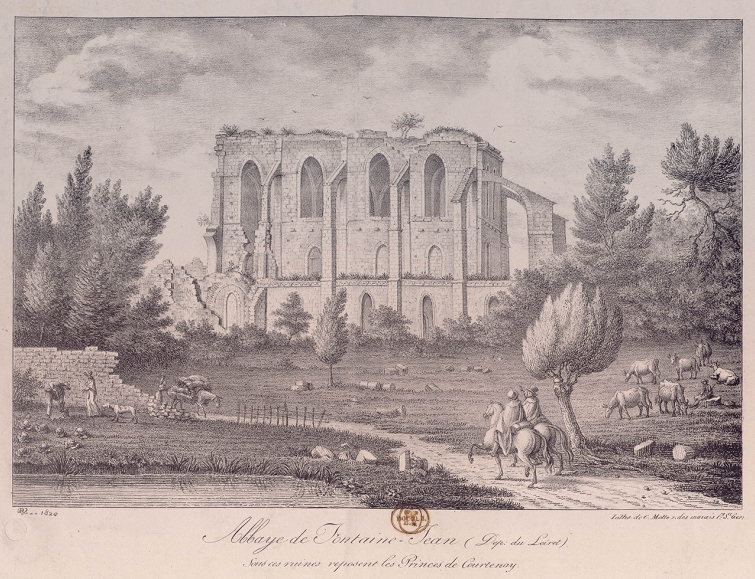
About this place
Fontainejean Abbey is the ruined site of a medieval Cistercian monastery in the commune of Saint-Maurice-sur-Aveyron, in the Gâtinais region of the Loiret département. Even though only fragments of the once-sprawling monastic complex survive, their scale still hints at how significant this religious community was nearly 900 years ago.
How was the abbey founded?
The monastery was established in 1124 as a daughter house of Pontigny Abbey. Its founder was Miles de Courtenay, a local feudal lord who had also founded Les Écharlis Abbey. On March 20, 1124, the first abbot, Étienne, arrived from Cîteaux with twelve monks — the customary founding group size for a new Cistercian house. Construction of the main monastic buildings began around 1140, on land that had previously been drained, which explains the site's name, referring to a spring or water source.
In 1148, Pierre I de Courtenay, brother of King Louis VII, granted the abbey royal status, considerably strengthening its standing and resources. The abbey church was consecrated to Notre-Dame in 1173. Growth continued steadily, and by 1189 the community numbered around 80 monks alongside roughly 400 lay members connected to the abbey's agricultural and economic activities — making Fontainejean one of the larger Cistercian centers in the region at the time.
What can you see on site today?
The abbey's fortunes turned during the Wars of Religion. In 1562, Protestant troops occupied the monastery and severely damaged the church. A second, decisive blow came with the French Revolution: in 1791 the monastic community was dissolved, and its properties sold off and divided. What remains today are the ruins of part of the monastic buildings — walls, vault fragments, and traces of the spatial layout typical of Cistercian architecture, which combined austere form with precise construction. The site sits within the wooded landscape of the Gâtinais, giving it a quiet, secluded character.
Since October 6, 1925, the ruins have been listed as a monument historique in France, a formal recognition of their historical and architectural value.
How to get there and when to visit?
The abbey lies within the commune of Saint-Maurice-sur-Aveyron, in the heart of the Gâtinais — a region straddling the Loiret and Yonne départements, known for its forests, ponds, and small villages. The site is best reached by car via local departmental roads; the nearest larger town in the area is Montargis. It's worth planning the visit as part of a longer tour of Gâtinais heritage sites, since the ruins themselves can be seen in under an hour.
Given the open, undeveloped character of the site — there's no visitor infrastructure typical of major tourist attractions — spring and autumn are the best times to visit, when the weather is mild and the surrounding greenery is at its most striking. In summer, expect more direct sun exposure, as part of the ruins stands in open ground.
Frequently asked questions
What was Fontainejean Abbey? It was a Cistercian abbey founded in 1124 as a daughter house of Pontigny Abbey, and for several centuries it served as a major religious center in the Gâtinais.
Why is the abbey now in ruins? The church was severely damaged in 1562 when Protestant troops occupied it during the Wars of Religion, and the monastic community itself was dissolved in 1791 during the French Revolution.
Are the ruins legally protected? Yes, they have been listed as a monument historique in France since October 6, 1925.
Is it worth visiting with children or a group? The site makes for a quiet, brief stop on a tour of the Gâtinais region — it works well as an addition to a longer heritage route through Loiret rather than as a standalone full-day destination.
Nearby places

Earn badges for the places you visit
Download NextOnTrip, discover new places and check off your trails.